

Designated encampments worth second look
Advertisement
Read this article for free:
or
Already have an account? Log in here »
To continue reading, please subscribe:

Digital Subscription
One year of digital access for only $205*
- Enjoy unlimited reading on winnipegfreepress.com
- Read the E-Edition, our digital replica newspaper
- Access News Break, our award-winning app
- Play interactive puzzles
*First annual payment billed as $205.00 + GST for one year. This annual subscription will automatically renew at $233.00 + GST every 52 weeks (10% off the regular annual price of $259.35). Offer available to new and qualified returning subscribers only. Cancel any time.
To continue reading, please subscribe:
Add Free Press access to your Brandon Sun subscription for only an additional
$1 for the first 4 weeks*
- Enjoy unlimited reading on winnipegfreepress.com
- Read the E-Edition, our digital replica newspaper
- Access News Break, our award-winning app
- Play interactive puzzles
*Your next Brandon Sun subscription payment will increase by $1.00 and you will be charged $17.95 plus GST for four weeks. After four weeks, your payment will increase to $24.95 plus GST every four weeks.
Read unlimited articles for free today:
or
Already have an account? Log in here »
Winnipeg city councillor Cindy Gilroy (Daniel McIntyre) continues to champion the idea of authorized, designated homeless encampments despite getting no support from her colleagues on city council or the provincial government. That’s too bad, because her idea has merit.
Reducing homelessness and all of the collateral problems it represents is a pressing issue for the city and the provincial NDP government. To that end, both levels of government have taken steps to address the problem, with differing results.
The province has taken the lead with Your Way Home, a program to provide permanent housing for the homeless with “wraparound” social and health services. Your Way Home has made some progress but there is evidence the size of Winnipeg’s homeless population is growing faster than the program can house it.
FREE PRESS FILES
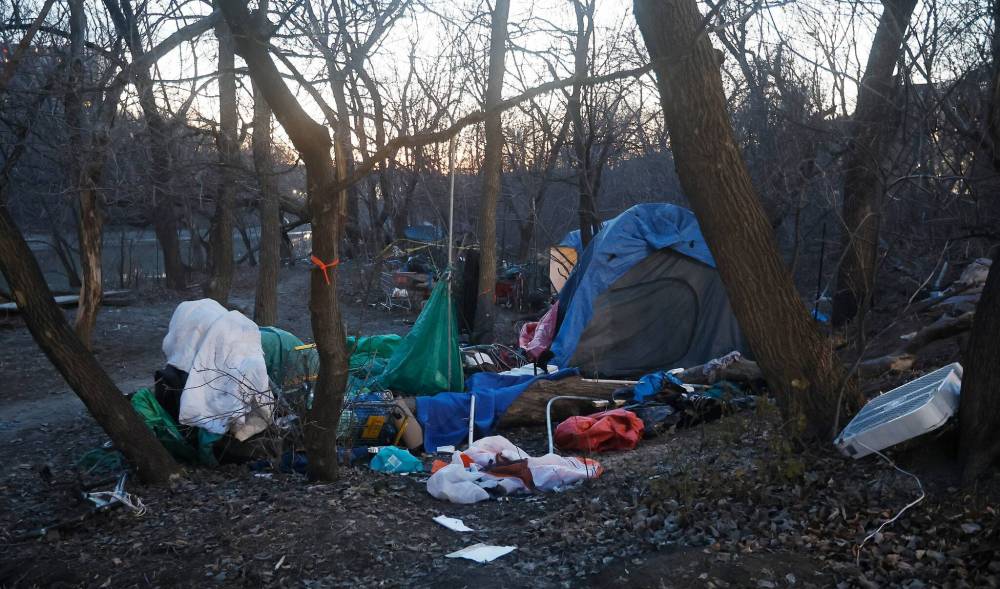
Designated homeless encampments could aid those in transition from homelessness to being housed.
At the same time, the city passed a bylaw to clear homeless encampments. To date, it has forcibly cleared some 60 encampments, containing hundreds of residents.
However, the city and provinces are working at different speeds and, at times, cross purposes.
Right now, encampments are being cleared with the knowledge there are not enough safe and secure places for residents to go. The result has been fewer encampments but more homeless people sleeping in doorways and alleys.
This is where Gilroy’s idea comes in. Establishing permanent or semi-permanent, managed homeless encampments would provide a safe place for the homeless as ad hoc encampments are cleared. Although not as secure as apartments, a managed encampment moves the homeless several steps closer to the wraparound services provided by Your Way Home.
Other cities in Canada have used this approach, with excellent overall results. Managed, authorized encampments are safer, cleaner and can be planned for areas where there is no immediate threat to schools, playgrounds or daycares, the principal concern behind the city’s bylaw. Some communities have gone further, establishing “tiny homes” communities, in which the homeless are provided with a small cabin in a designated site that allows them to live safely, securely and with access to health and social services.
Opposition to Gilroy’s proposal, and the whole idea of a designated encampment of some description, suggests there are only two options for the homeless — illegal encampments or permanent housing. They are trapped in that box because of fiscal concerns.

Gilroy’s proposal would obviously require funding from the province. Unfortunately, Premier Wab Kinew and his government are all-in on Your Way Home, and do not want to invest in any kind of transitional solution that bridges the gap that exists between the city’s bylaw and a longer-term solution.
Even social service agencies have been reluctant to support the idea of a designated encampment out of a fear it would siphon off limited resources provided to other organizations that support the homeless. Again, few will argue that a designated encampment could serve an important transitional purpose; social service groups are largely concerned that, if a transitional site were established, they would lose some of their current funding.
The debate over designated encampments has been left in a political and administrative limbo — many acknowledge the important role sites like this could play, but without a commitment from the province for new money, it is having trouble gaining support.
This is a short-sighted attitude, based largely on self-interest and not on the best interests of the homeless. All interested parties — the city, province and social-service groups — should take another look at the idea with the knowledge it could provide a valuable bridge between ad hoc encampment and permanent housing.
Given that no one is addressing that gap, Gilroy’s proposal is worth serious consideration.
Related Articles
Around city hall: sewage leaks, mayoral candidate, designated encampment Designated encampment debate returns to city hall



Advertisement Advertise With Us
Advertisement Advertise With Us