Online faith services find place in pandemic spotlight

Advertisement
Read this article for free:
or
Already have an account? Log in here »
To continue reading, please subscribe:
Digital Subscription
One year of digital access for only $1.44 a week*
- Enjoy unlimited reading on winnipegfreepress.com
- Read the E-Edition, our digital replica newspaper
- Access News Break, our award-winning app
- Play interactive puzzles
*Billed as $5.77 plus GST every four weeks. After 52 weeks, price increases to the regular rate of $19.95 plus GST every four weeks. Offer available to new and qualified returning subscribers only. Cancel any time.
To continue reading, please subscribe:
Add Free Press access to your Brandon Sun subscription for only an additional
$1 for the first 4 weeks*
- Enjoy unlimited reading on winnipegfreepress.com
- Read the E-Edition, our digital replica newspaper
- Access News Break, our award-winning app
- Play interactive puzzles
*Your next Brandon Sun subscription payment will increase by $1.00 and you will be charged $17.95 plus GST for four weeks. After four weeks, your payment will increase to $24.95 plus GST every four weeks.
Read unlimited articles for free today:
or
Already have an account? Log in here »
Hey there, time traveller!
This article was published 23/10/2020 (2192 days ago), so information in it may no longer be current.
When the COVID-19 pandemic struck Canada in early 2020, many places of worship were caught off guard.
Two Winnipeg congregations, however — Saint Benedict’s Table and Congregation Shaarey Zedek — were ahead of the game due to the foresight of respective visionaries.
Saint Ben’s, as it is known, started moving online in 2006, says Rector Jamie Howison.
“We’ve had a pretty strong web presence since then,” he said of the Anglican church, which used to meet in-person Sunday nights at All Saints downtown.
The church started by posting sermons on its website, then moved to podcasts, interviews and, more recently, an audio book. Last month, online offerings were downloaded about 3,000 times, with 56 per cent of those downloads from Canada, and 38 per cent from the U.S.
The pandemic accelerated the Winnipeg church’s move to doing more online; in addition to podcasts, it streams the evening service and offers a short prayer service each weekday at 5 p.m.
Going online has provided “a totally different frame of reference,” Howison said. “Now we see what we do and who we are through a different lens. We have a gathered community, and a virtual community, people we never see or know about.”
Howison credits member Bramwell Ryan for leading the online charge.
“He helped us up our game long before the pandemic started, and helped us to be well-positioned,” the rector said, adding the church will continue growing its online offerings after pandemic restrictions on gatherings are lifted.
Ryan, a communications consultant, has long-believed the internet was a way to democratize communication for places of worship.
“It provides an enormous opportunity to churches to share their messages,” he said, noting the tools are “cheap and easy to use.”
The product is also “authentic, deep and meaningful,” Ryan said, providing participants with a real sense of community.
Being active online also relieves places of worship from “the tyranny of geography and time. This is the new community. It’s where much of life happens now. If churches don’t go there, they are missing out.”
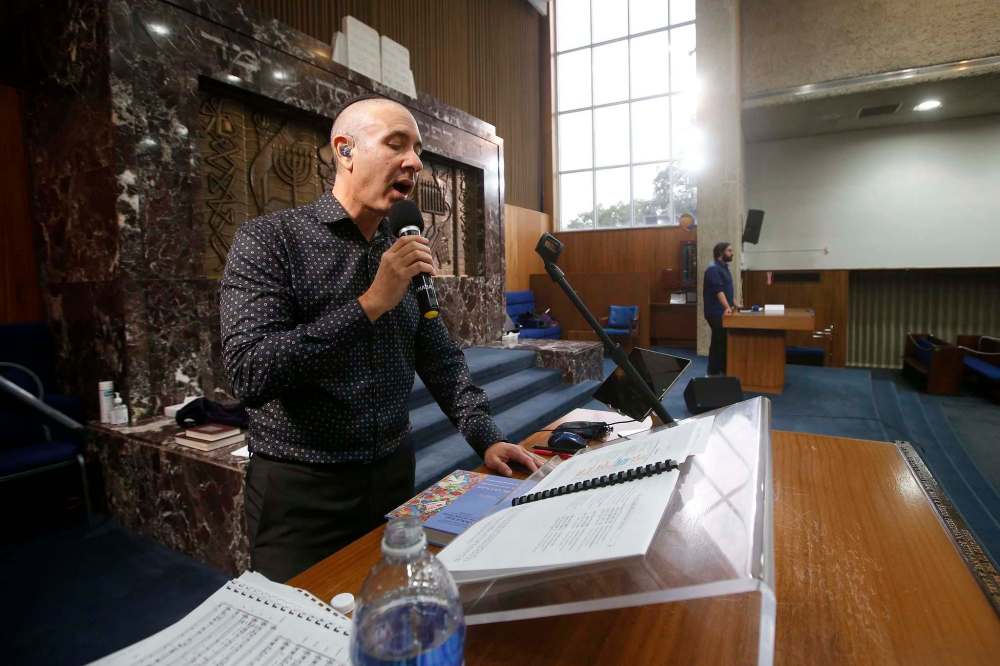
At Shaarey Zedek, it was ready for the pandemic due to the work of Rabbi Anibal Mass.
Mass, who has been at the synagogue for 18 years, has a background in computer science — “Something very unusual for clergy,” he said.
Under his leadership, Shaarey Zedek started began producing audio recordings of services in the early 2000s, before moving to video as well. Four years ago, it added more options to its streaming services through the support of generous donors at the synagogue.
Looking for inspiration to do better with online offerings, Mass checked with synagogues across North America to see what others were doing. Unable to find any, he went looking in an unusual place for a rabbi: American evangelical mega churches.
“I was blown away,” he said. “I told myself, ‘They are on to something here.’”
Mass watched what they were doing to “learn from their success and mistakes. I didn’t want to reinvent the wheel.”

As a result, Shaarey Zedek was in position when pandemic restrictions took hold — but even then, he said, “We needed to upgrade and step up our game.”
This meant making it more interactive, giving people the ability to share messages with leaders and with each other during services.
Going online has made the synagogue more accessible, Mass said.
“We are now more welcoming and friendly to everyone, offering them more options to connect with us, no matter where they live,” he said. “There are no borders online. You don’t have to be in Winnipeg to go to a service in Winnipeg. People around the world come to our services.”
faith@freepress.mb.ca
The Free Press is committed to covering faith in Manitoba through our Religion in the News project. This reporting continues because readers like you step forward to fund it.
Donate now to support our reporting on religion.
Your donation is eligible for a charitable tax receipt.
BECOME A FAITH JOURNALISM SUPPORTER
Our newsroom depends on a growing audience of readers to power our journalism. If you are not a paid reader, please consider becoming a subscriber.
Our newsroom depends on its audience of readers to power our journalism. Thank you for your support.
The Free Press is committed to covering faith in Manitoba through our Religion in the News project. This reporting continues because readers like you step forward to fund it.
Donate now to support our reporting on religion.
Your donation is eligible for a charitable tax receipt.
BECOME A FAITH JOURNALISM SUPPORTER
Our newsroom depends on a growing audience of readers to power our journalism. If you are not a paid reader, please consider becoming a subscriber.
Our newsroom depends on its audience of readers to power our journalism. Thank you for your support.
Advertisement Advertise With Us
Advertisement Advertise With Us
The Free Press acknowledges the financial support it receives from members of the city’s faith community, which makes our coverage of religion possible.