Patience at the polls and millions of pencils: How will a pandemic vote work?

Advertisement

Advertise with us

OTTAWA - The moment Elections Canada has been planning for is finally here: A federal election in the midst of the COVID-19 pandemic.

Read this article for free:


or

Already have an account? Log in here »

To continue reading, please subscribe:

Subscribe and receive a limited-edition Free Press branded hat or tote.

Digital Subscription

One year of digital access for only $205*

  • Enjoy unlimited reading on winnipegfreepress.com
  • Read the E-Edition, our digital replica newspaper
  • Access News Break, our award-winning app
  • Play interactive puzzles

*First annual payment billed as $205.00 + GST for one year. This annual subscription will automatically renew at $233.00 + GST every 52 weeks (10% off the regular annual price of $259.35). Offer available to new and qualified returning subscribers only. Cancel any time.

To continue reading, please subscribe:

Add Free Press access to your Brandon Sun subscription for only an additional

$1 for the first 4 weeks*

  • Enjoy unlimited reading on winnipegfreepress.com
  • Read the E-Edition, our digital replica newspaper
  • Access News Break, our award-winning app
  • Play interactive puzzles
Start now

*Your next Brandon Sun subscription payment will increase by $1.00 and you will be charged $17.95 plus GST for four weeks. After four weeks, your payment will increase to $24.95 plus GST every four weeks.

Hey there, time traveller!
This article was published 15/08/2021 (1861 days ago), so information in it may no longer be current.

OTTAWA – The moment Elections Canada has been planning for is finally here: A federal election in the midst of the COVID-19 pandemic.

The country’s top health officials say voting can happen safely while cases climb in the latest wave of the virus, but how exactly will casting a ballot work on Sept. 20?

Elections Canada believes doing so in person remains the easiest way to vote and says it’s watching as the pandemic changes.
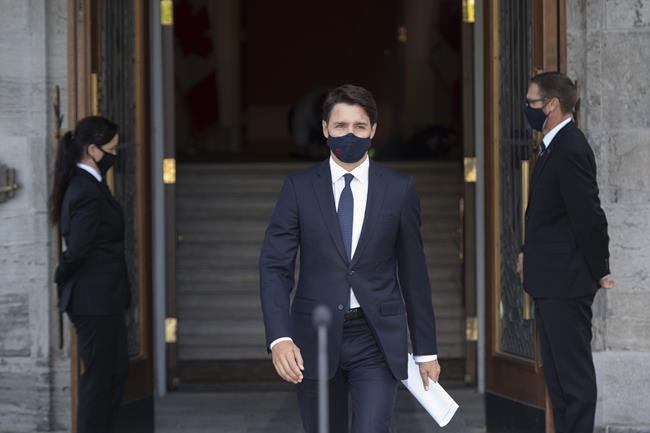
Prime Minister Justin Trudeau walks to the lectern as he leaves Rideau Hall after meeting with Governor General Mary Simon to ask her to dissolve Parliament, triggering an election, in Ottawa, on Sunday, Aug. 15, 2021. THE CANADIAN PRESS/Justin Tang

People can expect to see the familiar measures of Plexiglas barriers installed in rooms designed for people to stand about two metres apart along with bottles of hand sanitizers at polling stations.

As a result of needing to scrub down surfaces in between ballots being cast, the agency’s website warns voting could take longer than usual. The strict sanitation rules means voters won’t be sharing pencils to mark their ballots, but will each receive one of their own. Around 16 million single-use ones have been procured.

Elections workers, candidates and their representatives will be required to wear masks, but the agency is only encouraging voters to do so.

Provinces like Manitoba and Saskatchewan have rescinded their mandatory mask rules and Elections Canada says it will work with local public health rules to ensure consistency on the issue. It does plan to give a face covering to those who want to mask up.

As for where voters will be able to go, the agency says that’s being worked on by returning officers who have an eye to provide the extra space needed for physical distancing.

How many schools will be used remains a question. The buildings are typically go-tos for Elections Canada, but that’s all been complicated by the virus and the desire to keep students and staff learning safely in the classroom, free of any potential exposures.

“Returning officers are working with school boards, school principals and administrators to ensure that its health and safety plans are well known and followed,” reads a statement from an Elections Canada spokesperson.

“Poll workers will ensure doors and windows are kept open, where possible, to reduce touch points and encourage air circulation.”

The agency is also figuring out voting options for long-term care facilities.

As with the provincial elections that happened over the pandemic, not to mention last fall’s vote in the United States, Elections Canada anticipates more people wanting to vote by mail.

It says it has improved the way to get a special ballot and has “increased our capacity to process requests while preserving vote integrity.”

Elections Canada adds that special ballot boxes will be stationed at regular polling locations so those who requested to vote by mail can drop off their ballot on election day to ensure it’s received by the deadline to be counted.

All potential election workers will be encouraged to get vaccinated, it says, but that will not be mandatory.

The agency says returning officers will, when possible, prioritize putting election workers who are vaccinated into communities at high risk of getting COVID-19. These include remote First Nations communities and long-term care facilities.

This report by The Canadian Press was first published Aug. 15, 2021.

Report Error Submit a Tip

More Stories

United Way, other charities fight for dollars as donor base shrinks

Scott Billeck 7 minute read Preview

United Way, other charities fight for dollars as donor base shrinks

Scott Billeck 7 minute read Yesterday at 2:00 AM CDT

Winnipeg’s charitable sector is being squeezed from both sides: demand for help is growing while the pool of donors to meet that need is shrinking.

The imbalance is increasingly being carried by a relatively small group of deep-pocketed donors. Last year, 600 people — about three per cent of United Way Winnipeg’s individual donors — accounted for roughly $8 million, or 55 per cent of individual donations.

The fundraising pitch isn’t getting any easier.

Homelessness and public drug use have become increasingly visible, household budgets remain strained and the problems charities are trying to address can seem so entrenched that donors may reasonably wonder what difference another contribution can make.

Read
Yesterday at 2:00 AM CDT

Siloam Mission, WFPS discussing on-site paramedic to reduce staggering number of emergency calls

Scott Billeck 4 minute read Preview

Siloam Mission, WFPS discussing on-site paramedic to reduce staggering number of emergency calls

Scott Billeck 4 minute read Yesterday at 2:00 AM CDT

Winnipeg’s fire-paramedic service and its largest homeless-serving organization are discussing what it would look like to station at least one paramedic at Siloam Mission, as emergency calls to the downtown facility surge.

The ongoing discussions come as Winnipeg Fire Paramedic Service crews were dispatched 1,771 times during the first eight months of the year to the two adjacent Siloam properties at 303 Stanley St. and 300 Princess St.

WFPS said most of the calls were related to overdoses or other consequences of substance use, with the total nearly double the 854 calls recorded over the same period last year. By comparison, there were 831 calls during the same span in 2024, and 591 in 2023.

“The number of emergency calls isn’t sustainable for us as a service, but it’s certainly not sustainable for them as an agency trying to provide services,” WFPS chief Ryan Sneath told the Free Press. “And they recognize that they’re impacting emergency services, not them specifically, but the site in a significant way.”

Read
Yesterday at 2:00 AM CDT

Day 1 of Jets training camp in the books with pairings essentially cemented

Ken Wiebe 7 minute read Preview

Day 1 of Jets training camp in the books with pairings essentially cemented

Ken Wiebe 7 minute read Thursday, Sep. 17, 2026

Nearly six minutes into his question-and-answer session, Scott Arniel took a welcome detour from the news of the day.

After exhausting the discussion around the goalie who wasn’t in training camp, the head coach of the Winnipeg Jets finally got a query about the line combinations and defensive pairings that were unveiled in training camp.

And unlike past years, when exhibition games were more frequent and the training camp wasn’t this condensed, Arniel conceded these groupings were intentional and were likely staying together for some time.

The expansion to an 84-game regular season brings with it a reduction to four pre-season games and a much shorter training camp, which could limit the amount of experimentation that Arniel can do during the next two weeks.

Read
Thursday, Sep. 17, 2026

Puzzles Palace

1 minute read Monday, Jul. 27, 2026

To solve our puzzles, please subscribe with this special offer: |

Family account spiced with magic realism, geopolitical intrigue and a ghost story

Reviewed by Zilla Jones 4 minute read Preview

Family account spiced with magic realism, geopolitical intrigue and a ghost story

Reviewed by Zilla Jones 4 minute read 2:01 AM CDT

Tom Lin’s second novel Babylon, South Dakota moves beyond a historical account of an immigrant family’s struggle, delightfully blending and bending genres.

Lin is a Chinese-born novelist whose family emigrated to the U.S. when he was four years old. His debut novel, The Thousand Crimes of Ming Tsu, won the 2022 Andrew Carnegie Medal for Excellence in Fiction, making him the youngest ever recipient of that award. He earned a PhD in English from the University of California Davis and is currently an assistant professor of English and creative writing at the University of Iowa.

Babylon, South Dakota takes place in an unspecified time period that can be understood to be during the Mao era — likely the 1950s or ’60s. A young Chinese couple, the Hsuis, immigrate to the rural community that gives the book its title. They take the names Saul and Mei and settle on a 160-acre homestead left to them by a distant relative.

Saul’s dream is to breed and sell chrysanthemums from seeds he brought from China, while Mei wants to raise livestock. They speak no English, know nothing of life in the United States, are unprepared for the harshness of winter and the isolation of the farm and bring nothing with them except some gold, which Mei hides around the house for emergencies. Their only link to the outside world is a discarded and marginally functioning TV set, which Saul rescues and rigs up.

Read
2:01 AM CDT

Manitoba abandoning spring, fall clock changes

Carol Sanders 8 minute read Preview

Manitoba abandoning spring, fall clock changes

Carol Sanders 8 minute read Updated: Yesterday at 8:48 AM CDT

Time’s up for the time change in Manitoba.

Manitobans won’t be setting their clocks back an hour in November. The province has decided to permanently stay on daylight time after surveying residents on the twice annual clock adjustment.

“We heard from Manitobans loud and clear — no more changing the clocks in Manitoba,” Premier Wab Kinew said in a news release Thursday.

Most of the 72,000 votes submitted in an online EngageMB survey — 92 per cent — said they would like to see the practice end. The survey asked if they preferred earlier sunrises in winter with standard time or the later sunsets in summer with daylight time. More than half of survey participants (58 per cent) indicated a preference to stay on permanent daylight time; 34 per cent voted to eliminate the time change but stay on standard time.

Read
Updated: Yesterday at 8:48 AM CDT