It’s for science’s sake
In-depth research study aims to take the province’s pulse

Advertisement
Read this article for free:
or
Already have an account? Log in here »
To continue reading, please subscribe:

Digital Subscription
One year of digital access for only $205*
- Enjoy unlimited reading on winnipegfreepress.com
- Read the E-Edition, our digital replica newspaper
- Access News Break, our award-winning app
- Play interactive puzzles
*First annual payment billed as $205.00 + GST for one year. This annual subscription will automatically renew at $233.00 + GST every 52 weeks (10% off the regular annual price of $259.35). Offer available to new and qualified returning subscribers only. Cancel any time.
To continue reading, please subscribe:
Add Free Press access to your Brandon Sun subscription for only an additional
$1 for the first 4 weeks*
- Enjoy unlimited reading on winnipegfreepress.com
- Read the E-Edition, our digital replica newspaper
- Access News Break, our award-winning app
- Play interactive puzzles
*Your next Brandon Sun subscription payment will increase by $1.00 and you will be charged $17.95 plus GST for four weeks. After four weeks, your payment will increase to $24.95 plus GST every four weeks.
Read unlimited articles for free today:
or
Already have an account? Log in here »
Hey there, time traveller!
This article was published 21/02/2017 (3444 days ago), so information in it may no longer be current.
‘Name all the words you can think of that start with the letter F.”
The research assistant is looking at me expectantly, her pen hovering over the paper.
My mind is completely, utterly blank. The only F-word I can think is, well, the F-word, and I don’t think that’s going to count against my total.
So far, I have successfully (I hope) identified a camel and a rhinoceros. I have drawn (admittedly at a grade school level) a cube and a clock face showing the time 10 minutes after 10.
Now, at what should ostensibly be the easiest point of the test for someone who works with words all day long, my brain has frozen up. (Frozen! That’s an F-word, one that didn’t come to mind.)
Eventually, my mind thaws enough to throw out “flower,” “floppy” “fly” “fear” and a couple of other workaday words, but my plan to dazzle with my multi-syllabic vocabulary is a failure (F-word!).
However, my fair effort is good enough to give me a perfect score on the test, which is part of the Montreal Cognitive Assessment examination used to detect dementia.
It’s just one of the battery of tests I will undergo as part of The Manitoba Personalized Lifestyle Research (TMPLR) study at the University of Manitoba’s Richardson Centre for Functional Foods and Neutraceuticals.
The study is open to Manitobans from the ages of 30 to 46; researchers hope the results will help provide insight into conditions such as Type 2 diabetes, metabolic syndrome, obesity, cardiovascular disease and kidney diseases.
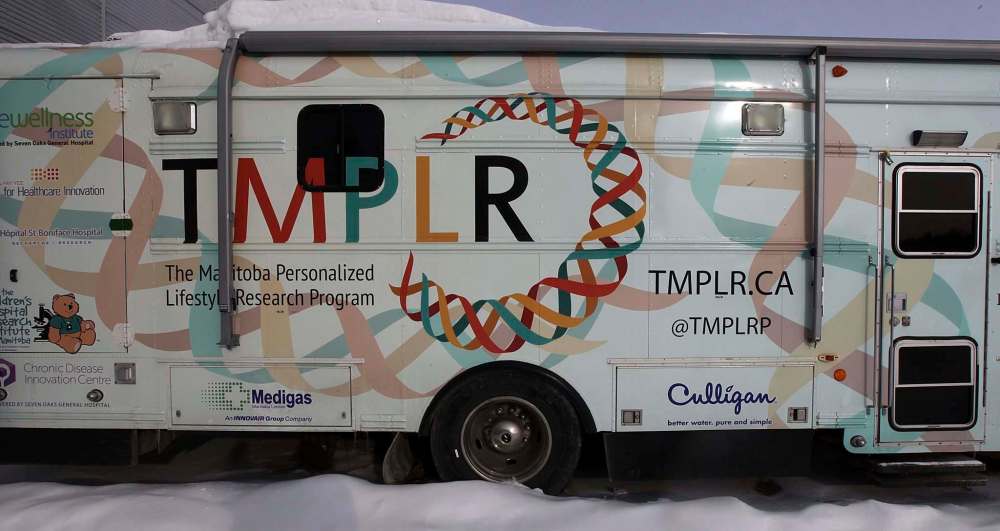
“The long-term goal is to take the pulse of the province in terms of chronic health and exposure and risk factors that contribute to those disease prevalences,” says Peter Jones, who heads up the team of researchers involved in TMPLR, funded by Research Manitoba.
“We’re looking at this central bandwidth of age, 30 to 46, because most individuals within that grouping are still healthy, but some of them will have signs or biomarkers that tie to disease risk, so we want to look at the lifestyle behaviours that connect with those biomarkers that suggest adversity.
“Also, there are some newer parameters that are really leading-edge, such as the intestinal microbiome — what categories of microbes exist in the bowel of individuals who, say, have higher insulin levels or higher cholesterol levels. And genetics: the genetic architecture of an individual may predict their susceptibility to disease.
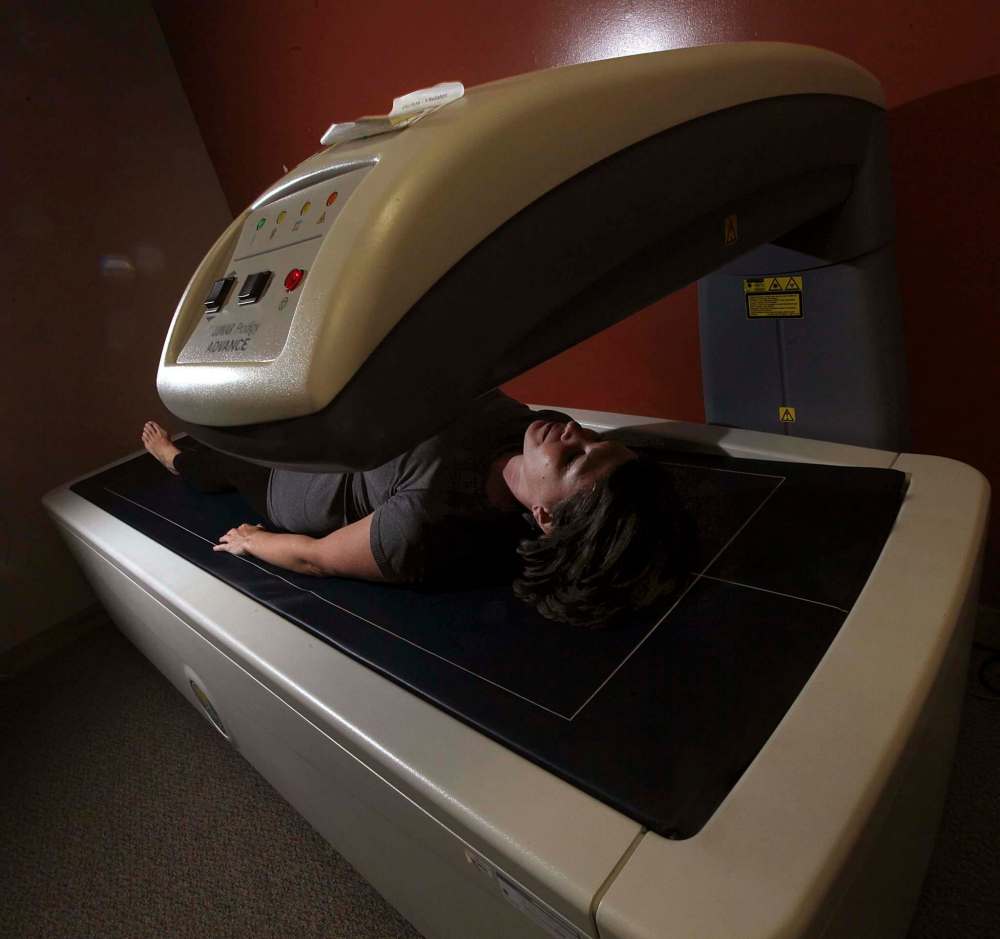
In addition to the cognitive testing, subjects are asked to give a few vials of blood, and provide DNA, urine and stool samples. The study also includes a DXA, an amazing dual-energy X-ray full-body scan that measures bone density, muscle mass and fat distribution and is a much better indicator of health than the body-mass index.
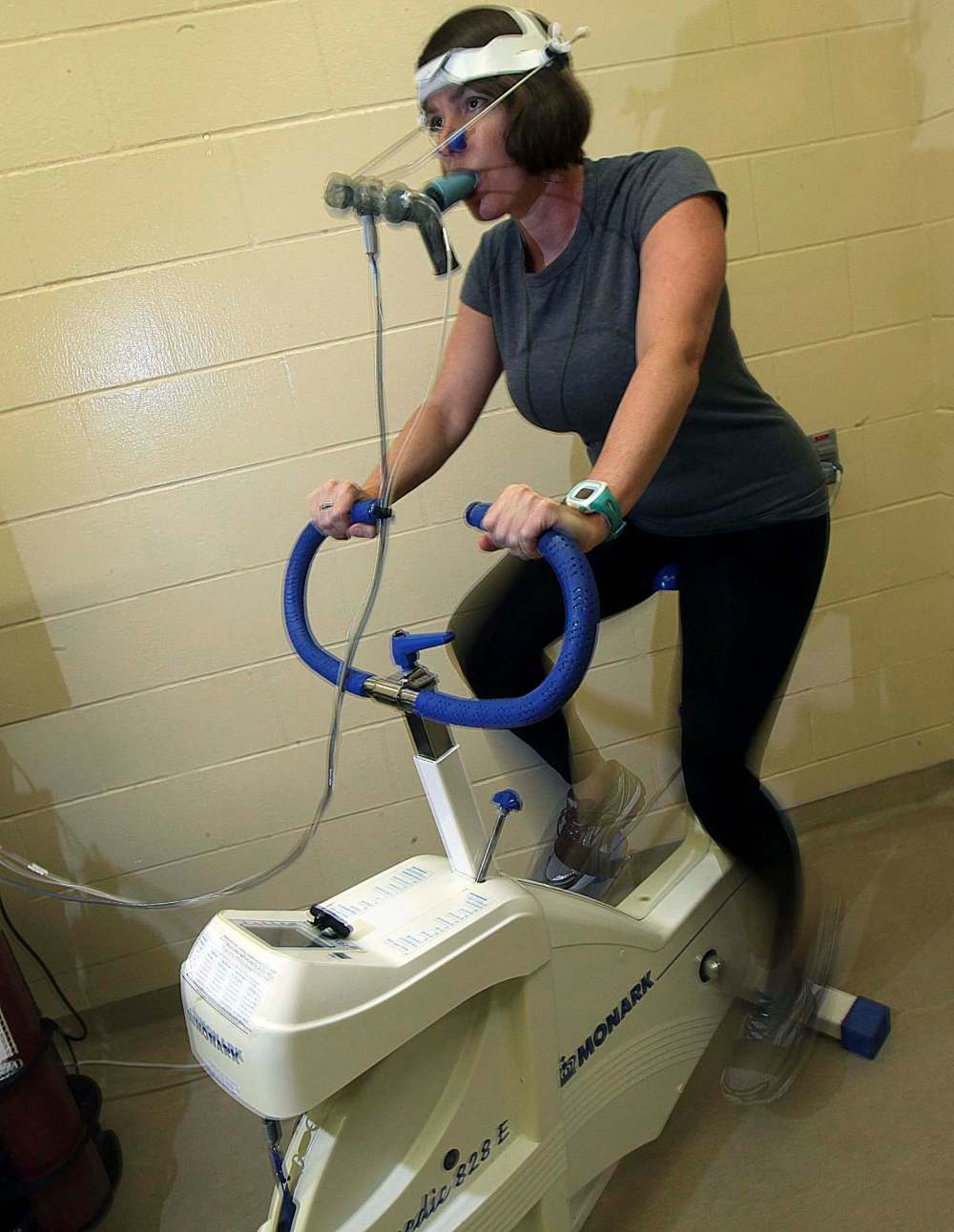
There’s also an exercise component, in which participants ride a stationary bike while wearing a heart-rate monitor and spirometry mask. (Note: the drool towel provided is not a mere courtesy.)
I am a fiercely competitive person, even when there’s no one to compete against (in elementary school, I had my father install a chin-up bar in our basement so I could practise my flexed-arm hang for the Canadian Fitness Award program). I’m tempted to ask if I can repeat the grip-strength test when I see the results — “very good” is not good enough; I strive for excellence — and I’m inwardly certain I can improve on my resting heart rate if I can just get into a more “zen” headspace.
This is, of course, not in the spirit of the exercise, which is to get real results, not optimal results, from all study participants.
That’s a particular challenge when it comes to the questionnaire and food-diary portion of the study. Participants are sent home with a thick booklet of questions that cover everything from the amount of citrus fruit you ate in the past year to whether you were bullied in junior high.
Some of the answers may be lost in the mists of time; others may be wilfully misrepresented — you may inaccurately recall your weight at age 12, you may wear rose-coloured glasses when you think about whether your childhood was a happy one, and you may not wish to talk about the fact that a parent was abusive or had a drinking problem.
The food-recall diary is completed online, and covers three non-overlapping 24-hour periods. There’s the temptation to paint yourself as the virtuous quinoa-and-kale type; it’s very hard to include the day where you (theoretically, of course) ate a pound of spinach dip and drank four glasses of wine.
Obviously, the TMPLR team — which includes researchers who specialize in childhood obesity, indigenous health, sleep and circadian rhythms, nutrition, cardiovascular and kidney disease, and genetics, to name but a few areas — would prefer total honesty and accuracy, but they’re very aware that people tend to underestimate their caloric intake and over-estimate their exercise.
The latter problem is taken care of via an activity monitor, which participants wear constantly for a week — even to bed, to measure sleep patterns. It’s like sporting a tiny fanny pack around the most unflattering circumference of your hips.
All these tests and questionnaires provide a wealth of data for researchers that they hope will lead to a program of precision medicine, targeting Manitobans’ specific health needs.
Unfortunately, the program is not nearly at a place where those data can be analyzed. In early February, only 268 participants had signed up — a far cry from the 1,000 the study requires to be registered as a cohort — and most of those people are like me: white women.
In some ways, it’s not an easy sell. Although the pair of two-hour on-site sessions are a snap, filling out the questionnaires and completing the food diaries is time-consuming, but the potential insight into your own health is invaluable.
It’s fascinating to think about how all the factors in your life, nature and nurture, have combined, and continue to interact to affect you personally.
Plus there’s an altruistic glow from knowing the data you contribute will be used to power “almost limitless” research areas.
“One of my favourites is this breastfeeding-versus-bottle-feeding idea,” says Jones, a nutritional biologist whose areas of expertise are cholesterol, fats and energy metabolism. “So normal mom’s milk is very high in cholesterol — it’s built that way — whereas formulas are almost completely devoid of cholesterol. The notion is that actually a whole generation of kids were put at a disadvantage because they were given formula so low in cholesterol that they forced their metabolic machinery to build their own cholesterol at a very young age.
“So rolling forward in a group of 30- to 45-year-olds — and more importantly, going forward to see what happens in 10 years — I would hypothesize that individuals who say they were bottle-fed as an infant will manifest a higher level of cholesterol synthesis… than those who were fed their mom’s milk, where the natural cholesterol suppressed synthesis at a young age. That would be a really cool finding.
“And it’s just one of literally thousands of associations. It’s not cause and effect — we can’t prove it — but it gives us a good starting position to then design studies where you might be able to prove it.”
When Jones talks about seeing what happens in the future, it’s not mere speculation. Participants are asked if they’re willing to provide their Manitoba Health PHINs; those who consent will continue to provide data to the study throughout their lifetimes.
“We can track our participants forward through their health-care usage,” says Dylan MacKay, a nutritional biologist on the TMPLR team. “Manitoba has a unique opportunity for researchers in their administrative data. It’s highly regulated how you access this data, but you can ask certain questions about the participants that gave a PHIN and you can see if they get Type 2 diabetes. Then you can say, ‘This group of people got Type 2 diabetes. Five years ago, what was special or what was unique related to lifestyle, or gut microbiome in these individuals?’
“That’s a powerful piece of data because it’s prospective.”
In an attempt to get the broad cross-section of participants needed to reflect the Manitoban population, TMPLR will be taking to the road this summer in a specially equipped bus that holds all the equipment needed to complete the sessions, including the DXA scanner and the stationary bike, with Jones or MacKay behind the wheel.
Although the study is structured to have equal numbers of men and women in a range of BMIs with an urban/rural split that mimics the province’s population, researchers would also be pleased to see a cross-section of socio-economic backgrounds, as well as participants from First Nations, Hutterite and other cultural groups that reflect the makeup of Manitoba.
At the end of the study, which encompasses a week in all, my payment is a $100 gift card, but for me, getting a copy of my test results is reward enough.
Jones is hopeful more possible participants will feel the same way when they hear about the vast potential the research holds.
“We hope they’ll say, ‘Wow, what an opportunity for me to learn about my health. Yes, it’s a modest or even significant investment of time, but look at the richness of the data set that comes with that, and hey, I get paid to do it too!’”
jill.wilson@freepress.mb.caTwitter: @dedaumier
Jill Wilson is the editor of the Arts & Life section. A born and bred Winnipegger, she graduated from the University of Winnipeg and worked at Stylus magazine, the Winnipeg Sun and Uptown before joining the Free Press in 2003. Read more about Jill.
Jill oversees the team that publishes news and analysis about art, entertainment and culture in Manitoba. It’s part of the Free Press‘s tradition, since 1872, of producing reliable independent journalism. Read more about Free Press’s history and mandate, and learn how our newsroom operates.
Our newsroom depends on a growing audience of readers to power our journalism. If you are not a paid reader, please consider becoming a subscriber.
Our newsroom depends on its audience of readers to power our journalism. Thank you for your support.
Joining TMPLR
The Manitoba Personalized Lifestyle Research (TMPLR) Program is recruiting Manitobans for a study looking at how genetics, lifestyle and microbiota interact to influence the development of chronic diseases.
Who can participate?
Anyone who is from 30 to 46 years of age and has lived in Manitoba for at least five years.
What do participants do?
Participants come for two assessments (two hours each on two consecutive days) at the Richardson Centre for Functional Foods and Nutraceuticals at the University of Manitoba (196 Innovation Dr.), or to TMPLR’s mobile research unit. Remuneration is provided.
Assessments include:
• blood pressure
• body scan to measure lean mass, fat mass and bone density
• blood and urine samples for biomarker analysis
• stool sample for gut microbiome analysis
• DNA sample for genetic analysis
• physical activity test on an exercise bike
• activity monitor for one week to assess day-to-day physical activity and sleep
• questionnaires about current lifestyle and childhood experiences
What are the benefits of participating?
The research team will provide participants with their information from the measurements performed such as the body scan, blood pressure and strength test.
Participants will also be remunerated for their participation in the trial.
The information from this study will benefit Manitobans in prevention of obesity, Type 2 diabetes, metabolic syndrome, cardiovascular disease and kidney diseases.
— TMPLR.ca
Jill Wilson is the editor of the Arts & Life section. A born and bred Winnipegger, she graduated from the University of Winnipeg and worked at Stylus magazine, the Winnipeg Sun and Uptown before joining the Free Press in 2003. Read more about Jill.
Jill oversees the team that publishes news and analysis about art, entertainment and culture in Manitoba. It’s part of the Free Press‘s tradition, since 1872, of producing reliable independent journalism. Read more about Free Press’s history and mandate, and learn how our newsroom operates.
Our newsroom depends on a growing audience of readers to power our journalism. If you are not a paid reader, please consider becoming a subscriber.
Our newsroom depends on its audience of readers to power our journalism. Thank you for your support.
Advertisement Advertise With Us
Advertisement Advertise With Us
History
Updated on Tuesday, February 21, 2017 6:31 AM CST: Adds photos