Inuit oral histories pointed to Franklin wreckage — but no one listened

Advertisement

Advertise with us

If ego were a parade in Canada's Arctic, a white man would probably lead it.

Read this article for free:


or

Already have an account? Log in here »

To continue reading, please subscribe:

Subscribe and receive a limited-edition Free Press branded hat or tote.

Digital Subscription

One year of digital access for only $205*

  • Enjoy unlimited reading on winnipegfreepress.com
  • Read the E-Edition, our digital replica newspaper
  • Access News Break, our award-winning app
  • Play interactive puzzles

*First annual payment billed as $205.00 + GST for one year. This annual subscription will automatically renew at $233.00 + GST every 52 weeks (10% off the regular annual price of $259.35). Offer available to new and qualified returning subscribers only. Cancel any time.

To continue reading, please subscribe:

Add Free Press access to your Brandon Sun subscription for only an additional

$1 for the first 4 weeks*

  • Enjoy unlimited reading on winnipegfreepress.com
  • Read the E-Edition, our digital replica newspaper
  • Access News Break, our award-winning app
  • Play interactive puzzles
Start now

*Your next Brandon Sun subscription payment will increase by $1.00 and you will be charged $17.95 plus GST for four weeks. After four weeks, your payment will increase to $24.95 plus GST every four weeks.

Hey there, time traveller!
This article was published 30/01/2016 (3894 days ago), so information in it may no longer be current.

If ego were a parade in Canada’s Arctic, a white man would probably lead it.

For it could well be that the Inuit in Canada’s North got a raw deal and should get more credit for helping to locate the bones of one of the world’s most famous ships — Sir John Franklin’s Erebus — in her underwater grave in 2014.

Author David Pelly says information passed down by the Inuit in the late 1800s defined where the ship was (although searchers argue it was technology that pinpointed its exact location).

Either way, while Canada’s Inuit unquestionably helped solve one of the greatest exploratory mysteries of the Victorian Age, it was then-prime minister Stephen Harper who excitedly announced it to the world in 2014. While there was mention of the Inuit contribution, if any of their people were there with the beaming Harper, they were lost in a sea of white.

But what may make people such as Pelly fume more than anything is that the finding of the ship was characterized as a discovery. It wasn’t. Franklin’s sailing ship, trapped in the ice and abandoned, was discovered by the Inuit, as much as 169 years earlier.

The distinction isn’t moot because to sidestep, to mistake, to misrepresent, to ignore the history of a people who are the unquestionably respected masters and custodians of Canada’s Arctic is to inch toward cultural genocide. At the very least, it is insulting and demeaning.

Franklin’s sailing ship and everybody aboard it vanished around 1845 on a dangerous mission: to conquer the Northwest Passage sea corridor from the Atlantic to the Pacific in what was the most treacherous, ice-clogged body of water anywhere. It was then the biggest maritime prize in the world.

Although not the theme of his latest book, Pelly describes in Ukkusiksalik some of the information in Inuit oral histories that were like bread crumbs on the ice leading to what is left of HMS Erebus.

In a chapter on Franklin, Inuit elder Tuinnaq Kanayuk Bruce repeats information passed down to her orally about how Inuit helped a U.S. 3rd cavalry officer and his men hunt for the explorers from 1878-80.

The cavalry party was informed by an Inuk, Ikinilik, that he had visited a ship frozen in the ice but there was no sign of life, and when they got inside there was a corpse in a bunk as well as canned meat, forks, knives and spoons. Inuit also said they had to walk out five kilometres from the shore on smooth ice to reach the abandoned ship.

Another man, Puhtoorak, said he visited the ship multiple times at Ootgoolik. That name corresponds to the area in which Erebus was found. (The ship later sank.)

More importantly, a New York journalist with the cavalry searchers reported he had learned (obviously from Inuit) that the ship was near an island named Keeweewoo, a small island near O’Reilly Island, which, author Pelly says, “as far as we know, corresponds very closely with the location of the shipwreck found in 2014.”

Says a critical Pelly: “It is evident that this long-standing Inuit oral testimony pointed quite accurately to the ultimate modern ‘discovery’ of the Erebus shipwreck.”
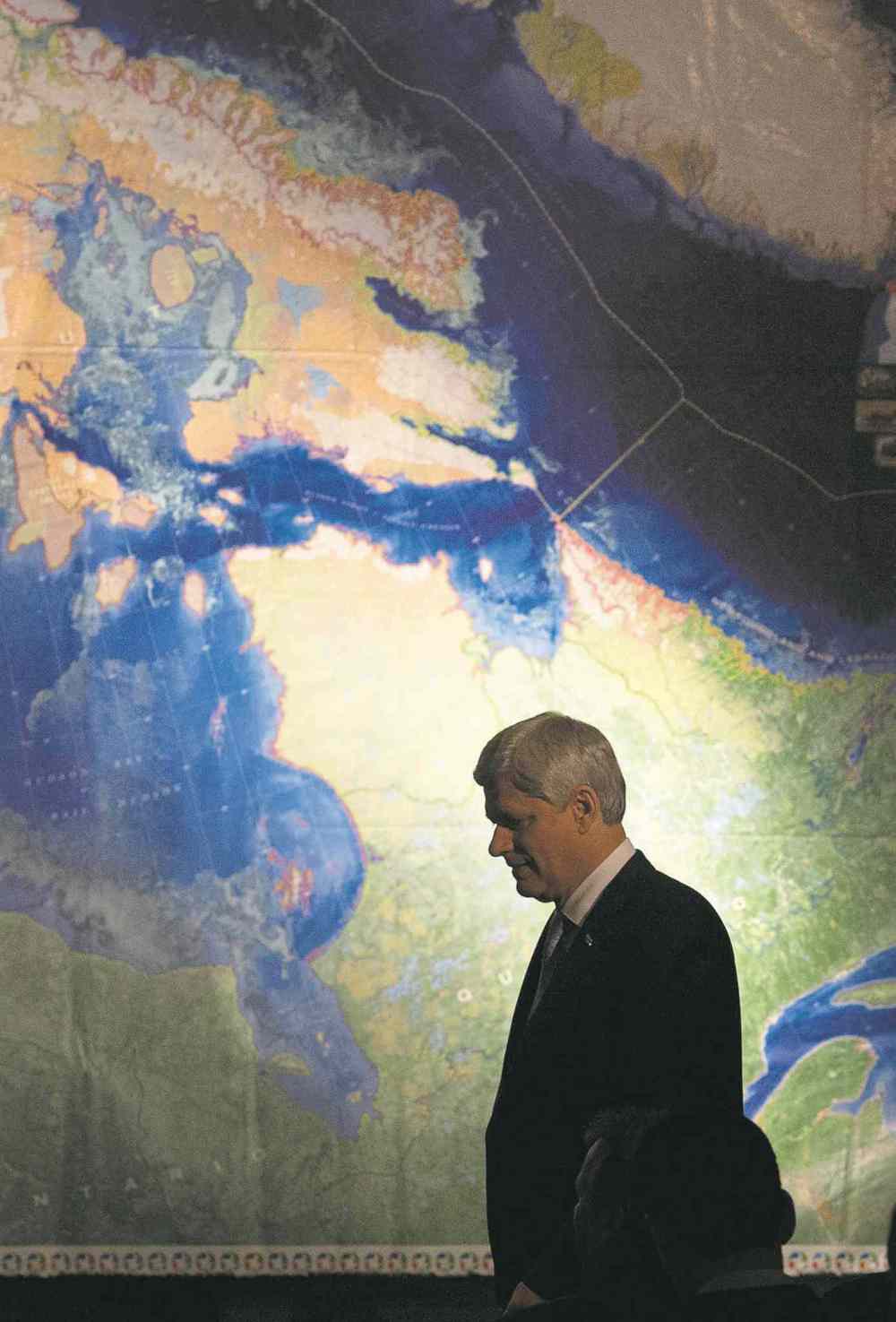
Darren Calabrese / THE CANADIAN PRESS files 
In 2014, then-prime minister Stephen Harper announced the discovery of the sunken Erebus.
Darren Calabrese / THE CANADIAN PRESS files In 2014, then-prime minister Stephen Harper announced the discovery of the sunken Erebus.

Franklin and his 129 men all died in the expedition; The Erebus’ sister ship, Terror, is still missing.

A sizeable portion of Pelly’s book is the oral histories of Inuit life and their experiences in the Ukkusiksalik area north-northwest of Hudson Bay, among rock 2.5 billion years old.

Inuit oral storytelling is arresting. There is no embellishment, no guile, no attempt to please or persuade, deceive or distort, somewhat like a good occurrence report by police: matter-of-fact, neutral, robotic.

It takes some getting used to, but it’s worth it.


In 1969, writer Barry Craig was aboard the icebreaker that helped the first commercial vessel conquer the Northwest Passage and fulfil the dream that Franklin and his men died trying to achieve.

Report Error Submit a Tip

More Stories

Inuit oral histories pointed to Franklin wreckage — but no one listened

Reviewed by Barry Craig 4 minute read Preview

Inuit oral histories pointed to Franklin wreckage — but no one listened

Reviewed by Barry Craig 4 minute read Saturday, Jan. 30, 2016

If ego were a parade in Canada's Arctic, a white man would probably lead it.

For it could well be that the Inuit in Canada's North got a raw deal and should get more credit for helping to locate the bones of one of the world's most famous ships — Sir John Franklin's Erebus — in her underwater grave in 2014.

Author David Pelly says information passed down by the Inuit in the late 1800s defined where the ship was (although searchers argue it was technology that pinpointed its exact location).

Either way, while Canada's Inuit unquestionably helped solve one of the greatest exploratory mysteries of the Victorian Age, it was then-prime minister Stephen Harper who excitedly announced it to the world in 2014. While there was mention of the Inuit contribution, if any of their people were there with the beaming Harper, they were lost in a sea of white.

Read
Saturday, Jan. 30, 2016

Is a better Winnipeg on the horizon?

Tom Brodbeck, Rebecca Chambers, Niigaan Sinclair and Brent Bellamy 20 minute read Preview

Is a better Winnipeg on the horizon?

Tom Brodbeck, Rebecca Chambers, Niigaan Sinclair and Brent Bellamy 20 minute read Friday, Sep. 25, 2026

Four Free Press columnists weigh in on the challenges ahead and how the city can become better.

Read
Friday, Sep. 25, 2026

The wheels on the bus burned down, down, down…

Russell Wangersky 7 minute read Preview

The wheels on the bus burned down, down, down…

Russell Wangersky 7 minute read Saturday, Sep. 26, 2026

Up on the high ground, a year after the big forest fire in Newfoundland’s Conception Bay North, and the bare rock is startling.

It’s ghostly. The little birds flit and chirp from the naked silver bare-wood branches, and a solitary northern flicker makes its call from — somewhere. But mostly, it’s still, and silent. With the underbrush gone, you can see how little animal life is here right now.

But the most astounding thing is underfoot. On the high rock behind Adam’s Cove and away from the sea, not only are the trees and low brush gone, but much of the soil has burned away as well.

It burned very, very hot.

Read
Saturday, Sep. 26, 2026

Bombers let another one slip away and face pivotal issue

Taylor Allen 7 minute read Preview

Bombers let another one slip away and face pivotal issue

Taylor Allen 7 minute read Saturday, Sep. 26, 2026

Mike O’Shea summed it up best.

“That one doesn’t feel very good.”

Nor should it.

The Winnipeg Blue Bombers started out hot Friday night, only to run out of gas down the stretch and allow the visiting Toronto Argonauts to steal a 30-28 victory.

Read
Saturday, Sep. 26, 2026

Wab Kinew as ‘communicator in chief’

Paul G. Thomas 6 minute read Preview

Wab Kinew as ‘communicator in chief’

Paul G. Thomas 6 minute read 2:00 AM CDT

Premier Wab Kinew and his party have been riding high in the polls longer than normal for a government one year or less away from its first re-election contest. One reason is his ubiquitous, dominating communications presence as NDP leader and premier.

The argument here is that Kinew has supplemented his prerogatives as premier and party leader (such as appointing cabinet ministers and approving party nominations) with the skilful use of communications to advance his policy agenda, boost his personal popularity and maintain the competitive advantage of his party over the opposition Progressive Conservatives.

Communications has always been a significant part of politics and policy making. However, in the contemporary political and media environments, communications considerations have moved from the background to the foreground of decision-making by political parties, including when they are performing in the role of government. Campaigning and governing now overlap in what has been described as a permanent election campaign.

Political parties use communications strategies for several purposes: to establish an image of the leader which makes a positive emotional connection with voters; to promote a coherent message and to keep party members on message; and to gain favourable media coverage for its policies and other actions on almost a daily basis.

Read
2:00 AM CDT

Restaurants ‘under pressure’

Gabrielle Piché 5 minute read Preview

Restaurants ‘under pressure’

Gabrielle Piché 5 minute read Friday, Sep. 25, 2026

Happy hour outings are on Jackie Piggott’s calendar — but even those are fewer.

She and her husband might visit a restaurant once a month. It’s a change over the past year: earlier, they may go twice, thrice or weekly.

“It’s something that we’ve talked about, my husband and myself, just because the pricing is so expensive,” Piggott said, stopping during a grocery run in St. Vital. “It’s also better for our health.”

She’s in the majority: a new Restaurants Canada report found 80 per cent of Canadians are eating out less frequently because of higher living costs, up from 75 per cent in 2025.

Read
Friday, Sep. 25, 2026