Wanted: More pastures for West’s overpopulated wild horses

Advertisement

Advertise with us

CHEYENNE, Wyo. - If you ever wished to gaze at a stomping, snorting, neighing panorama of Western heritage from your living-room window, now could be your chance.

Read this article for free:


or

Already have an account? Log in here »

To continue reading, please subscribe:

Subscribe and receive a limited-edition Free Press branded hat or tote.

Digital Subscription

One year of digital access for only $205*

  • Enjoy unlimited reading on winnipegfreepress.com
  • Read the E-Edition, our digital replica newspaper
  • Access News Break, our award-winning app
  • Play interactive puzzles

*First annual payment billed as $205.00 + GST for one year. This annual subscription will automatically renew at $233.00 + GST every 52 weeks (10% off the regular annual price of $259.35). Offer available to new and qualified returning subscribers only. Cancel any time.

To continue reading, please subscribe:

Add Free Press access to your Brandon Sun subscription for only an additional

$1 for the first 4 weeks*

  • Enjoy unlimited reading on winnipegfreepress.com
  • Read the E-Edition, our digital replica newspaper
  • Access News Break, our award-winning app
  • Play interactive puzzles
Start now

*Your next Brandon Sun subscription payment will increase by $1.00 and you will be charged $17.95 plus GST for four weeks. After four weeks, your payment will increase to $24.95 plus GST every four weeks.

Hey there, time traveller!
This article was published 09/03/2019 (2752 days ago), so information in it may no longer be current.

CHEYENNE, Wyo. – If you ever wished to gaze at a stomping, snorting, neighing panorama of Western heritage from your living-room window, now could be your chance.

A classic image of the American West — wild horses stampeding across the landscape — not only has endured through the years but has multiplied past the point of range damage. Through May 3, the U.S. government is seeking more private pastures for an overpopulation of wild horses.

Many consider rounding up wild horses to live out their lives on private pastures a reasonable approach to a tricky problem. Wild horses, after all, not only have romantic value, they are protected by federal law.
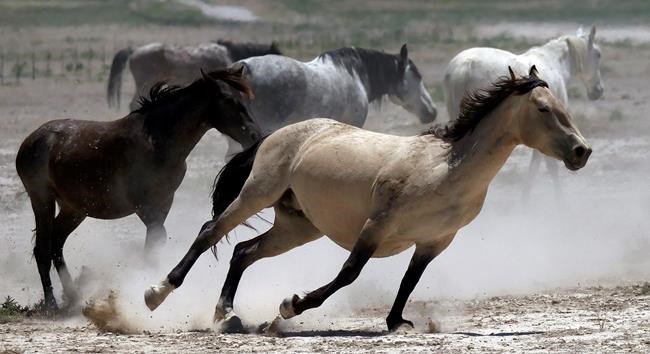
FILE - In this June 29, 2018, file photo, wild horses kick up dust as they run at a watering hole outside Salt Lake City. The U.S. government is seeking new pastures for thousands of wild horses that have overpopulated Western ranges. Landowners interested in hosting large numbers of rounded-up wild horses on their property can now apply with the U.S. Bureau of Land Management. (AP Photo/Rick Bowmer, File)

Just keep in mind a few of the dozens of requirements for getting paid by the government to provide wild horses a home.

“It’s not like you can do this in your backyard, or even a 5 acre (2 hectare) plot,” said Debbie Collins, outreach specialist for the U.S. Bureau of Land Management’s Wild Horse and Burro Program in Norman, Oklahoma.

You need a lot of fenced-in land, enough to sustain anywhere from 200 to 5,000 healthy horses. Exactly how much land depends on pasture quality as determined by the government, but you can safely assume several hundred if not thousands of acres (hectares).

The pastured horses typically are left on their own with little human intervention. Still, they require continuous water and basic shelter from the elements, such as trees or a canyon; supplemental forage; and corrals for loading and unloading from trailers.

Participants in the private-pasture system must live in 14 Western and Midwestern states, from eastern Washington to the Texas Panhandle. Over two-thirds of the 37 existing off-range pastures are in Oklahoma and Kansas.

And: These horses aren’t pets. They’ve had little exposure to people. Many are over 5 years old and therefore not ideal for training and individual adoption or sale, other options available through the BLM.

Still, there’s no shortage of interest in the off-range pasture program. People call all the time asking for details, Collins said.

“My only advice would be to go into it with your eyes wide open,” said Dwayne Oldham, a former Wyoming state veterinarian who has taken in wild horses on his family’s Double D cattle ranch outside Lander, Wyoming, since 2015.

Working with the government can be demanding, but providing for the over 130 horses on the Wind River Wild Horse Sanctuary on the ranch isn’t too difficult, Oldham said.

The sanctuary is a little different from most private wild-horse pastures: It’s open to the public. Tourists headed to Yellowstone and Grand Teton national parks increasingly stop there.

About 50 miles (80 kilometres) to the south, cattle ranchers, wild horse advocates and the BLM have been embroiled in decades of lawsuits over wild horses in an area of mostly unfenced, interspersed public and private lands called the Checkerboard. The booming wild horse population there competes with cattle for forage and water in the high desert, the ranchers claim.

The BLM abides by the 1971 Wild and Free-Roaming Horses and Burros Act, which protects wild horses and burros on BLM land in 10 Western states, attorneys for the government say.

“We want to be part of the solution and not just the adversary,” Oldham said.

A group often involved in wild-horse litigation, the American Wild Horse Campaign, says darting mares with contraceptives is the best answer to overpopulation but is underused. Roundups only encourage compensatory breeding and overpopulation, said Grace Kuhn with the group.

However, the group doesn’t oppose off-range pastures as an alternative to keeping wild horses in corrals for long periods.

“We do advocate that if the government is going to be removing wild horses from the range, long-term is more cost-effective than short-term holding,” Kuhn said.

Over 55,000 more horses and burros live wild in the West than the roughly 27,000 the BLM says can thrive in harmony with the landscape.

Adoptions and sales through the Wild Horse and Burro Program have recovered to over 3,400 a year after hitting a low of about 1,800 in 2014.

But while the number of off-range pastures has boomed from just a couple in the 1990s, the number of horses on them hovers very close to their current carrying capacity of about 36,500.

The number of pastured wild horses is determined mainly through roundups and adoptions. Stallions are gelded and kept at different off-range pastures than mares, preventing reproduction aside from the occasional pregnant mare rounded up from the wild.

How many new off-range pastures are established through the latest bid solicitation, the first of its kind since 2016, will depend on costs and how many existing ones get renewed, Collins said.

“It’s just a happier, healthier environment for a horse to be able to be out in a pasture,” she said.

___

Follow Mead Gruver at https://twitter.com/meadgruver

Report Error Submit a Tip

More Stories

Grieving child builds backyard rocket ship

Harriet Zaidman 4 minute read 2:01 AM CDT

I Built a Rocket Ship (Kids Can Press, 32 pages, hardcover, $22) by Winnipegger Anna Lazowski is a tender story for children ages 4-8 about a little girl trying to make sense of her mother’s death. The child engages in conversation with her late mom, agreeing and disagreeing about things said as she carries objects (and of course, the cat) to the backyard. There, she is building a rocket ship she will pilot into the skies to find her mom again.

Jennica Lounsbury’s varied perspectives show the range of emotions the little girl experiences.

● ● ●

Northwoods Lullaby by Mary Casanova (University of Minnesota Press, 32 pages, hardover, $25) is a bedtime book for readers up to age eight, perfect to bring a busy, happy day to a close. Just like children who are listening to adults reading the book, all the animal babies are being tucked into their nests and burrows by loving parents: “Thump and scamper,/nimble clover./ Soon it’s time to rest. Baby loon/ nestles in/as Papa floats along.”

Siloam Mission, WFPS discussing on-site paramedic to reduce staggering number of emergency calls

Scott Billeck 4 minute read Preview

Siloam Mission, WFPS discussing on-site paramedic to reduce staggering number of emergency calls

Scott Billeck 4 minute read Yesterday at 2:00 AM CDT

Winnipeg’s fire-paramedic service and its largest homeless-serving organization are discussing what it would look like to station at least one paramedic at Siloam Mission, as emergency calls to the downtown facility surge.

The ongoing discussions come as Winnipeg Fire Paramedic Service crews were dispatched 1,771 times during the first eight months of the year to the two adjacent Siloam properties at 303 Stanley St. and 300 Princess St.

WFPS said most of the calls were related to overdoses or other consequences of substance use, with the total nearly double the 854 calls recorded over the same period last year. By comparison, there were 831 calls during the same span in 2024, and 591 in 2023.

“The number of emergency calls isn’t sustainable for us as a service, but it’s certainly not sustainable for them as an agency trying to provide services,” WFPS chief Ryan Sneath told the Free Press. “And they recognize that they’re impacting emergency services, not them specifically, but the site in a significant way.”

Read
Yesterday at 2:00 AM CDT

Former Bombers linebacker Gauthier enjoying career as electrician

Taylor Allen 6 minute read Preview

Former Bombers linebacker Gauthier enjoying career as electrician

Taylor Allen 6 minute read Yesterday at 12:44 PM CDT

Most professional football players don’t ride off into the sunset on their own terms.

Shayne Gauthier was well aware of that, but it didn’t make it sting any less when the Winnipeg Blue Bombers informed the veteran linebacker that they weren’t bringing him back for 2026.

“I was really hoping to play one more (season) because it would have been my 10th season, so, I’d say it didn’t really end the way I wanted,” Gauthier recently told the Free Press.

“It left a little sour taste in my mouth, but that’s part of pro sports. If everybody got the ending that they wanted, then it wouldn’t really work.”

Read
Yesterday at 12:44 PM CDT

Give-and-take relationship of Roman leaders takes centre stage in Harris’s historical fiction

Reviewed by Kathryne Cardwell 4 minute read Preview

Give-and-take relationship of Roman leaders takes centre stage in Harris’s historical fiction

Reviewed by Kathryne Cardwell 4 minute read 2:01 AM CDT

British novelist Robert Harris’s latest work is a reflection on tyranny, corruption and betrayal among all-powerful political leaders.

You might be forgiven for thinking it’s a contemporary thriller — it’s actually historical fiction set in ancient Rome.

A former BBC journalist, Harris debuted as a novelist in 1992 with Fatherland, an alternative history where Nazi Germany won the Second World War.

Since then, the prolific author has become best-known for his works of historical fiction, especially his ancient Rome trilogy released from 2006-2015 and the novel Conclave, which was published in 2016 and was made into the film of the same name in 2024.

Read
2:01 AM CDT

Cabernet Sauvignon star of wine festival

Ben Sigurdson 5 minute read Preview

Cabernet Sauvignon star of wine festival

Ben Sigurdson 5 minute read 3:00 AM CDT

The Winnipeg Wine Festival will celebrate the king of red wine grapes next weekend — the theme of this year’s festival, which takes place Sept. 25 and 26 at the RBC Convention Centre, is Cabernet Sauvignon.

Cab Sauv, as it’s also known, is the world’s most widely planted wine grape of any colour, first coming to prominence in the 1800s in France’s Bordeaux region, where the grape is still popular. Rather than single-variety wines, Bordeaux reds tend to be blends, with those coming from the left bank of the Gironde estuary being Cabernet-dominant, while right-bank wines are Merlot-dominant, with Cabernet Sauvignon playing a supporting role. Cabernet and Merlot work well together and many other countries have followed suit in blending the two.

A team at University of California Davis put Cabernet Sauvignon through a DNA test in 1996 and discovered its parent grapes are Cabernet Franc and Sauvignon Blanc — it’s likely that at some point the two varieties, planted next to each other in some vineyard, crossed and mutated and became the grape we know today. (Someone growing grapes in the 19th century must have had an inkling of what was up, as the grape has been called Cabernet Sauvignon since long before the DNA test.)

Flavour-wise, most Cabernet Sauvignon wines are big and bold, with a core of deep dark berry flavours, some graphite and spice notes and relatively bright acidity. It’s a grape that is well-suited to barrel aging, with most examples seeing at least some time in wood.

Read
3:00 AM CDT

Canada-U.S. trade relationship is broken, but the damage can — and will — be repaired

Tom Brodbeck 5 minute read Preview

Canada-U.S. trade relationship is broken, but the damage can — and will — be repaired

Tom Brodbeck 5 minute read Thursday, Sep. 17, 2026

Canada needs to get serious about diversifying its trade beyond the United States. But at the same time, Canadians should expect relations with the U.S. to normalize after Donald Trump is no longer in the White House.

For generations, Canada-U.S. trade was considered almost a fact of geography. The two countries share the world’s longest undefended border, deeply integrated supply chains and a century of commercial relationships.

Canadian manufacturers depend on American customers. American manufacturers depend on Canadian suppliers. Energy, agriculture, automotive production and countless other industries operate across the border as though it barely exists.

That isn’t going to change dramatically, even in the midst of a bitter trade war unleashed by the U.S. president.

Read
Thursday, Sep. 17, 2026