WEATHER ALERT

Blankets, bed-sharing common in accidental baby suffocations

Advertisement

Advertise with us

CHICAGO - Accidental suffocation is a leading cause of injury deaths in U.S. infants and common scenarios involve blankets, bed-sharing with parents and other unsafe sleep practices, an analysis of government data found.

Read this article for free:

or

Already have an account? Log in here »

To continue reading, please subscribe:

Subscribe and receive a limited-edition Free Press branded hat or tote.

Digital Subscription

One year of digital access for only $205*

  • Enjoy unlimited reading on winnipegfreepress.com
  • Read the E-Edition, our digital replica newspaper
  • Access News Break, our award-winning app
  • Play interactive puzzles

*First annual payment billed as $205.00 + GST for one year. This annual subscription will automatically renew at $233.00 + GST every 52 weeks (10% off the regular annual price of $259.35). Offer available to new and qualified returning subscribers only. Cancel any time.

To continue reading, please subscribe:

Add Free Press access to your Brandon Sun subscription for only an additional

$1 for the first 4 weeks*

  • Enjoy unlimited reading on winnipegfreepress.com
  • Read the E-Edition, our digital replica newspaper
  • Access News Break, our award-winning app
  • Play interactive puzzles
Start now

*Your next Brandon Sun subscription payment will increase by $1.00 and you will be charged $17.95 plus GST for four weeks. After four weeks, your payment will increase to $24.95 plus GST every four weeks.

Hey there, time traveller!
This article was published 21/04/2019 (2656 days ago), so information in it may no longer be current.

CHICAGO – Accidental suffocation is a leading cause of injury deaths in U.S. infants and common scenarios involve blankets, bed-sharing with parents and other unsafe sleep practices, an analysis of government data found.

These deaths “are entirely preventable. That’s the most important point,” said Dr. Fern Hauck, a co-author and University of Virginia expert in infant deaths.

Among 250 suffocation deaths, roughly 70 per cent involved blankets, pillows or other soft bedding that blocked infants’ airways. Half of these soft bedding-related deaths occurred in an adult bed where most babies were sleeping on their stomachs.
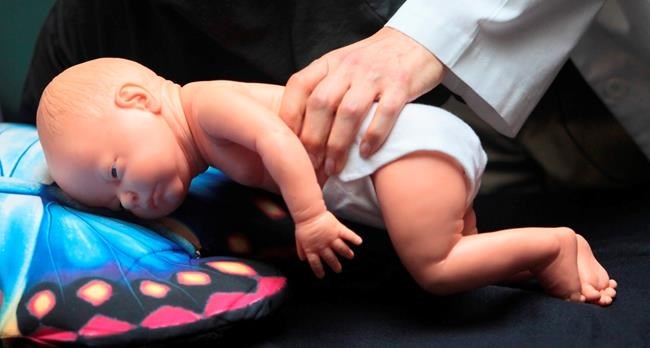
FILE - In this March 22, 2012 file photo, a doctor demonstrates how an infant can die due to unsafe sleeping practices using a scene re-enactment doll in Norfolk, Va. Released on Monday, April 22, 2019, an analysis of five years of CDC data found most accidental suffocation deaths in U.S. infants occur when babies are sleeping on their stomachs in adult beds with blankets and pillows. (AP Photo/The Virginian-Pilot, Steve Earley, File)

Almost 20 per cent suffocated when someone in the bed accidentally moved against or on top of them, and about 12 per cent died when their faces were wedged against a wall or mattress.

The authors studied 2011-2014 data from a Centers for Disease Control and Prevention registry of deaths in 10 states. The results offer a more detailed look at death circumstances than previous studies using vital records, said lead author Alexa Erck Lambert, a CDC researcher.

The authors said anecdotal reports suggest there’s been little change in unsafe sleep practices in more recent years.

“It is very, very distressing that in the U.S. we’re just seeing this resistance, or persistence of these high numbers,” Hauck said.

The study was published Monday in Pediatrics.

For years, the U.S. government and the American Academy of Pediatrics have waged safe-sleep campaigns aimed at preventing accidental infant suffocations and strangulations and sudden infant death syndrome. These include “back to sleep” advice promoting having babies sleep on their backs, which experts believe contributed to a decline in SIDS deaths over nearly 30 years. But bed-sharing has increased, along with bed-related accidental suffocations — from 6 deaths per 100,000 infants in 1999 to 23 per 100,000 in 2015, the researchers note.

Dr. Rachel Moon, a University of Virginia pediatrics professor not involved in the study, said the results are not surprising.

“Every day I talk to parents who have lost babies. They thought they were doing the right thing, and it seems safe and it seems OK, until you lose a baby,” Moon said.

Some studies have found bed-sharing increases breastfeeding and it’s common in some families because of cultural traditions. Others simply can’t afford a crib.

Erika Moulton, a stay-at-home mom in suburban New York, said bed-sharing was the only way her son, Hugo, would sleep as a newborn. Moulton struggled with getting enough sleep herself for months, and while she knew doctors advise against it, bed-sharing seemed like the only option.

Now 14 months old, “he’s still in our bed,” she said. “Trying to transition him out is a little difficult.”

The pediatricians group recommends that infants sleep on firm mattresses in their own cribs or bassinets but in their parents’ room for the first year. A tight-fitting top sheet is the only crib bedding recommended, to avoid suffocation or strangulation.

Young babies can’t easily move away from bedding or a sleeping parent; all of the study deaths were in infants younger than 8 months old.

___

Follow AP Medical Writer Lindsey Tanner at @LindseyTanner.

___

The Associated Press Health and Science Department receives support from the Howard Hughes Medical Institute’s Department of Science Education. The AP is solely responsible for all content.

Report Error Submit a Tip

More Stories

Blankets, bed-sharing common in accidental baby suffocations

Lindsey Tanner, The Associated Press 4 minute read Preview

Blankets, bed-sharing common in accidental baby suffocations

Lindsey Tanner, The Associated Press 4 minute read Sunday, Apr. 21, 2019

CHICAGO - Accidental suffocation is a leading cause of injury deaths in U.S. infants and common scenarios involve blankets, bed-sharing with parents and other unsafe sleep practices, an analysis of government data found.

These deaths "are entirely preventable. That's the most important point," said Dr. Fern Hauck, a co-author and University of Virginia expert in infant deaths.

Among 250 suffocation deaths, roughly 70 per cent involved blankets, pillows or other soft bedding that blocked infants' airways. Half of these soft bedding-related deaths occurred in an adult bed where most babies were sleeping on their stomachs.

Almost 20 per cent suffocated when someone in the bed accidentally moved against or on top of them, and about 12 per cent died when their faces were wedged against a wall or mattress.

Read
Sunday, Apr. 21, 2019

CMHR ‘fans flames of antisemitism,’ Asper says, ending support from family that led effort to create it

Carol Sanders 7 minute read Preview

CMHR ‘fans flames of antisemitism,’ Asper says, ending support from family that led effort to create it

Carol Sanders 7 minute read Updated: Yesterday at 8:49 PM CDT

The Winnipeg family that led the effort to build the Canadian Museum for Human Rights will not provide support going forward, philanthropist and honorary board member Gail Asper says.

Read
Updated: Yesterday at 8:49 PM CDT

Students continue to criticize handling of MITT’s closure

Morgan Modjeski 5 minute read Preview

Students continue to criticize handling of MITT’s closure

Morgan Modjeski 5 minute read Yesterday at 6:00 AM CDT

Students at a Manitoba trade college say their education has been hampered as a result of its impending closure and they blame government for a poor transition.

The provincial government announced in January it would close the Manitoba Institute of Trades and Technology because it was no longer financially viable following the federal government’s decision to cut the number of international students allowed to study in Canada.

Officials have said students would remain the top priority as 19 programs from MITT are set to be absorbed by Red River College Polytech.

Kieran Smith, an electrical applications student at MITT, said it feels like those in charge “don’t really care.”

Read
Yesterday at 6:00 AM CDT

An eroding Winnipeg neighbourhood looks to new foundations

Ian Bickis, The Canadian Press 6 minute read Preview

An eroding Winnipeg neighbourhood looks to new foundations

Ian Bickis, The Canadian Press 6 minute read Updated: Yesterday at 10:45 AM CDT

The lot Jesse Bettcher lives on in Winnipeg's North End used to be a pile of burnt rubble. Same with the one next door. And the one across the street. But he's now the proud owner of a two-storey house with blue-grey siding and white trim.

Read
Updated: Yesterday at 10:45 AM CDT

Visitors from across Canada make Somerset restaurant’s social media challenge a success

Zoe Pierce 3 minute read Preview

Visitors from across Canada make Somerset restaurant’s social media challenge a success

Zoe Pierce 3 minute read Saturday, Jul. 25, 2026

There may not be another restaurant in Manitoba that can say it has welcomed visitors from as many communities across the province and beyond as the Somerset Food Bar & Lounge has this summer.

In just over a two week span, visitors from more than 100 towns have come out to the family-owned restaurant tucked away in Somerset, a community of roughly 450 people in the Pembina Valley 130 kilometres southwest of Winnipeg.

It started as a challenge, “60 Towns in 60 Days,” where the restaurant wanted to document how many different places they could reach, as it often sees people travelling across Canada stop at the restaurant. The goal was also to encourage people to make a drive they normally wouldn’t.

“The more we started sharing, the more people really started getting behind it, and it turned into this really big thing fairly quickly,” said Jay Friesen, restaurant manager.

Read
Saturday, Jul. 25, 2026

Pilot project targets defence contract tracking

Gabrielle Piché 4 minute read Preview

Pilot project targets defence contract tracking

Gabrielle Piché 4 minute read 7:16 PM CDT

As Manitoba businesses cast eyes on national defence contracts, a local firm is piloting technology to ease regulatory headaches.

Mode40 announced its project — and a $2.6 million injection from the feds — earlier this month.

Defence contracts require stringent tracking of parts manufacturing and data may come from hundreds of different systems, said Cameron Bergen, Mode40’s chief executive.

There are raw material conversions, inspections and standards to track. Parts might go to several plants before landing in a finished product.

Read
7:16 PM CDT