Documentary examines an inspiring life

Advertisement
Read this article for free:
or
Already have an account? Log in here »
To continue reading, please subscribe:

Digital Subscription
One year of digital access for only $205*
- Enjoy unlimited reading on winnipegfreepress.com
- Read the E-Edition, our digital replica newspaper
- Access News Break, our award-winning app
- Play interactive puzzles
*First annual payment billed as $205.00 + GST for one year. This annual subscription will automatically renew at $233.00 + GST every 52 weeks (10% off the regular annual price of $259.35). Offer available to new and qualified returning subscribers only. Cancel any time.
To continue reading, please subscribe:
Add Free Press access to your Brandon Sun subscription for only an additional
$1 for the first 4 weeks*
- Enjoy unlimited reading on winnipegfreepress.com
- Read the E-Edition, our digital replica newspaper
- Access News Break, our award-winning app
- Play interactive puzzles
*Your next Brandon Sun subscription payment will increase by $1.00 and you will be charged $17.95 plus GST for four weeks. After four weeks, your payment will increase to $24.95 plus GST every four weeks.
Read unlimited articles for free today:
or
Already have an account? Log in here »
Hey there, time traveller!
This article was published 01/11/2019 (2515 days ago), so information in it may no longer be current.
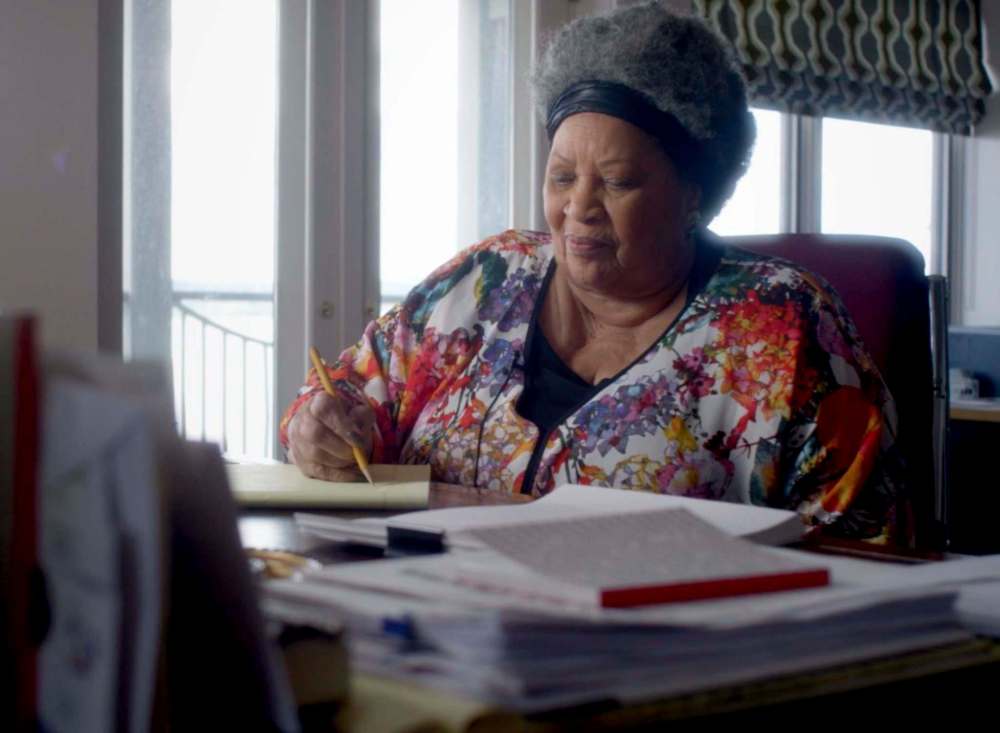
The opening credits of this powerful, personal, complex documentary feature a collage being created before our eyes. The “pieces” of Toni Morrison referenced in the title are arranged and rearranged, offering layered glimpses of a young woman and an old woman; an editor, teacher, writer and mother; an artist who is by turns weary, thoughtful, angry and hopeful.
The film follows up with a fittingly faceted and full portrait of the African-American writer, examining both her inspiring life and her influential work. Interview subjects include activist and author Angela Davis, novelist Walter Mosley, critic Hilton Als, editor Robert Gottlieb, and most importantly Morrison herself, who filmed several long, frank, funny talks before her death in August at age 88.
Director Timothy Greenfield-Sanders, who has worked extensively on the American Masters documentary series, manages to make literature and talk of literature cinematic, all these talking-head conversations artfully and effectively counterpointed with archival photographs and historical paintings.
He also avoids the common pitfalls of the “first she did this and then she did that” biopic. Even though this is a mostly linear and chronological look at Morrison’s life and major works, Pieces feels expansive and unexpected, partly because everyone talking is so smart, but mostly because the ideas are so big.
Morrison says she writes out of her community, as everyone does, and the experiences of that community bring in difficult questions of history, race and identity, and how art can crack these things wide open.
The granddaughter of a Georgia sharecropper, the daughter of an Ohio steelworker, Morrison taught English at Howard University in Washington, D.C., and later became an editor at Random House in New York, all while creating her own work and raising two sons on her own. When her children were small, she would get up at 5 a.m. to write, a habit she kept until her death. A friend recalls Morrison sometimes worked on Song of Solomon while driving to work in the Big Apple, jotting down notes when traffic stalled.
When Morrison was young, images of black people were rare, and even then, she says, tended to involve white people explaining black people to other white people. In order to really write, she had to shake off “the little white man who sits on your shoulder,” as she describes it, the imaginary editor questioning whether you measure up to established standards.
Early reviews of works like The Bluest Eye and Sula, which deal with the lives of black women and girls, probably didn’t help, with condescending critics acknowledging Morrison’s stylistic skills but urging her to leave behind the “narrowness” of her subject and take on the wider world. (Hard to imagine similar advice being given to, say, John Updike, obsessive chronicler of adulterous suburban white men.)
Even when Morrison received the Nobel Prize for Literature in 1993, there would be critics who maintained this international recognition was purely the product of political correctness.
The film is less concerned with critics, however, and more concerned with Morrison’s audience. Beloved, her most controversial book, was a lacerating examination of the lasting wound of slavery in America. Morrison wrote about things that even Frederick Douglass, a former slave, author and renowned abolitionist, had not wanted to speak of — “things too terrible to relate,” as Morrison says.
One reader of The Black Book (1974), a written and visual compendium of the African American experience that Morrison helped edit, wrote to say he needed two copies of the book: “One to throw against the wall and one to hold next to his heart.” This reaction, suggesting a complex emotional mixture of pain, rage, consolation and compassion, comes up again and again in the film.
This complicated, difficult, necessary reckoning is at the core of her work. Morrison, as she tells us, once received a letter informing her that her book Paradise had been banned in Texas prisons because it might cause riots.
She framed the letter.
alison.gillmor@freepress.mb.ca
Studying at the University of Winnipeg and later Toronto’s York University, Alison Gillmor planned to become an art historian. She ended up catching the journalism bug when she started as visual arts reviewer at the Winnipeg Free Press in 1992.
Our newsroom depends on a growing audience of readers to power our journalism. If you are not a paid reader, please consider becoming a subscriber.
Our newsroom depends on its audience of readers to power our journalism. Thank you for your support.
Movie review
Toni Morrison: The Pieces I Am
Starring Toni Morrison
● Cinematheque
● PG
● 121 minutes
★★★★ out of five
Studying at the University of Winnipeg and later Toronto’s York University, Alison Gillmor planned to become an art historian. She ended up catching the journalism bug when she started as visual arts reviewer at the Winnipeg Free Press in 1992.
Our newsroom depends on a growing audience of readers to power our journalism. If you are not a paid reader, please consider becoming a subscriber.
Our newsroom depends on its audience of readers to power our journalism. Thank you for your support.
Advertisement Advertise With Us
Advertisement Advertise With Us