Delta variant behind increase in COVID-19 case numbers in British Columbia: experts

Advertisement

Advertise with us

VANCOUVER - The number of COVID-19 cases caused by the Delta variant is doubling every seven to 10 days in British Columbia, experts say.

Read this article for free:


or

Already have an account? Log in here »

To continue reading, please subscribe:

Subscribe and receive a limited-edition Free Press branded hat or tote.

Digital Subscription

One year of digital access for only $205*

  • Enjoy unlimited reading on winnipegfreepress.com
  • Read the E-Edition, our digital replica newspaper
  • Access News Break, our award-winning app
  • Play interactive puzzles

*First annual payment billed as $205.00 + GST for one year. This annual subscription will automatically renew at $233.00 + GST every 52 weeks (10% off the regular annual price of $259.35). Offer available to new and qualified returning subscribers only. Cancel any time.

To continue reading, please subscribe:

Add Free Press access to your Brandon Sun subscription for only an additional

$1 for the first 4 weeks*

  • Enjoy unlimited reading on winnipegfreepress.com
  • Read the E-Edition, our digital replica newspaper
  • Access News Break, our award-winning app
  • Play interactive puzzles
Start now

*Your next Brandon Sun subscription payment will increase by $1.00 and you will be charged $17.95 plus GST for four weeks. After four weeks, your payment will increase to $24.95 plus GST every four weeks.

Hey there, time traveller!
This article was published 04/08/2021 (1872 days ago), so information in it may no longer be current.

VANCOUVER – The number of COVID-19 cases caused by the Delta variant is doubling every seven to 10 days in British Columbia, experts say.

Prof. Sarah Otto of the University of British Columbia said the variant, which first became prominent in India, is displacing the one that originated in the United Kingdom.

“Delta is now the most common variant in the province, with its frequency doubling every week relative to Alpha,” said Otto, who is an expert in the university’s zoology department on the mathematical models of pandemic growth and evolution.

A worker picks up a COVID-19 self collection test kit which are given to arriving international passengers at Vancouver International Airport, in Richmond, B.C., on Friday, July 30, 2021. The Delta variant of the novel coronavirus is doubling COVID-19 cases every seven to 10 days in British Columbia, experts say. THE CANADIAN PRESS/Darryl Dyck

“The Delta variant increases the viral load by about one-thousand-fold, making it much easier to catch and transmit.”

COVID-19 cases in B.C. continued their upward march as the province reported more than 700 infections Tuesday over a four-day period, with more than half of those in the Interior where the vaccination rate is lower.

On Wednesday, the daily COVID-19 case count in B.C. increased to 342.

Paul Tupper, a mathematics professor from Simon Fraser University, said the Delta variant is a “large part” of the reason for the increase in COVID-19 case numbers.

The relaxing of restrictions and reopening of the economy have also contributed to the growth, he said.

If the Alpha variant infects two people on an average, the Delta infects three, he said.

“And that’s bad news.”

The good news is that areas with higher vaccination rates are showing fewer infections even among the Delta variant, he said.

The Vancouver Coastal region has a vaccination rate of about 80 per cent while it is 65 per cent for the Interior and that is reflected in COVID-19 case numbers, Tupper said.

Dean Karlen, a physics professor at the University of Victoria, said the emergence of the Delta variant is stronger than scientists expected, and Canada’s next wave has the potential to be similar to what is happening in the United States if no special measures such as mask mandates are reintroduced.

“But right now, in Alberta and British Columbia, it’s very clear that Delta is starting to play a big role,” he said.

The exact trajectory and intensity of growth will become clearer as more data comes in over the next few weeks, he said.

Otto said B.C. is beginning a fourth wave of COVID-19 infections, but how high it will get and how fast it will rise depends on everybody’s behaviour.

The two things people can do to prevent the wave from getting “very high” is get vaccinated and avoid indoor crowded spaces without a mask, she said.

The province and the country will continue seeing such waves as new, more transmissible variants arise, but Otto noted that “vaccinations are really protecting people from the worst ravages of this disease.”

Caroline Colijn, a mathematics professor at Simon Fraser University, said most of the infections are likely to be among the unvaccinated population.

“And they of course have the same risk of hospitalization they always did or maybe more with Delta because it may be more severe and higher viral loads,” she said.

While the vaccines are about 90 per cent effective against the virus, Tupper said there will still be some people who get sick and transmit to others.

A higher degree of immunity can be achieved by vaccinating children under 12, he said.

Health Canada has not yet approved a vaccine for children under 12.

“Children when immunized can contribute to herd immunity, and that makes other people that they’re with safer,” he said.

It “definitely makes sense” to have some restrictions until a higher vaccination rate is reached, Tupper said.

“So, anything that buys us time, that allows us to have fewer infections before we get our vaccination numbers high, that makes sense.”

This report by The Canadian Press was first published Aug. 4, 2021.

Report Error Submit a Tip

More Stories

Desperate Poilievre wants Canadians to believe the sky is falling when it’s just cloudy outside

Tom Brodbeck 5 minute read Preview

Desperate Poilievre wants Canadians to believe the sky is falling when it’s just cloudy outside

Tom Brodbeck 5 minute read Yesterday at 12:47 PM CDT

Pierre Poilievre has a problem.

Canadians just don’t seem to be paying much attention to him anymore.

So, naturally, the Conservative Opposition leader has decided to turn up the volume.

At a recent party caucus retreat in Penticton, B.C., Poilievre delivered the familiar message: Canada is in trouble, Canadians are hurting and the Liberal government is making everything worse.

Read
Yesterday at 12:47 PM CDT

A quick look at where provinces and territories stand on time changes

The Canadian Press 2 minute read Preview

A quick look at where provinces and territories stand on time changes

The Canadian Press 2 minute read Updated: Yesterday at 6:28 AM CDT

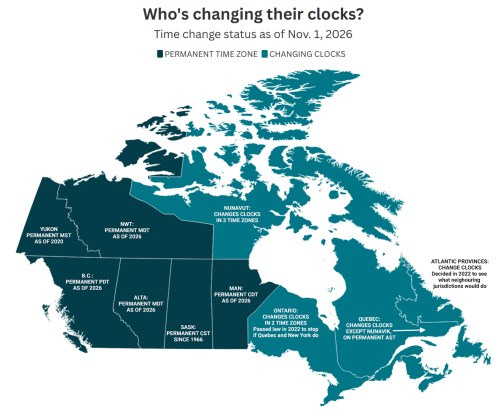
WINNIPEG - Manitoba's government said Thursday the province will be sticking with daylight time year-round, making it the latest jurisdiction to move away from twice-annual time changes. Here's a look at where things stand across Canada:

British Columbia said in March that it was moving to permanent Pacific daylight time. The change also means that parts of northeastern B.C., which have been on mountain standard time year round, are now in alignment with the rest of the province.

Alberta also switched to permanent daylight time this year in what it calls Alberta time. The change means it now has the same time as Saskatchewan year round.

Saskatchewan has been on permanent central standard time since 1966.

Read
Updated: Yesterday at 6:28 AM CDT

Kinew delivered what most of us wanted; now we’ll have to deal with the consequences

Dan Lett 5 minute read Preview

Kinew delivered what most of us wanted; now we’ll have to deal with the consequences

Dan Lett 5 minute read Updated: Yesterday at 8:43 AM CDT

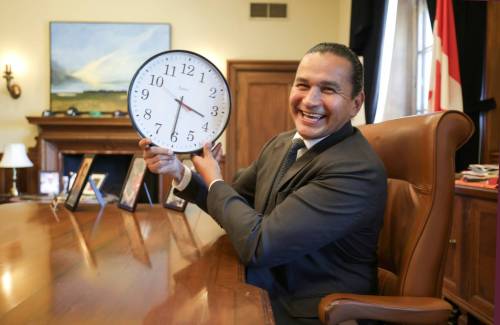
Premier Wab Kinew has decided to adopt permanent daylight savings time, which means a permanent end to the spring forward, fall back tradition of adjusting our clocks. And absolutely no one is surprised.

Read
Updated: Yesterday at 8:43 AM CDT

Puzzles Palace

1 minute read Monday, Jul. 27, 2026

To solve our puzzles, please subscribe with this special offer: |

Give-and-take relationship of Roman leaders takes centre stage in Harris’s historical fiction

Reviewed by Kathryne Cardwell 4 minute read Preview

Give-and-take relationship of Roman leaders takes centre stage in Harris’s historical fiction

Reviewed by Kathryne Cardwell 4 minute read 2:01 AM CDT

British novelist Robert Harris’s latest work is a reflection on tyranny, corruption and betrayal among all-powerful political leaders.

You might be forgiven for thinking it’s a contemporary thriller — it’s actually historical fiction set in ancient Rome.

A former BBC journalist, Harris debuted as a novelist in 1992 with Fatherland, an alternative history where Nazi Germany won the Second World War.

Since then, the prolific author has become best-known for his works of historical fiction, especially his ancient Rome trilogy released from 2006-2015 and the novel Conclave, which was published in 2016 and was made into the film of the same name in 2024.

Read
2:01 AM CDT

Siloam Mission, WFPS discussing on-site paramedic to reduce staggering number of emergency calls

Scott Billeck 4 minute read Preview

Siloam Mission, WFPS discussing on-site paramedic to reduce staggering number of emergency calls

Scott Billeck 4 minute read Yesterday at 2:00 AM CDT

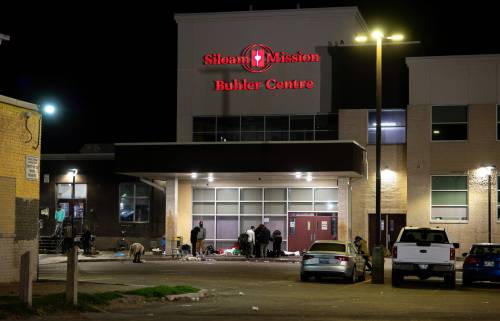
Winnipeg’s fire-paramedic service and its largest homeless-serving organization are discussing what it would look like to station at least one paramedic at Siloam Mission, as emergency calls to the downtown facility surge.

The ongoing discussions come as Winnipeg Fire Paramedic Service crews were dispatched 1,771 times during the first eight months of the year to the two adjacent Siloam properties at 303 Stanley St. and 300 Princess St.

WFPS said most of the calls were related to overdoses or other consequences of substance use, with the total nearly double the 854 calls recorded over the same period last year. By comparison, there were 831 calls during the same span in 2024, and 591 in 2023.

“The number of emergency calls isn’t sustainable for us as a service, but it’s certainly not sustainable for them as an agency trying to provide services,” WFPS chief Ryan Sneath told the Free Press. “And they recognize that they’re impacting emergency services, not them specifically, but the site in a significant way.”

Read
Yesterday at 2:00 AM CDT