‘Truth, justice and healing:’ Métis and Inuit delegates meet with Pope Francis

Advertisement

Advertise with us

ROME - Angie Crerar says she was nervous when she walked into a room at the Vatican and came face to face with Pope Francis.

Read this article for free:


or

Already have an account? Log in here »

To continue reading, please subscribe:

Subscribe and receive a limited-edition Free Press branded hat or tote.

Digital Subscription

One year of digital access for only $205*

  • Enjoy unlimited reading on winnipegfreepress.com
  • Read the E-Edition, our digital replica newspaper
  • Access News Break, our award-winning app
  • Play interactive puzzles

*First annual payment billed as $205.00 + GST for one year. This annual subscription will automatically renew at $233.00 + GST every 52 weeks (10% off the regular annual price of $259.35). Offer available to new and qualified returning subscribers only. Cancel any time.

To continue reading, please subscribe:

Add Free Press access to your Brandon Sun subscription for only an additional

$1 for the first 4 weeks*

  • Enjoy unlimited reading on winnipegfreepress.com
  • Read the E-Edition, our digital replica newspaper
  • Access News Break, our award-winning app
  • Play interactive puzzles
Start now

*Your next Brandon Sun subscription payment will increase by $1.00 and you will be charged $17.95 plus GST for four weeks. After four weeks, your payment will increase to $24.95 plus GST every four weeks.

Hey there, time traveller!
This article was published 28/03/2022 (1636 days ago), so information in it may no longer be current.

ROME – Angie Crerar says she was nervous when she walked into a room at the Vatican and came face to face with Pope Francis.

But she left feeling empowered.

The 85-year-old Métis elder knew when she was in a residential school as a child that what was happening wasn’t right. She wanted to tell the person in charge — the one at the top. Now, almost 80 years later, she has.
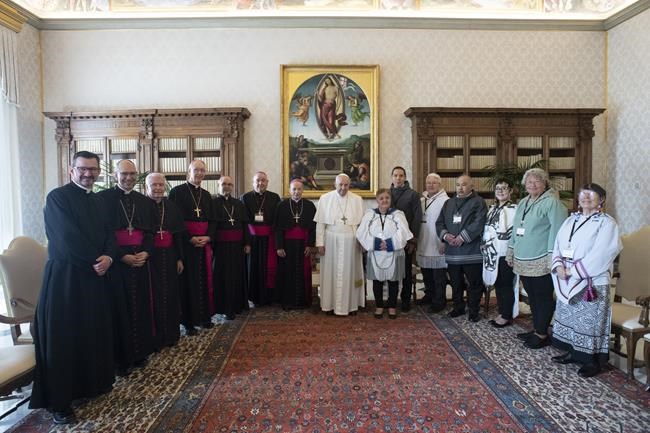
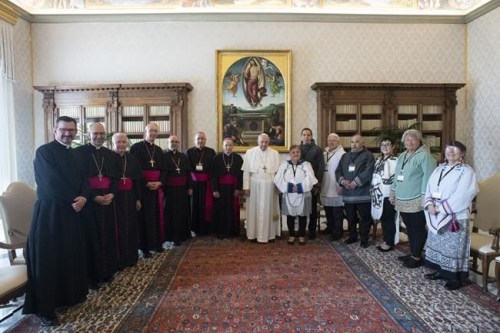
Pope Francis meets with the Canadian Metis delegates at the Vatican, Monday March 28, 2022. THE CANADIAN PRESS/HO-Vatican Media **MANDATORY CREDIT**

“They did not break us. We are still here and we intend to live here forever,” said Crerar, who is from Grande Prairie, Alta.

Métis and Inuit residential school survivors and leaders had meetings with the head of the Roman Catholic Church at the Vatican on Monday.

The weight of the historic moment was palpable to many. Delegates spoke about wanting the Pope to truly hear their stories and understand how they’ve been shaped by the legacy left by the Catholic Church and colonialism.

Inuit residential school survivor Martha Greig said she told the Pope there is a need to heal. That means working toward forgiveness, which she says the church must play a role in. If Pope Francis came to Canada to deliver an apology, it would mean a lot to survivors and their families, she said.

“If you don’t forgive, it eats at you, though you don’t forget,” Grieg said.

Those who met with the Pope on Monday said justice, transparency and an apology are even more important now that unmarked graves have been found at former residential schools across Canada.

The pontiff did not offer an apology to either group of delegates.

Cassidy Caron, president of the Métis National Council, said she feels Francis committed to a journey of justice.

“He repeated ‘truth, justice and healing’ and I take that as a personal commitment,” Caron said outside St. Peter’s Square.

The Métis have always requested that any apology take place on Canadian soil, she added.

Eight Métis delegates spent an hour with the pontiff and three survivors shared their stories of residential schools.

The group presented the Pope with a pair of red, beaded moccasins as a sign of the Métis people’s willingness to forgive if there is meaningful action. The red represents the traditional red papal shoes, the group explained, and the Pope walks with the legacy of those who came before him — including the terrible parts.

Pixie Wells, president of the Fraser Valley Métis Association in B.C., said she was proud to be a two-spirit person in the room with the Pope. She said that homophobia is directly connected to colonization and residential schools.

“We are bringing back that cultural component of being a two-spirit individual,” Wells said. “We were leaders, healers in our communities … that was my power in that room for every other two-spirit person.”

The eight Inuit delegates presented Francis with a stole, which is a liturgical vestment, and a rosary case, both made of seal skin. They also provided him with two carvings and some personal messages.
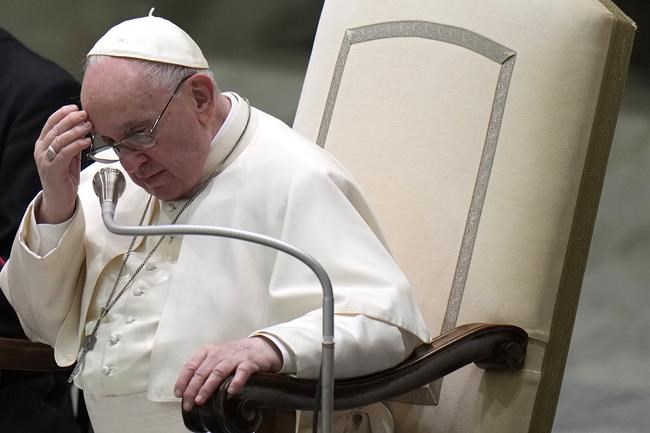
Pope Francis gestures, during his weekly general audience in the Paul VI Hall, at the Vatican, Wednesday, March 23, 2022. Métis and Inuit delegates are set to speak with Pope Francis at the Vatican in two separate meetings today.THE CANADIAN PRESS/AP/Alessandra Tarantino

Natan Obed, president of Inuit Tapiriit Kanatami, specifically asked the Pope to intervene in the case of an Oblate priest, Johannes Rivoire, who continues to live free in France despite multiple allegations of sexual abuse linked to his time in Nunavut.

“We ask that the Pope speak with Father Rivoire directly and ask him to go to Canada to face the charges he is up on in Canada,” Obed said.

Obed asked the Pope to request that France step in if Rivoire is not receptive

Obed said he wants the relationship with the Catholic Church to be based on action, and that includes seeing members of the church brought to justice if they have done harm.

There were also positive conversations about the role of the church moving forward, he said.

“There was a true sense of openness and kindness that was showed to us.”

First Nations delegates are to meet with the pontiff on Thursday. All three groups are to gather with the Pope on Friday.

An estimated 150,000 Indigenous children were forced to attend residential schools, more than 60 per cent of which were run by the Catholic Church.

A total of 32 Indigenous elders, leaders, survivors and youth are taking part in the Vatican meetings. The Canadian Conference of Catholic Bishops, which organized and is paying for the delegation, has also sent a handful of members.

Bishop William McGrattan, vice-president of the bishops, said the meetings are “just the beginning” and are important so that Pope Francis can hear first-hand the impacts of residential schools.

“We are not just doing this for now. We are doing it for generations to come,” he said.

This report by The Canadian Press was first published March 28, 2022.

Report Error Submit a Tip

The Free Press acknowledges the financial support it receives from members of the city’s faith community, which makes our coverage of religion possible.

More Stories

Jets GM insists club’s not working under any deadline in netminder’s trade request

Mike McIntyre 7 minute read Preview

Jets GM insists club’s not working under any deadline in netminder’s trade request

Mike McIntyre 7 minute read Thursday, Sep. 17, 2026

Connor Hellebuyck and his family were subject to so much post-Olympic vitriol that both the Winnipeg Jets security team and even police had to get involved.

Read
Thursday, Sep. 17, 2026

Cabernet Sauvignon star of wine festival

Ben Sigurdson 5 minute read Preview

Cabernet Sauvignon star of wine festival

Ben Sigurdson 5 minute read 3:00 AM CDT

The Winnipeg Wine Festival will celebrate the king of red wine grapes next weekend — the theme of this year’s festival, which takes place Sept. 25 and 26 at the RBC Convention Centre, is Cabernet Sauvignon.

Cab Sauv, as it’s also known, is the world’s most widely planted wine grape of any colour, first coming to prominence in the 1800s in France’s Bordeaux region, where the grape is still popular. Rather than single-variety wines, Bordeaux reds tend to be blends, with those coming from the left bank of the Gironde estuary being Cabernet-dominant, while right-bank wines are Merlot-dominant, with Cabernet Sauvignon playing a supporting role. Cabernet and Merlot work well together and many other countries have followed suit in blending the two.

A team at University of California Davis put Cabernet Sauvignon through a DNA test in 1996 and discovered its parent grapes are Cabernet Franc and Sauvignon Blanc — it’s likely that at some point the two varieties, planted next to each other in some vineyard, crossed and mutated and became the grape we know today. (Someone growing grapes in the 19th century must have had an inkling of what was up, as the grape has been called Cabernet Sauvignon since long before the DNA test.)

Flavour-wise, most Cabernet Sauvignon wines are big and bold, with a core of deep dark berry flavours, some graphite and spice notes and relatively bright acidity. It’s a grape that is well-suited to barrel aging, with most examples seeing at least some time in wood.

Read
3:00 AM CDT

Canada-U.S. trade relationship is broken, but the damage can — and will — be repaired

Tom Brodbeck 5 minute read Preview

Canada-U.S. trade relationship is broken, but the damage can — and will — be repaired

Tom Brodbeck 5 minute read Thursday, Sep. 17, 2026

Canada needs to get serious about diversifying its trade beyond the United States. But at the same time, Canadians should expect relations with the U.S. to normalize after Donald Trump is no longer in the White House.

For generations, Canada-U.S. trade was considered almost a fact of geography. The two countries share the world’s longest undefended border, deeply integrated supply chains and a century of commercial relationships.

Canadian manufacturers depend on American customers. American manufacturers depend on Canadian suppliers. Energy, agriculture, automotive production and countless other industries operate across the border as though it barely exists.

That isn’t going to change dramatically, even in the midst of a bitter trade war unleashed by the U.S. president.

Read
Thursday, Sep. 17, 2026

Métis, Inuit delegates meet with Pope Francis

Kelly Geraldine Malone, The Canadian Press 5 minute read Preview

Métis, Inuit delegates meet with Pope Francis

Kelly Geraldine Malone, The Canadian Press 5 minute read Monday, Mar. 28, 2022

ROME - Angie Crerar says she was nervous when she walked into a room at the Vatican and came face to face with Pope Francis.

But she left feeling empowered.

The 85-year-old Métis elder knew when she was in a residential school as a child that what was happening wasn’t right. She wanted to tell the person in charge — the one at the top. Now, almost 80 years later, she has.

"They did not break us. We are still here and we intend to live here forever," said Crerar, who is from Grande Prairie, Alta.

Read
Monday, Mar. 28, 2022

United Way, other charities fight for dollars as donor base shrinks

Scott Billeck 8 minute read Preview

United Way, other charities fight for dollars as donor base shrinks

Scott Billeck 8 minute read Yesterday at 2:00 AM CDT

Winnipeg’s charitable sector is being squeezed from both sides: demand for help is growing while the pool of donors to meet that need is shrinking.

The imbalance is increasingly being carried by a relatively small group of deep-pocketed donors. Last year, 600 people — about three per cent of United Way Winnipeg’s individual donors — accounted for roughly $8 million, or 55 per cent of individual donations.

The fundraising pitch isn’t getting any easier.

Homelessness and public drug use have become increasingly visible, household budgets remain strained and the problems charities are trying to address can seem so entrenched that donors may reasonably wonder what difference another contribution can make.

Read
Yesterday at 2:00 AM CDT

Canada must not accept another Iranian autocracy

David Matas 5 minute read 2:01 AM CDT

Iran is a state run by a radical government victimizing its citizens and its neighbours. How do we change that? Any regime change that repeats the mistakes of the past is not a solution.

What went wrong in the past which led to the current regime? One answer is the U.K. and American aided coup which led to the ouster in 1953 of a democratically elected government headed at the time by Mohammad Mossadegh and its replacement with an American friendly autocrat, the Shah of Iran, Mohammad Reza Pahlavi.

The Shah imposed his rule through the Iranian National Intelligence and Security Organization — SAVAK, the acronym of its Persian name. SAVAK systematically inflicted torture, arbitrary killings and extra-judicial killings on perceived opponents of the regime. It was only a matter of time before repression of a regime directed to serving foreign interests would be overthrown.

What replaced the regime of the Shah, in 1979, the current regime of the mullahs, is a regime as intolerant and violent as the regime of the Shah and then some. That was not inevitable. But neither was it surprising. The vicious nature of the current regime, following the example set by the Shah, and its hatred for the United States, reacting to the U.S. aided imposition of the Shah, both echoes and reacts to the past. In 1979, the U.S. reaped what it sowed in 1953.