
Agency ruling delivers big setback to Okefenokee mining plan

Advertisement

Advertise with us

SAVANNAH, Ga. (AP) — A federal agency has delivered a big setback to a company's controversial plan to mine near the edge of the Okefenokee Swamp and its vast wildlife refuge.

Read this article for free:


or

Already have an account? Log in here »

To continue reading, please subscribe:

Subscribe and receive a limited-edition Free Press branded hat or tote.

Digital Subscription

One year of digital access for only $205*

  • Enjoy unlimited reading on winnipegfreepress.com
  • Read the E-Edition, our digital replica newspaper
  • Access News Break, our award-winning app
  • Play interactive puzzles

*First annual payment billed as $205.00 + GST for one year. This annual subscription will automatically renew at $233.00 + GST every 52 weeks (10% off the regular annual price of $259.35). Offer available to new and qualified returning subscribers only. Cancel any time.

To continue reading, please subscribe:

Add Free Press access to your Brandon Sun subscription for only an additional

$1 for the first 4 weeks*

  • Enjoy unlimited reading on winnipegfreepress.com
  • Read the E-Edition, our digital replica newspaper
  • Access News Break, our award-winning app
  • Play interactive puzzles
Start now

*Your next Brandon Sun subscription payment will increase by $1.00 and you will be charged $17.95 plus GST for four weeks. After four weeks, your payment will increase to $24.95 plus GST every four weeks.

Hey there, time traveller!
This article was published 03/06/2022 (1569 days ago), so information in it may no longer be current.

SAVANNAH, Ga. (AP) — A federal agency has delivered a big setback to a company’s controversial plan to mine near the edge of the Okefenokee Swamp and its vast wildlife refuge.

A government memo said Friday that the Army Corps of Engineers is reasserting jurisdiction over Twin Pines Minerals’ proposal to mine minerals just outside the Okefenokee, home to the largest U.S. wildlife refuge east of the Mississippi River.

Scientists have warned that mining close to the swamp’s bowl-like rim could damage its ability to hold water. They urged the Army Corps of Engineers to deny the project a permit. But the agency declared in 2020 it no longer had that authority after regulatory rollbacks under then-President Donald Trump narrowed the types of waterways qualifying for protection under the Clean Water Act.
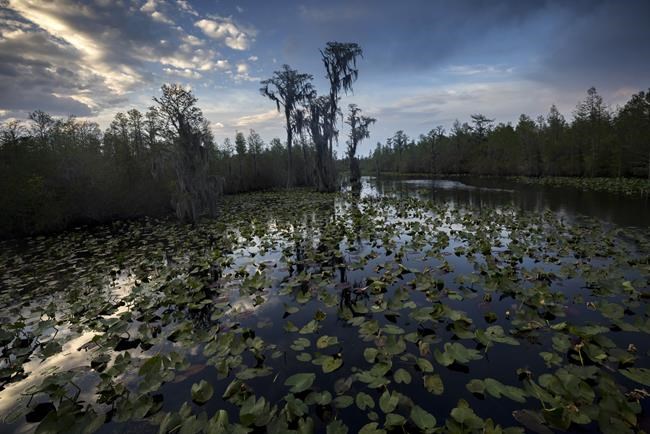
FILE - The sun sets over water lilies and cypress trees along the remote Red Trail wilderness water trail of Okefenokee National Wildlife Refuge, Wednesday, April 6, 2022, in Fargo, Ga. The refuge is one of the world's largest intact freshwater ecosystems and averages 300,000 visitors a year and 4,000 visitors permitted for overnight camping along trails such as this. According to a government memo, Friday, June 3, 2022, a federal agency has delivered a big setback to a company's controversial plan to mine at the edge of the Okefenokee Swamp's vast wildlife refuge. (AP Photo/Stephen B. Morton, File)

Trump’s rollbacks were later scrapped by federal courts. President Joe Biden’s administration has sought to restore federal oversight of development projects that under Trump had been allowed to sidestep regulations to prevent pollution of streams or draining of wetlands.

Michael Connor, the assistant Army secretary for civil works, said in the Friday memo that prior decisions waiving the Army Corps’ jurisdiction over the Georgia mining plan and another proposed mine outside Tucson, Arizona, had been reversed.

Connor wrote that both projects would have to start over with new applications for federal permits. He said the prior decisions allowing them to bypass federal regulators “are not valid” because tribal governments with ancestral ties to the proposed mining sites had not been consulted.

The Twin Pines project in Georgia will require consultation with the Muscogee Creek Nation before it can move forward, the memo said.

“We have said from the day we announced our plans that we would follow the regulations before us at any given time,” Steve Ingle, president of Twin Pines, said in a statement. He added: “We intend to move forward with our application and fulfill all requirements.”

U.S. Sen. Jon Ossoff, a Georgia Democrat who has fought the proposed mine outside the Okefenokee since he took office last year, called the decision a major victory.

“I am pleased to announce the restoration of protection for this wildlife refuge and its surrounding wetlands,” Ossoff said in a statement late Friday. “The Okefenokee is a natural wonder and one of Georgia’s most precious lands. I will continue fighting to protect it for future generations.”

Alabama-based Twin Pines had been awaiting a permitting decision by Georgia’s Environmental Protection Division, the sole regulator with oversight over the project before the federal government’s Friday decision, which restores the Army Corps regulatory authority over 556 acres (225 hectares) of wetlands in the proposed mining area.

The Okefenokee National Wildlife Refuge covers nearly 630 square miles (1,630 square kilometers) in southeast Georgia and is home to alligators, bald eagles and other protected species. The swamp’s wildlife, cypress forests and flooded prairies draw roughly 600,000 visitors each year, according to the U.S. Fish and Wildlife Service, which manages the refuge.

Two decades ago, chemical giant DuPont retreated from plans to mine outside the Okefenokee after meeting fierce resistance. Twin Pines wants permits to mine a small fraction of the acreage DuPont pursued. Ingle has insisted his company can mine the site without harming the swamp.

Government scientists have been skeptical. In February 2019, the Fish and Wildlife Service wrote that the proposed mine could pose “substantial risks” to the swamp, including its ability to hold water. Some impacts, it said, “may not be able to be reversed, repaired, or mitigated for.”

Conservation groups cheered the federal government’s decision.

“Mining on the doorstep of a rare ecological treasure like Georgia’s Okefenokee Swamp defies common sense,” Kelly Moser, an attorney for the Southern Environmental Law Center who specializes in clean water issues, said in a statement. “And we are thrilled that this announcement removes the threat to hundreds of acres of critically important wetlands.”

Report Error Submit a Tip

More Stories

Not falling back means time loop remains unclosed

Jen Zoratti 4 minute read 2:01 AM CDT

I demand restitution. Where’s my hour?

In the traditional fall-back, spring-forward time change set up — you know, ol’ trusty that’s been effect for lo these 63 years — we lost an hour in the spring that we got back in the fall.

That was the social contract: you commit to feeling like you’re on cold medication for a week in March because you know a glorious extra hour of sleep will be returned to you in November. (Unless, of course, you have little kids, but look: we all make our choices.)

Well, that transaction, flawed as it was, isn’t happening this year. That hour you sacrificed to the sun gods in the spring? Gone. Not coming back. We’ve sprung forward and we shan’t be falling back — not in November, and (possibly) not ever. The scale shall remain unbalanced and the loop shall remain unclosed as Manitoba has adopted permanent daylight time.

Puzzles Palace

1 minute read Monday, Jul. 27, 2026

To solve our puzzles, please subscribe with this special offer: |

Siloam Mission, WFPS discussing on-site paramedic to reduce staggering number of emergency calls

Scott Billeck 4 minute read Preview

Siloam Mission, WFPS discussing on-site paramedic to reduce staggering number of emergency calls

Scott Billeck 4 minute read Yesterday at 2:00 AM CDT

Winnipeg’s fire-paramedic service and its largest homeless-serving organization are discussing what it would look like to station at least one paramedic at Siloam Mission, as emergency calls to the downtown facility surge.

The ongoing discussions come as Winnipeg Fire Paramedic Service crews were dispatched 1,771 times during the first eight months of the year to the two adjacent Siloam properties at 303 Stanley St. and 300 Princess St.

WFPS said most of the calls were related to overdoses or other consequences of substance use, with the total nearly double the 854 calls recorded over the same period last year. By comparison, there were 831 calls during the same span in 2024, and 591 in 2023.

“The number of emergency calls isn’t sustainable for us as a service, but it’s certainly not sustainable for them as an agency trying to provide services,” WFPS chief Ryan Sneath told the Free Press. “And they recognize that they’re impacting emergency services, not them specifically, but the site in a significant way.”

Read
Yesterday at 2:00 AM CDT

A Winnipeg lawyer has been disbarred after admitting to six counts of professional misconduct and two counts of providing incompetent service involving eight clients.

The career-ending decision marks the sixth time Gisele Champagne has been disciplined by the Law Society of Manitoba since she was called to the bar in 1992.

“Disbarment is the appropriate remedy when a lawyer has demonstrated a repeated pattern of conduct that violates professional standards,” a law society panel said in a written decision released Wednesday.

“A lawyer who has been unable to learn from past discipline proceedings to fulfill his or her obligation to provide ethical and high-quality legal services must at some point lose the privilege of practising law.”

Canada must not accept another Iranian autocracy

David Matas 5 minute read 2:01 AM CDT

Iran is a state run by a radical government victimizing its citizens and its neighbours. How do we change that? Any regime change that repeats the mistakes of the past is not a solution.

What went wrong in the past which led to the current regime? One answer is the U.K. and American aided coup which led to the ouster in 1953 of a democratically elected government headed at the time by Mohammad Mossadegh and its replacement with an American friendly autocrat, the Shah of Iran, Mohammad Reza Pahlavi.

The Shah imposed his rule through the Iranian National Intelligence and Security Organization — SAVAK, the acronym of its Persian name. SAVAK systematically inflicted torture, arbitrary killings and extra-judicial killings on perceived opponents of the regime. It was only a matter of time before repression of a regime directed to serving foreign interests would be overthrown.

What replaced the regime of the Shah, in 1979, the current regime of the mullahs, is a regime as intolerant and violent as the regime of the Shah and then some. That was not inevitable. But neither was it surprising. The vicious nature of the current regime, following the example set by the Shah, and its hatred for the United States, reacting to the U.S. aided imposition of the Shah, both echoes and reacts to the past. In 1979, the U.S. reaped what it sowed in 1953.

American Hostage stars recall warmth of Winnipeggers during brutal winter

Randall King 7 minute read Preview

American Hostage stars recall warmth of Winnipeggers during brutal winter

Randall King 7 minute read Yesterday at 6:13 PM CDT

TORONTO — When you stream the eight-part series American Hostage, a sense of familiarity may strike.

That’s because the show was shot in Winnipeg — especially in the Exchange District — from November of last year to the beginning of February, with Winnipeg portraying Indianapolis circa 1977.

The whole world seemed to be watching that midwest American city that year as a hostage crisis unfolded involving one Tony Kiritsis, an angry man who goes ballistic when a mortgage brokerage was poised to foreclose on property he had dreamed of developing into a shopping centre.

Kiritsis kidnapped his mortgage broker, Richard Hall, wiring a shotgun to the back of his head, and demanded a public airing of his grievances, with the reluctant help of popular radio broadcaster Fred Heckman.

Read
Yesterday at 6:13 PM CDT