First Nations blast Alberta Energy Regulator at hearing; Guibeault promises reform

Advertisement

Advertise with us

OTTAWA - Chiefs of First Nations affected by releases of wastewater from an oilsands mine excoriated Alberta's regulator at a House of Commons committee hearing, calling it a system that serves theindustry and not the public.

Read this article for free:


or

Already have an account? Log in here »

To continue reading, please subscribe:

Subscribe and receive a limited-edition Free Press branded hat or tote.

Digital Subscription

One year of digital access for only $205*

  • Enjoy unlimited reading on winnipegfreepress.com
  • Read the E-Edition, our digital replica newspaper
  • Access News Break, our award-winning app
  • Play interactive puzzles

*First annual payment billed as $205.00 + GST for one year. This annual subscription will automatically renew at $233.00 + GST every 52 weeks (10% off the regular annual price of $259.35). Offer available to new and qualified returning subscribers only. Cancel any time.

To continue reading, please subscribe:

Add Free Press access to your Brandon Sun subscription for only an additional

$1 for the first 4 weeks*

  • Enjoy unlimited reading on winnipegfreepress.com
  • Read the E-Edition, our digital replica newspaper
  • Access News Break, our award-winning app
  • Play interactive puzzles
Start now

*Your next Brandon Sun subscription payment will increase by $1.00 and you will be charged $17.95 plus GST for four weeks. After four weeks, your payment will increase to $24.95 plus GST every four weeks.

Hey there, time traveller!
This article was published 17/04/2023 (1253 days ago), so information in it may no longer be current.

OTTAWA – Chiefs of First Nations affected by releases of wastewater from an oilsands mine excoriated Alberta’s regulator at a House of Commons committee hearing, calling it a system that serves theindustry and not the public.

“The (Alberta Energy Regulator) has zero credibility outside Calgary’s echo chamber,” Daniel Stuckless of the Fort McKay Métis Nation said in Ottawa on Monday.

“They actively dismiss and downplay impacts of oilsands on communities and their aboriginal and treaty rights.”
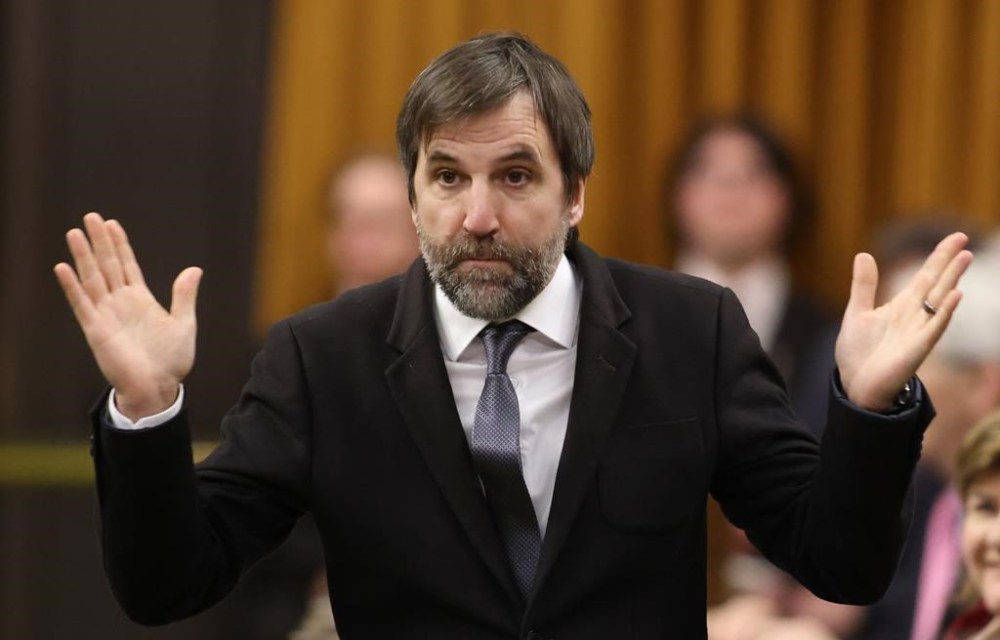
Minister of Environment and Climate Change Steven Guilbeault rises during Question Period in the House of Commons on Parliament Hill in Ottawa on Tuesday, February 14, 2023. Guilbeault is taking the first step towards an improved reporting process for environmental emergencies following a leak of wastewater from an oilsands mine in Alberta that wasn't made public for nine months. THE ;CANADIAN PRESS/ Patrick Doyle

Chief Allan Adam of the Athabasca Chipewyan First Nation went further outside the committee room.

“The Alberta system, when it comes to the Alberta regulator, is completely broken and should be dismantled,” he said.

Ottawa shares culpability by failing to enforce environmental laws, he added.

“While Alberta bears much of the blame, Canada must also shoulder responsibility for what has happened,” Adam said.

The comments came as the House of Commons environment and sustainability committee held hearings to examine why it took nine months for First Nations and governments to find out what was happening with both tailings pond seepage and overflow from a containment pond at Imperial Oil’s Kearl mine.

But the six First Nations leaders who addressed the committee quickly insisted their concerns go much deeper than a single case.

“Alberta’s reaction throughout is to simply say this is a communications issue,” said Adam, who broke down in tears describing what it was like telling his people their water may be contaminated.

“The Alberta Energy Regulator is a joke. A complete joke.”

The hearing was struck after two releases of toxic oilsands tailings water from the Kearl mine north of Fort McMurray.

The first release was spotted and reported in May as discoloured water near a tailings pond. It was found to be tailings seepage, but no further updates were provided to area First Nations until February. That’s when it was disclosed to the public and federal and provincial environment ministers, along with news of a second release of 5.3 million litres of tailings-contaminated water.

On Monday, leader after leader said the problem is much deeper than a single delayed notification.

“There’s a question around the neutrality of the regulator in Alberta,” said Russell Noseworthy of the Fort McMurray Métis.

Timothy Clark, who is also working with the Fort McMurray Métis, said the regulator “is more concerned about protecting the image of the industry and the investment than it is about protecting the health and rights of the people who live in this area.”

Melody Lepine of the Mikisew Cree First Nation said both Alberta and Ottawa have long ignored community requests for a comprehensive health assessment of people in Fort Chipewyan. Nor have governments acted on calls for an assessment of the cumulative impacts of all oilsands development or for a risk assessment posed by the tailings ponds, Lepine said.

The Alberta Energy Regulator did not immediately respond to a request for comment.

Laurie Pushor, head of the regulator, is scheduled to testify Thursday. Imperial Oil officials are expected next Monday.

Just before the hearings began, Environment Minister Steven Guilbeault, announced the first step towards an improved reporting process for environmental emergencies.

Guilbeault said the committee testimony should help inform efforts of the new “notification and monitoring working group” to help design a better reporting system for the future.

The group is to be made up of representatives from federal and provincial governments, the Northwest Territories and Indigenous communities affected by the releases.

Jennifer Lash, a senior adviser to Guilbeault, said the goal of the working group is to develop a way to fix the notification process when something goes wrong, as well as to address ongoing concerns about the possibility of seepage from all oilsands tailings ponds, not just from Kearl.

Lash said a letter was sent Monday to invite any Indigenous Nations in the affected areas to participate. She said the government is not being prescriptive about what the new policy would look like. The hope is that the working group will be running within two months.

She said the N.W. T. government has agreed to join and the government of Alberta has responded positively but not fully confirmed participation.

Meanwhile, the Alberta government defended its communication with First Nations after the Kearl releases.

It says it began sharing information about the issue both internally and publicly by the week of Feb. 27, about three weeks after the regulator revealed the problem. Extra monitoring has begun and will be increased as the spring runoff begins.

An information-sharing group with federal, provincial, municipal and First Nations governments has been formed.

“Our current lab results from ongoing independent water sampling of Lake Athabasca show drinking water is safe,” department spokesman Miguel Racin said in an email.

This report by The Canadian Press was first published April 17, 2023.

— With files from Bob Weber in Edmonton

Note to readers: This is a corrected story; An earlier version had the incorrect spelling for Chief Allan Adam.
Report Error Submit a Tip

More Stories

A quick look at where provinces and territories stand on time changes

The Canadian Press 2 minute read Preview

A quick look at where provinces and territories stand on time changes

The Canadian Press 2 minute read Friday, Sep. 18, 2026

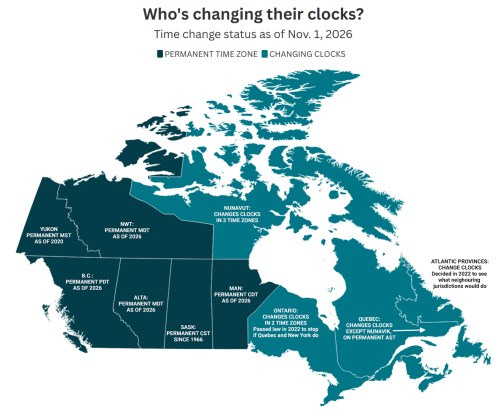
WINNIPEG - Manitoba's government said Thursday the province will be sticking with daylight time year-round, making it the latest jurisdiction to move away from twice-annual time changes. Here's a look at where things stand across Canada:

British Columbia said in March that it was moving to permanent Pacific daylight time. The change also means that parts of northeastern B.C., which have been on mountain standard time year round, are now in alignment with the rest of the province.

Alberta also switched to permanent daylight time this year in what it calls Alberta time. The change means it now has the same time as Saskatchewan year round.

Saskatchewan has been on permanent central standard time since 1966.

Read
Friday, Sep. 18, 2026

Transportation Safety Board investigating after two pilots found dead near Regina

The Canadian Press 1 minute read Preview

Transportation Safety Board investigating after two pilots found dead near Regina

The Canadian Press 1 minute read Updated: Yesterday at 4:41 PM CDT

REGINA - A Manitoba-based flying school and air taxi provider says two of its pilots were found dead near Regina on Friday.

Adam Penner, president of Harv's Air, says in a statement that two people were aboard the Cessna 172 on a night flight from Regina to Steinbach, Man.

Penner says a search began after the aircraft did not arrive on schedule, and the plane was found along with its two occupants on Friday evening near Kisbey, southeast of Regina.

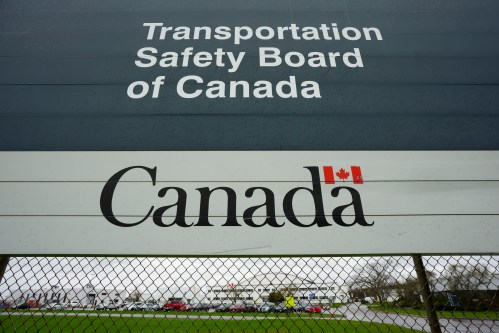
Harv's Air says it is shocked and saddened by the tragedy, and it is working with the Transportation Safety Board of Canada in determining the cause of the deaths.

Read
Updated: Yesterday at 4:41 PM CDT

News briefs for Sunday, September 20, 2026

2 minute read Updated: Yesterday at 3:36 PM CDT

A collection of breaking news briefs filed on Sunday, September 20, 2026

Woman charged after Toronto Street shooting

3:18 PM

The Winnipeg Police Service Major Crimes Unit is continuing to investigate a shooting in the 600 block of Toronto Street that took place around 1 a.m. on Friday.

American Hostage stars recall warmth of Winnipeggers during brutal winter

Randall King 7 minute read Preview

American Hostage stars recall warmth of Winnipeggers during brutal winter

Randall King 7 minute read Friday, Sep. 18, 2026

TORONTO — When you stream the eight-part series American Hostage, a sense of familiarity may strike.

That’s because the show was shot in Winnipeg — especially in the Exchange District — from November of last year to the beginning of February, with Winnipeg portraying Indianapolis circa 1977.

The whole world seemed to be watching that midwest American city that year as a hostage crisis unfolded involving one Tony Kiritsis, an angry man who goes ballistic when a mortgage brokerage was poised to foreclose on property he had dreamed of developing into a shopping centre.

Kiritsis kidnapped his mortgage broker, Richard Hall, wiring a shotgun to the back of his head, and demanded a public airing of his grievances, with the reluctant help of popular radio broadcaster Fred Heckman.

Read
Friday, Sep. 18, 2026

Elmwood–East Kildonan candidate promises to tackle ‘inefficiency’ in government

Gabrielle Piché 3 minute read Preview

Elmwood–East Kildonan candidate promises to tackle ‘inefficiency’ in government

Gabrielle Piché 3 minute read Saturday, Sep. 19, 2026

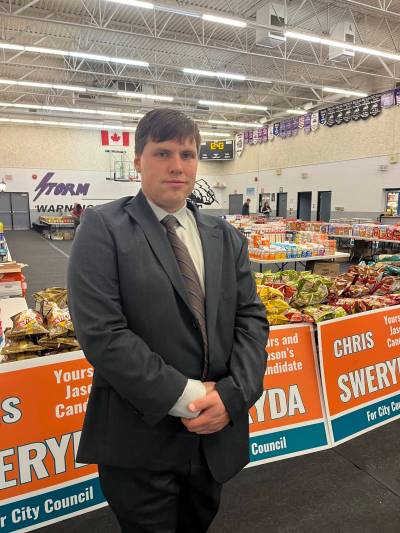
The former assistant of late Elmwood–East Kildonan councillor Jason Schreyer is again running for the seat.

Chris Sweryda officially launched his campaign Saturday. He did so with the backdrop of a grocery program he runs, where food is sold near-cost out of St. Gerard School’s gym.

Rows of cereal, pasta sauce and chips filled tables ahead of the program’s afternoon opening. Sweryda created the pop-up with Schreyer months ahead of the former councillor’s April 2025 death.

The program sees roughly 500 people each day it’s open (which is every other week on Saturday), Sweryda said.

Read
Saturday, Sep. 19, 2026

Cabernet Sauvignon star of wine festival

Ben Sigurdson 5 minute read Preview

Cabernet Sauvignon star of wine festival

Ben Sigurdson 5 minute read Saturday, Sep. 19, 2026

The Winnipeg Wine Festival will celebrate the king of red wine grapes next weekend — the theme of this year’s festival, which takes place Sept. 25 and 26 at the RBC Convention Centre, is Cabernet Sauvignon.

Cab Sauv, as it’s also known, is the world’s most widely planted wine grape of any colour, first coming to prominence in the 1800s in France’s Bordeaux region, where the grape is still popular. Rather than single-variety wines, Bordeaux reds tend to be blends, with those coming from the left bank of the Gironde estuary being Cabernet-dominant, while right-bank wines are Merlot-dominant, with Cabernet Sauvignon playing a supporting role. Cabernet and Merlot work well together and many other countries have followed suit in blending the two.

A team at University of California Davis put Cabernet Sauvignon through a DNA test in 1996 and discovered its parent grapes are Cabernet Franc and Sauvignon Blanc — it’s likely that at some point the two varieties, planted next to each other in some vineyard, crossed and mutated and became the grape we know today. (Someone growing grapes in the 19th century must have had an inkling of what was up, as the grape has been called Cabernet Sauvignon since long before the DNA test.)

Flavour-wise, most Cabernet Sauvignon wines are big and bold, with a core of deep dark berry flavours, some graphite and spice notes and relatively bright acidity. It’s a grape that is well-suited to barrel aging, with most examples seeing at least some time in wood.

Read
Saturday, Sep. 19, 2026