Seven in 10 Canadians worried about climate change, link it to extreme weather

Advertisement

Advertise with us

OTTAWA - A large majority of Canadians are worried about climate change and believe it is the reason for an increase in extreme weather, a new national poll suggests.

Read this article for free:


or

Already have an account? Log in here »

To continue reading, please subscribe:

Subscribe and receive a limited-edition Free Press branded hat or tote.

Digital Subscription

One year of digital access for only $205*

  • Enjoy unlimited reading on winnipegfreepress.com
  • Read the E-Edition, our digital replica newspaper
  • Access News Break, our award-winning app
  • Play interactive puzzles

*First annual payment billed as $205.00 + GST for one year. This annual subscription will automatically renew at $233.00 + GST every 52 weeks (10% off the regular annual price of $259.35). Offer available to new and qualified returning subscribers only. Cancel any time.

To continue reading, please subscribe:

Add Free Press access to your Brandon Sun subscription for only an additional

$1 for the first 4 weeks*

  • Enjoy unlimited reading on winnipegfreepress.com
  • Read the E-Edition, our digital replica newspaper
  • Access News Break, our award-winning app
  • Play interactive puzzles
Start now

*Your next Brandon Sun subscription payment will increase by $1.00 and you will be charged $17.95 plus GST for four weeks. After four weeks, your payment will increase to $24.95 plus GST every four weeks.

Hey there, time traveller!
This article was published 13/09/2023 (1121 days ago), so information in it may no longer be current.

Leger poll: Climate change

OTTAWA – A large majority of Canadians are worried about climate change and believe it is the reason for an increase in extreme weather, a new national poll suggests.

But the Leger poll says only a small fraction of people listed climate change as the top issue facing Canada today, and many say they’re only likely to change their behaviour if that doesn’t come with a cost.

The polling firm asked more than 1,500 people about their views on climate change in an online survey conducted between Sept. 8 and 10.
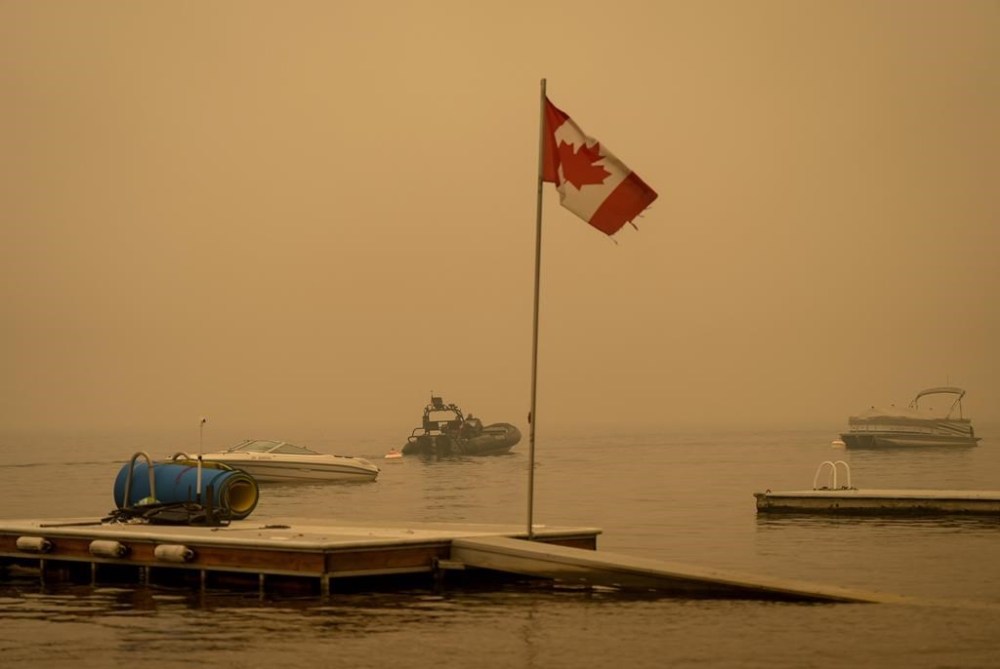
A large majority of Canadians are worried about climate change and believe it is behind an increase in extreme weather a new national poll suggests. Thick smoke from the Lower East Adams Lake wildfire fills the air and a Canadian flag flies in the wind as RCMP officers on a boat patrol Shuswap Lake, in Scotch Creek, B.C., on Sunday, August 20, 2023. THE CANADIAN PRESS/Darryl Dyck

The poll, which is weighted to account for demographic differences, can’t be assigned a margin of error because online surveys are not considered truly random samples.

It comes at the end of Canada’s worst wildfire season in history.

Globally, temperatures hit record highs in July, while Canadians in every province and much of the North were directly impacted by fires — if not from the blazes directly, then by the thick smoke from those fires that blanketed cities and towns thousands of kilometres away.

More than 100,000 people were forced to evacuate their homes between May and September and hundreds of homes burned, including about 200 in suburban Halifax in the spring, and almost as many in West Kelowna, B.C., in August.

Against that backdrop, 72 per cent of Canadians surveyed said they are worried or very worried about climate change and 21 per cent said they were not very worried. Only seven per cent said they weren’t worried about it at all.

Respondents from Quebec were most likely to be worried or very worried, at 84 per cent, while Albertans were the least likely to be worried, at 55 per cent.

Younger Canadians are more concerned about the climate than older Canadians, and women are more worried than men.

Pocketbook issues heavily outweighed climate change as a top-of-mind issue for Canadians in the poll, with only seven per cent of those surveyed listing climate change as the top issue facing the country.

The largest share — 33 per cent — said inflation is the top issue, 16 per cent chose housing affordability, and eight per cent pointed to rising interest rates.

Sixty-nine per cent of those surveyed said climate change is caused by human activity, while 21 per cent said they believe it’s just part of a natural pattern. More than 80 per cent of Quebec residents polled blame people for climate change, compared with 51 per cent in Alberta.

Almost three quarters of Canadians surveyed think extreme weather events are linked to climate change, and about two in three think we’re going to see more extreme weather in the future.

Sixty-one per cent of respondents said they have already changed some of their daily behaviour because of their concerns about climate change and 68 per cent said they planned to make changes to their daily life in the next five years.

However, only 40 per cent said they’d make changes to their daily lives if that comes with a cost.

Environmental activists have long argued Canadians need to be thinking not just about how much it costs to change our behaviour to slow climate change, but also how much it costs not to act.

Last spring, the federal government issued an updated analysis showing it costs Canada $261 this year for every tonne of greenhouse gas emissions emitted. Those costs include the impact of extreme weather on things like food production, human health and disaster-repair bills. The analysis suggested that by 2030, that cost will rise to $294 per tonne.

The most recent inventory showed Canada emitted about 670 million tonnes in 2021. The current target aims to reduce that by more than 230 million tonnes a year by 2030.

This report by The Canadian Press was first published Sept. 13, 2023.

History

Updated on Wednesday, September 13, 2023 10:10 AM CDT: Adds graphic

Report Error Submit a Tip

More Stories

Israeli election once again up for grabs

Allan Levine 5 minute read Preview

Israeli election once again up for grabs

Allan Levine 5 minute read 2:00 AM CDT

The next general election in Israel will be held on Oct. 27. Needless to say, like most elections in the country’s modern and fraught history since 1948, it is a critical contest between right and left, secular and orthodox, and left, moderate, right and extreme.

Also, given Israel’s complex proportional representative political system, which allocates a seat in its 120-seat Knesset (parliament) for winning only 3.25 per cent of the national vote, this election is nearly impossible to predict.

Even before 1948, Israelis’ ardent faith in democracy, their differing points of view and penchant for arguing led to the establishment of a multitude of political parties representing a smorgasbord of almost every conceivable position on the political spectrum.

Because no political party has ever won the 61 seats required to form a majority government, the major parties have frequently had to rely on fringe parties to hold power.

Read
2:00 AM CDT

Khan’s abrupt departure presents desperate Tories with a valuable opportunity

Tom Brodbeck 5 minute read Preview

Khan’s abrupt departure presents desperate Tories with a valuable opportunity

Tom Brodbeck 5 minute read Tuesday, Oct. 6, 2026

If the Manitoba Progressive Conservatives are serious about getting out of the political wilderness, they should start by electing a progressive conservative leader.

Read
Tuesday, Oct. 6, 2026

Police seize cocaine valued at $1.5M, about $750K in cash in raid on St. Vital house

Scott Billeck 5 minute read Preview

Police seize cocaine valued at $1.5M, about $750K in cash in raid on St. Vital house

Scott Billeck 5 minute read Tuesday, Oct. 6, 2026

A St. Vital homeowner and her husband were going about their business during an afternoon last month when police officers in tactical gear suddenly appeared, walking across their front lawn.

The target was a few doors down: a maroon bi-level home on a quiet stretch of Satinwood Place, within earshot of children playing outside at a nearby school.

The homeowner, who asked not to be named to protect their privacy, said the police presence caught the couple by surprise in the Southglen neighbourhood, where they weren’t accustomed to seeing that kind of activity.

“We never heard the (police) cars pull up, but there were cars blocking the entrance to the street from both sides,” said the neighbour. “They had a shield, a battering ram — everything. Just not used to seeing that.”

Read
Tuesday, Oct. 6, 2026

Permanent daylight time brings quirky NHL start times in Western Canada

Donna Spencer, The Canadian Press 5 minute read Preview

Permanent daylight time brings quirky NHL start times in Western Canada

Donna Spencer, The Canadian Press 5 minute read Updated: Yesterday at 2:19 PM CDT

Winnipeg's road schedule contains the odd nightcap for Jets fans, though, including a 10 p.m. game Feb. 13 against the Canucks and a 9:30 p.m. start Dec. 2 against the Utah Mammoth.

Read
Updated: Yesterday at 2:19 PM CDT

Alzheimer’s has sent my mother back in time

Pam Frampton 5 minute read Preview

Alzheimer’s has sent my mother back in time

Pam Frampton 5 minute read Yesterday at 2:01 AM CDT

My mother does a lot of time-travelling — time-shifting, the Alzheimer’s Society calls it.

Read
Yesterday at 2:01 AM CDT

Canadians worried about climate change, poll shows

Mia Rabson, The Canadian Press 4 minute read Preview

Canadians worried about climate change, poll shows

Mia Rabson, The Canadian Press 4 minute read Wednesday, Sep. 13, 2023

OTTAWA - A large majority of Canadians are worried about climate change and believe it is the reason for an increase in extreme weather, a new national poll suggests.

But the Leger poll says only a small fraction of people listed climate change as the top issue facing Canada today, and many say they're only likely to change their behaviour if that doesn't come with a cost.

The polling firm asked more than 1,500 people about their views on climate change in an online survey conducted between Sept. 8 and 10.

The poll, which is weighted to account for demographic differences, can't be assigned a margin of error because online surveys are not considered truly random samples.

Read
Wednesday, Sep. 13, 2023