Pacific storm that unleashed coastal flooding pushes across Southern California into Arizona
Advertisement
Read this article for free:
or
Already have an account? Log in here »
To continue reading, please subscribe:

Digital Subscription
One year of digital access for only $205*
- Enjoy unlimited reading on winnipegfreepress.com
- Read the E-Edition, our digital replica newspaper
- Access News Break, our award-winning app
- Play interactive puzzles
*First annual payment billed as $205.00 + GST for one year. This annual subscription will automatically renew at $233.00 + GST every 52 weeks (10% off the regular annual price of $259.35). Offer available to new and qualified returning subscribers only. Cancel any time.
To continue reading, please subscribe:
Add Free Press access to your Brandon Sun subscription for only an additional
$1 for the first 4 weeks*
- Enjoy unlimited reading on winnipegfreepress.com
- Read the E-Edition, our digital replica newspaper
- Access News Break, our award-winning app
- Play interactive puzzles
*Your next Brandon Sun subscription payment will increase by $1.00 and you will be charged $17.95 plus GST for four weeks. After four weeks, your payment will increase to $24.95 plus GST every four weeks.
Read unlimited articles for free today:
or
Already have an account? Log in here »
Hey there, time traveller!
This article was published 21/12/2023 (986 days ago), so information in it may no longer be current.
LOS ANGELES (AP) — Lightning crackled offshore as a blustery Pacific storm crossed the San Diego coast and pushed eastward through desert areas into Arizona early Friday after flooding communities northwest of Los Angeles.
As millions scrambled to finish holiday shopping or headed out onto highways, a swath of Southern California remained under a flood watch due to possible periods of more rain, but forecasters said there was much less storminess and the holiday weekend would be dry.
After slowly moving down the coast during the week, the brunt of the storm reached San Diego late Thursday. Just before midnight, a squall with gusts up to 55 mph (88.5 kph) dumped more than a half-inch (1.5 centimeters) of rain at Point Loma in 30 to 40 minutes, the National Weather Service said.
Rain also began arriving in southwest Arizona. The weather service’s Flagstaff office said the center of the low-pressure system was expected to move from southwest of San Diego to near Yuma by evening.
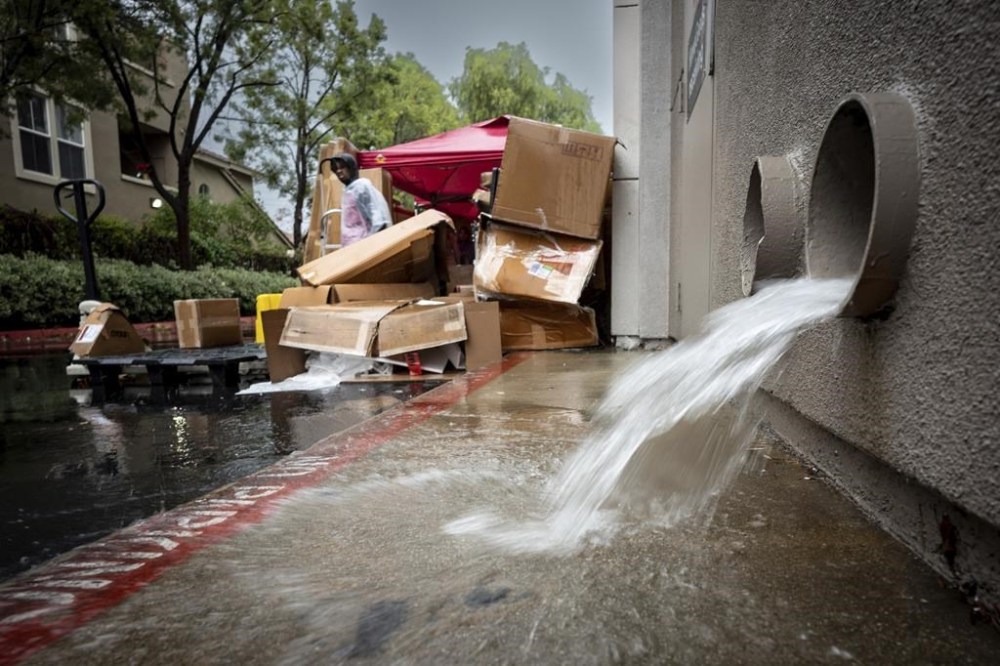
On Thursday, the storm unleashed extraordinary rainfall on coastal counties northwest of Los Angeles, flooding homes and stranding motorists on streets inundated with water.
Downpours swamped areas in the Ventura County cities of Port Hueneme and Oxnard, and about 35 miles (56 kilometers) up the coast in Santa Barbara County.
Between midnight and 1 a.m., the storm dumped 3.18 inches (8 centimeters) of rainfall in downtown Oxnard, surpassing the area’s average of 2.56 inches (6.5 centimeters) for the entire month of December, according to the National Weather Service.
“In Oxnard, particularly, overnight there were downpours that preliminary data suggests were probably the heaviest downpours ever observed in that part of Southern California,” climate scientist Daniel Swain, of the University of California, Los Angeles, said in an online briefing.
Sven Dybdahl, owner of olive oil and vinegar store Viva Oliva in downtown Santa Barbara, said he was grateful that the weather came at the tail end of the holiday shopping season, otherwise he’d be worried about his store’s bottom line.
“It will have an impact, but thankfully it’s happening quite late,” he said.
The storm swept through Northern California earlier in the week as the center of the low-pressure system slowly moved south off the coast. Forecasters described it as a “cutoff low,” a storm that is cut off from the general west-to-east flow and can linger for days, increasing the amount of rainfall.
On the central coast between Los Angeles and San Francisco, the storm dropped about 16 inches (41 centimeters) of rain at Rocky Butte in San Luis Obispo County, the weather service said.
Despite the storm’s prolific precipitation, it brought little snow to Southern California’s mountains, a condition also being experienced elsewhere in the country.
Winter weather advisories were to remain in effect until 4 a.m. Saturday but forecasters said there would be little, if any, accumulation below 7,500-foot (2,286-meter) elevations.
___
Associated Press reporters Stefanie Dazio and Christopher Weber in Los Angeles contributed to this report.