China lands a spacecraft on the moon’s far side to collect rocks for study

Advertisement

Advertise with us

BEIJING (AP) — A Chinese spacecraft landed on the far side of the moon Sunday to collect soil and rock samples that could provide insights into differences between the less-explored region and the better-known near side.

Read this article for free:


or

Already have an account? Log in here »

To continue reading, please subscribe:

Subscribe and receive a limited-edition Free Press branded hat or tote.

Digital Subscription

One year of digital access for only $205*

  • Enjoy unlimited reading on winnipegfreepress.com
  • Read the E-Edition, our digital replica newspaper
  • Access News Break, our award-winning app
  • Play interactive puzzles

*First annual payment billed as $205.00 + GST for one year. This annual subscription will automatically renew at $233.00 + GST every 52 weeks (10% off the regular annual price of $259.35). Offer available to new and qualified returning subscribers only. Cancel any time.

To continue reading, please subscribe:

Add Free Press access to your Brandon Sun subscription for only an additional

$1 for the first 4 weeks*

  • Enjoy unlimited reading on winnipegfreepress.com
  • Read the E-Edition, our digital replica newspaper
  • Access News Break, our award-winning app
  • Play interactive puzzles
Start now

*Your next Brandon Sun subscription payment will increase by $1.00 and you will be charged $17.95 plus GST for four weeks. After four weeks, your payment will increase to $24.95 plus GST every four weeks.

Hey there, time traveller!
This article was published 01/06/2024 (841 days ago), so information in it may no longer be current.

BEIJING (AP) — A Chinese spacecraft landed on the far side of the moon Sunday to collect soil and rock samples that could provide insights into differences between the less-explored region and the better-known near side.

The landing module touched down at 6:23 a.m. Beijing time in a huge crater known as the South Pole-Aitken Basin, the China National Space Administration said.

The mission is the sixth in the Chang’e moon exploration program, which is named after a Chinese moon goddess. It is the second designed to bring back samples, following the Chang’e 5, which did so from the near side in 2020.
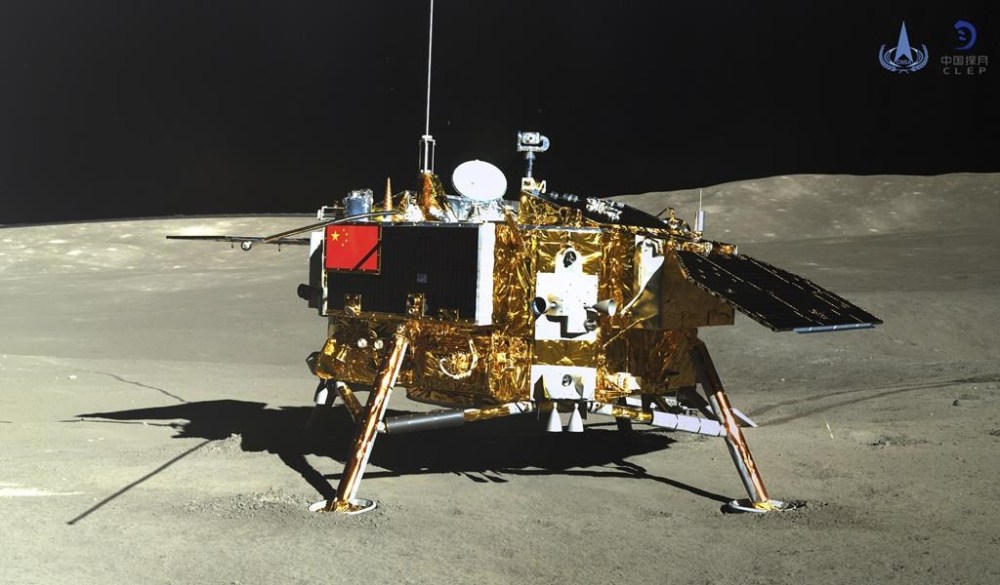
FILE - This photo provided on Jan. 12, 2019, by the China National Space Administration via Xinhua News Agency shows the lunar lander of the Chang'e-4 probe in a photo taken by the rover Yutu-2 on Jan. 11. China is preparing to launch a lunar probe Friday, May 3, 2024, that would land on the far side of the moon and return with samples that could provide insights into geological and other differences between the less-explored region and the better-known near side. (China National Space Administration/Xinhua News Agency via AP, File)

The moon program is part of a growing rivalry with the U.S. — still the leader in space exploration — and others, including Japan and India. China has put its own space station in orbit and regularly sends crews there.

The emerging global power aims to put a person on the moon before 2030, which would make it the second nation after the United States to do so. America is planning to land astronauts on the moon again — for the first time in more than 50 years — though NASA pushed the target date back to 2026 earlier this year.

U.S. efforts to use private-sector rockets to launch spacecraft have been repeatedly delayed. Last-minute computer trouble nixed the planned launch of Boeing’s first astronaut flight Saturday.

Earlier Saturday, a Japanese billionaire called off his plan to orbit the moon because of uncertainty over the development of a mega rocket by SpaceX. NASA is planning to use the rocket to send its astronauts to the moon.

In China’s current mission, the lander is to use a mechanical arm and a drill to gather up to 2 kilograms (4.4 pounds) of surface and underground material over about two days.

An ascender atop the lander will then take the samples in a metal vacuum container back to another module that is orbiting the moon. The container will be transferred to a reentry capsule that is due to return to Earth in the deserts of China’s Inner Mongolia region about June 25.

In this photo released by Xinhua News Agency, technical personnel work at the Beijing Aerospace Control Center (BACC) in Beijing, Sunday, June 2, 2024. A Chinese spacecraft landed on the far side of the moon Sunday to collect soil and rock samples that could provide insights into differences between the less-explored region and the better-known near side. (Jin Liwang/Xinhua via AP)

Missions to the moon’s far side are more difficult because it doesn’t face the Earth, requiring a relay satellite to maintain communications. The terrain is also more rugged, with fewer flat areas to land.

The South Pole-Aitken Basin, an impact crater created more than 4 billion years ago, is 13 kilometers (8 miles) deep and has a diameter of 2,500 kilometers (1,500 miles), according to a report by China’s Xinhua News Agency.

It is the oldest and largest of such craters on the moon, so may provide the earliest information about it, Xinhua said, adding that the huge impact may have ejected materials from deep below the surface.
Report Error Submit a Tip

More Stories

Family account spiced with magic realism, geopolitical intrigue and a ghost story

Reviewed by Zilla Jones 4 minute read Preview

Family account spiced with magic realism, geopolitical intrigue and a ghost story

Reviewed by Zilla Jones 4 minute read Yesterday at 2:01 AM CDT

Tom Lin’s second novel Babylon, South Dakota moves beyond a historical account of an immigrant family’s struggle, delightfully blending and bending genres.

Lin is a Chinese-born novelist whose family emigrated to the U.S. when he was four years old. His debut novel, The Thousand Crimes of Ming Tsu, won the 2022 Andrew Carnegie Medal for Excellence in Fiction, making him the youngest ever recipient of that award. He earned a PhD in English from the University of California Davis and is currently an assistant professor of English and creative writing at the University of Iowa.

Babylon, South Dakota takes place in an unspecified time period that can be understood to be during the Mao era — likely the 1950s or ’60s. A young Chinese couple, the Hsuis, immigrate to the rural community that gives the book its title. They take the names Saul and Mei and settle on a 160-acre homestead left to them by a distant relative.

Saul’s dream is to breed and sell chrysanthemums from seeds he brought from China, while Mei wants to raise livestock. They speak no English, know nothing of life in the United States, are unprepared for the harshness of winter and the isolation of the farm and bring nothing with them except some gold, which Mei hides around the house for emergencies. Their only link to the outside world is a discarded and marginally functioning TV set, which Saul rescues and rigs up.

Read
Yesterday at 2:01 AM CDT

AC/DC fans power up with pre-show pop-up

By Sheldon Birnie 3 minute read Preview

AC/DC fans power up with pre-show pop-up

By Sheldon Birnie 3 minute read Friday, Sep. 18, 2026

Those getting ready to rock on Sunday night at Princess Auto Stadium, can prime their engines at AC/DC’s PWR/UP Pop-Up this weekend.

Fans lined up all the way down Fort Street south of the Pyramid Cabaret for a special preview event on Friday night.

“We’re so excited,” said Marcella Ceron shortly after getting into the Pyramid. Ceron and her husband were hoping to win tickets to Sunday’s concert, one of a number of promotions running throughout the pop-up’s tenure at the downtown bar. “We were in line since 5 o’clock.”

According to organizers, the venues across Canada have been handpicked – including the Commodore Ballroom in Vancouver and Foufounes Électriques in Montreal, among others — owing to their reputations as “places where fans already gather and music culture lives.”

Read
Friday, Sep. 18, 2026

Klein has burned bridges with PM, Gillingham says

Joyanne Pursaga 3 minute read Preview

Klein has burned bridges with PM, Gillingham says

Joyanne Pursaga 3 minute read Friday, Sep. 18, 2026

One mayoral candidate accused another of writing a column so critical it could compromise his ability to work with the federal government.

Read
Friday, Sep. 18, 2026

American Hostage stars recall warmth of Winnipeggers during brutal winter

Randall King 7 minute read Preview

American Hostage stars recall warmth of Winnipeggers during brutal winter

Randall King 7 minute read Friday, Sep. 18, 2026

TORONTO — When you stream the eight-part series American Hostage, a sense of familiarity may strike.

That’s because the show was shot in Winnipeg — especially in the Exchange District — from November of last year to the beginning of February, with Winnipeg portraying Indianapolis circa 1977.

The whole world seemed to be watching that midwest American city that year as a hostage crisis unfolded involving one Tony Kiritsis, an angry man who goes ballistic when a mortgage brokerage was poised to foreclose on property he had dreamed of developing into a shopping centre.

Kiritsis kidnapped his mortgage broker, Richard Hall, wiring a shotgun to the back of his head, and demanded a public airing of his grievances, with the reluctant help of popular radio broadcaster Fred Heckman.

Read
Friday, Sep. 18, 2026

Cabernet Sauvignon star of wine festival

Ben Sigurdson 5 minute read Preview

Cabernet Sauvignon star of wine festival

Ben Sigurdson 5 minute read Yesterday at 3:00 AM CDT

The Winnipeg Wine Festival will celebrate the king of red wine grapes next weekend — the theme of this year’s festival, which takes place Sept. 25 and 26 at the RBC Convention Centre, is Cabernet Sauvignon.

Cab Sauv, as it’s also known, is the world’s most widely planted wine grape of any colour, first coming to prominence in the 1800s in France’s Bordeaux region, where the grape is still popular. Rather than single-variety wines, Bordeaux reds tend to be blends, with those coming from the left bank of the Gironde estuary being Cabernet-dominant, while right-bank wines are Merlot-dominant, with Cabernet Sauvignon playing a supporting role. Cabernet and Merlot work well together and many other countries have followed suit in blending the two.

A team at University of California Davis put Cabernet Sauvignon through a DNA test in 1996 and discovered its parent grapes are Cabernet Franc and Sauvignon Blanc — it’s likely that at some point the two varieties, planted next to each other in some vineyard, crossed and mutated and became the grape we know today. (Someone growing grapes in the 19th century must have had an inkling of what was up, as the grape has been called Cabernet Sauvignon since long before the DNA test.)

Flavour-wise, most Cabernet Sauvignon wines are big and bold, with a core of deep dark berry flavours, some graphite and spice notes and relatively bright acidity. It’s a grape that is well-suited to barrel aging, with most examples seeing at least some time in wood.

Read
Yesterday at 3:00 AM CDT

A life’s story: activist, educator, organizer knew the true meaning of community

Janine LeGal 7 minute read Preview

A life’s story: activist, educator, organizer knew the true meaning of community

Janine LeGal 7 minute read Yesterday at 3:00 AM CDT

Somewhere between a love for sharing stories and a love of community connections, Michael (Mike) Maunder lived his life. Giving voice to people and neighbourhoods was a passion for the natural-born community organizer.

An author, teacher and principal, Maunder lived in a one-bedroom apartment in West Broadway and devoted himself to community development, education and neighbourhood renewal.

He maintained a connection with Augustine United Church, whose commitment to social justice he appreciated, volunteered at the Sandy-Saulteaux Spiritual Centre, and found comfort in a Buddhist prayer community.

Maunder died on July 15 at the age of 80.

Read
Yesterday at 3:00 AM CDT