Environmentalists concerned after protected Mexican wolf dies in Arizona

Advertisement

Advertise with us

FLAGSTAFF, Ariz. (AP) — A federally protected female Mexican wolf was found dead in an area near the northern Arizona city of Flagstaff, alarming environmentalists who worry someone may have deliberately killed the animal.

Read this article for free:


or

Already have an account? Log in here »

To continue reading, please subscribe:

Subscribe and receive a limited-edition Free Press branded hat or tote.

Digital Subscription

One year of digital access for only $205*

  • Enjoy unlimited reading on winnipegfreepress.com
  • Read the E-Edition, our digital replica newspaper
  • Access News Break, our award-winning app
  • Play interactive puzzles

*First annual payment billed as $205.00 + GST for one year. This annual subscription will automatically renew at $233.00 + GST every 52 weeks (10% off the regular annual price of $259.35). Offer available to new and qualified returning subscribers only. Cancel any time.

To continue reading, please subscribe:

Add Free Press access to your Brandon Sun subscription for only an additional

$1 for the first 4 weeks*

  • Enjoy unlimited reading on winnipegfreepress.com
  • Read the E-Edition, our digital replica newspaper
  • Access News Break, our award-winning app
  • Play interactive puzzles
Start now

*Your next Brandon Sun subscription payment will increase by $1.00 and you will be charged $17.95 plus GST for four weeks. After four weeks, your payment will increase to $24.95 plus GST every four weeks.

Hey there, time traveller!
This article was published 15/11/2024 (674 days ago), so information in it may no longer be current.

FLAGSTAFF, Ariz. (AP) — A federally protected female Mexican wolf was found dead in an area near the northern Arizona city of Flagstaff, alarming environmentalists who worry someone may have deliberately killed the animal.

The U.S. Fish and Wildlife Service and Arizona Game and Fish Department announced in a joint statement Friday that the animal known to biologists as Mexican wolf F2979 was found dead on Nov. 7. It was located outside the boundaries established along the Arizona-New Mexico border for managing the rarest subspecies of gray wolf in North America.

Officials did not release the cause of death except to say that it was “not related to agency management actions.” Up to $103,500 in reward money from state and federal agencies, as well as non-governmental organizations and private individuals, had been pledged for information “that leads to successful prosecution in the case,” they said.

If someone deliberately killed the wolf, “the full weight of the federal and state law should be brought to bear” against anyone responsible, Cyndi Tuell, Arizona and New Mexico director of the Western Watersheds Project, said in a statement.

Mexican gray wolves are protected under the Endangered Species Act. Killing a Mexican wolf can result in criminal penalties of up to $50,000, and/or up to one year in jail, seizure of firearms, vehicles, and buildings involved in the crime, along with a potential civil penalty of up to $25,000.

The state and federal agencies said in the joint release that the female wolf was first documented outside the government-designated “Mexican Wolf Experimental Population Area,” located north of Interstate 40 near Flagstaff in the early summer of 2024.

The animal was captured, fitted with a GPS collar, and released back into the wild in July. DNA analysis revealed the female had left its pack, known as the Tu Dil Hil pack, in the the designated population area and was traveling on its own with another wolf.

Efforts to capture the pair and bring them back to the area had been underway. The other wolf’s whereabouts are unknown.

Federal regulations require the Fish and Wildlife Service to remove all Mexican wolves found roaming north of Interstate 40, even in cases in which the animal is causing no inconvenience or loss. Ranchers in New Mexico and Arizona, who have long complained that wolves are responsible for dozens of livestock deaths every year, are concerned about any expansion of the animals’ range.

Mexican gray wolves were first reintroduced into the Southwestern U.S. a quarter century ago. After a slow start, their numbers have grown in recent years to more than 250 in Arizona and New Mexico.

Report Error Submit a Tip

More Stories

Winnipeg Jets at Edmonton Oilers

0 minute read Yesterday at 3:22 PM CDT

Steinbach Credit Union member warns others after scammer steals $10K

Scott Billeck 5 minute read Preview

Steinbach Credit Union member warns others after scammer steals $10K

Scott Billeck 5 minute read Friday, Sep. 18, 2026

A Winnipeg single mother whose bank account was drained of nearly $10,000 says Steinbach Credit Union needs to warn its members about what she believes is a broader security problem.

The woman, who is not being named to protect her identity, said a scammer gained access to her account earlier this week after calling SCU’s contact centre, claiming to be her and successfully completing the credit union’s authentication process.

She said she knows of at least six others who have experienced similar incidents in which callers impersonate SCU account holders and pass the authentication checks.

The woman discovered something was wrong when her minor son asked why money had been transferred out of an account they jointly hold.

Read
Friday, Sep. 18, 2026

American Hostage stars recall warmth of Winnipeggers during brutal winter

Randall King 7 minute read Preview

American Hostage stars recall warmth of Winnipeggers during brutal winter

Randall King 7 minute read Friday, Sep. 18, 2026

TORONTO — When you stream the eight-part series American Hostage, a sense of familiarity may strike.

That’s because the show was shot in Winnipeg — especially in the Exchange District — from November of last year to the beginning of February, with Winnipeg portraying Indianapolis circa 1977.

The whole world seemed to be watching that midwest American city that year as a hostage crisis unfolded involving one Tony Kiritsis, an angry man who goes ballistic when a mortgage brokerage was poised to foreclose on property he had dreamed of developing into a shopping centre.

Kiritsis kidnapped his mortgage broker, Richard Hall, wiring a shotgun to the back of his head, and demanded a public airing of his grievances, with the reluctant help of popular radio broadcaster Fred Heckman.

Read
Friday, Sep. 18, 2026

Cabernet Sauvignon star of wine festival

Ben Sigurdson 5 minute read Preview

Cabernet Sauvignon star of wine festival

Ben Sigurdson 5 minute read Yesterday at 3:00 AM CDT

The Winnipeg Wine Festival will celebrate the king of red wine grapes next weekend — the theme of this year’s festival, which takes place Sept. 25 and 26 at the RBC Convention Centre, is Cabernet Sauvignon.

Cab Sauv, as it’s also known, is the world’s most widely planted wine grape of any colour, first coming to prominence in the 1800s in France’s Bordeaux region, where the grape is still popular. Rather than single-variety wines, Bordeaux reds tend to be blends, with those coming from the left bank of the Gironde estuary being Cabernet-dominant, while right-bank wines are Merlot-dominant, with Cabernet Sauvignon playing a supporting role. Cabernet and Merlot work well together and many other countries have followed suit in blending the two.

A team at University of California Davis put Cabernet Sauvignon through a DNA test in 1996 and discovered its parent grapes are Cabernet Franc and Sauvignon Blanc — it’s likely that at some point the two varieties, planted next to each other in some vineyard, crossed and mutated and became the grape we know today. (Someone growing grapes in the 19th century must have had an inkling of what was up, as the grape has been called Cabernet Sauvignon since long before the DNA test.)

Flavour-wise, most Cabernet Sauvignon wines are big and bold, with a core of deep dark berry flavours, some graphite and spice notes and relatively bright acidity. It’s a grape that is well-suited to barrel aging, with most examples seeing at least some time in wood.

Read
Yesterday at 3:00 AM CDT

Desperate Poilievre wants Canadians to believe the sky is falling when it’s just cloudy outside

Tom Brodbeck 5 minute read Preview

Desperate Poilievre wants Canadians to believe the sky is falling when it’s just cloudy outside

Tom Brodbeck 5 minute read Friday, Sep. 18, 2026

Pierre Poilievre has a problem.

Canadians just don’t seem to be paying much attention to him anymore.

So, naturally, the Conservative Opposition leader has decided to turn up the volume.

At a recent party caucus retreat in Penticton, B.C., Poilievre delivered the familiar message: Canada is in trouble, Canadians are hurting and the Liberal government is making everything worse.

Read
Friday, Sep. 18, 2026

A quick look at where provinces and territories stand on time changes

The Canadian Press 2 minute read Preview

A quick look at where provinces and territories stand on time changes

The Canadian Press 2 minute read Friday, Sep. 18, 2026

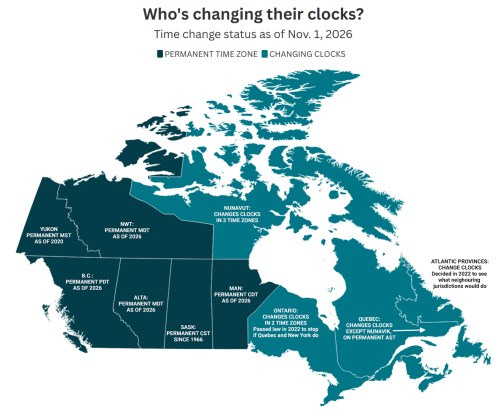
WINNIPEG - Manitoba's government said Thursday the province will be sticking with daylight time year-round, making it the latest jurisdiction to move away from twice-annual time changes. Here's a look at where things stand across Canada:

British Columbia said in March that it was moving to permanent Pacific daylight time. The change also means that parts of northeastern B.C., which have been on mountain standard time year round, are now in alignment with the rest of the province.

Alberta also switched to permanent daylight time this year in what it calls Alberta time. The change means it now has the same time as Saskatchewan year round.

Saskatchewan has been on permanent central standard time since 1966.

Read
Friday, Sep. 18, 2026