Negotiators are urged to get down to business as climate talks in Baku enter second week

Advertisement

Advertise with us

BAKU, Azerbaijan (AP) — United Nations climate talks resumed Monday with negotiators urged to make progress on a stalled-out deal that could see developing countries get more money to spend on clean energy and adapting to climate-charged weather extremes.

Read this article for free:


or

Already have an account? Log in here »

To continue reading, please subscribe:

Subscribe and receive a limited-edition Free Press branded hat or tote.

Digital Subscription

One year of digital access for only $205*

  • Enjoy unlimited reading on winnipegfreepress.com
  • Read the E-Edition, our digital replica newspaper
  • Access News Break, our award-winning app
  • Play interactive puzzles

*First annual payment billed as $205.00 + GST for one year. This annual subscription will automatically renew at $233.00 + GST every 52 weeks (10% off the regular annual price of $259.35). Offer available to new and qualified returning subscribers only. Cancel any time.

To continue reading, please subscribe:

Add Free Press access to your Brandon Sun subscription for only an additional

$1 for the first 4 weeks*

  • Enjoy unlimited reading on winnipegfreepress.com
  • Read the E-Edition, our digital replica newspaper
  • Access News Break, our award-winning app
  • Play interactive puzzles
Start now

*Your next Brandon Sun subscription payment will increase by $1.00 and you will be charged $17.95 plus GST for four weeks. After four weeks, your payment will increase to $24.95 plus GST every four weeks.

Hey there, time traveller!
This article was published 18/11/2024 (672 days ago), so information in it may no longer be current.

BAKU, Azerbaijan (AP) — United Nations climate talks resumed Monday with negotiators urged to make progress on a stalled-out deal that could see developing countries get more money to spend on clean energy and adapting to climate-charged weather extremes.

U.N. Climate Change executive secretary Simon Stiell called for countries to “cut the theatrics and get down to real business.”

“We will only get the job done if Parties are prepared to step forward in parallel, bringing us closer to common ground,” Stiell said to a room of delegates in Baku, Azerbaijan. “I know we can get this done.”

Attendees arrive at the venue as it rains during the COP29 U.N. Climate Summit, Monday, Nov. 18, 2024, in Baku, Azerbaijan. (AP Photo/Peter Dejong)

Climate and environment ministers from around the world have arrived at the summit to help push the talks forward.

“Politicians have the power to reach a fair and ambitious deal,” said COP29 President Mukhtar Babayev at a press conference at the venue. “They must deliver and engage immediately and constructively.”

Climate cash is still a sticking point

Talks in Baku are focused on getting more climate cash for developing countries to transition away from fossil fuels, adapt to climate change and pay for damages caused by extreme weather. But countries are far apart on how much money that will require.

A group of developing nations last week put the sum at $1.3 trillion, while rich countries are yet to name a figure. Several experts estimated that the money needed for climate finance is around $1 trillion.

“We all know it is never easy in politics and in international politics to talk about money, but the cost of action today is, as a matter of fact, much lower than the cost of inaction,” said Wopke Hoekstra, the EU climate commissioner at press conference.

“We will continue to lead to do our fair share and even more than our fair share, as we’ve always done,” he said. But Hoekstra added that “others have a responsibility to contribute based on their emissions and based on their economic growth too.”

Arnold Jason Del Rosario leads a demonstration on climate finance at the COP29 U.N. Climate Summit, Monday, Nov. 18, 2024, in Baku, Azerbaijan. (AP Photo/Peter Dejong)

Teresa Anderson, the Global Lead on Climate Justice at ActionAid International, was skeptical about rich countries’ intentions.

“The concern is that the pressure to add developing countries to the list of contributors is not, in fact, about raising more money for frontline countries,” Anderson said. “Rich countries are just trying to point the finger and have an excuse to provide less finance. That’s not the way to address runaway climate breakdown, and is a distraction from the real issues at stake.”

Rachel Cleetus from the Union of Concerned Scientists said $1 trillion in global climate funds “is going to look like a bargain five, 10 years from now.”

“We’re going to wonder why we didn’t take that and run with it,” she said, citing a multitude of costly recent extreme weather events from flooding in Spain to hurricanes Helene and Milton in the United States.

Robert Habeck, Germany’s climate and economic affairs minister said rich nations shouldn’t try to stop developing nations from producing more energy, but it has to come from cleaner sources.

“They have the same right to create (the) same work, same education and health system,” he said. “On other hand, if … they are doing the same as we did for 100 years of burning fossil energy, that is completely messed up.”
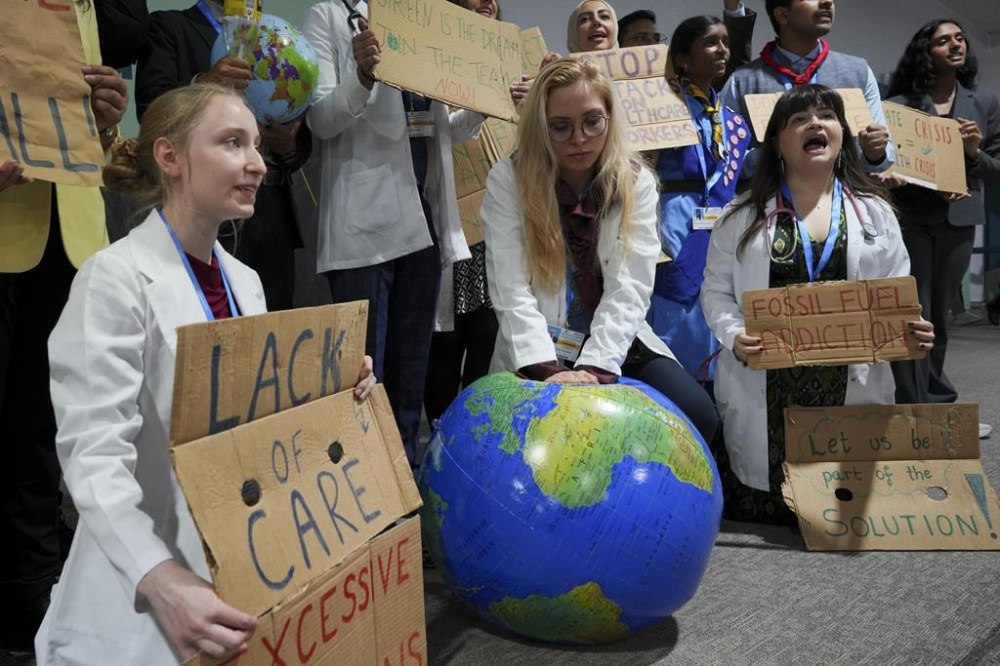
Activist Ann Carlotta Oltmanns, center, pretends to resuscitate Earth with others during a demonstration at the COP29 U.N. Climate Summit, Monday, Nov. 18, 2024, in Baku, Azerbaijan. (AP Photo/Peter Dejong)

Alongside U.K. energy minister Ed Miliband, Habeck announced around $1.3 billion on Monday for developing countries to move away from fossil fuels.

“The industrialized countries are committed to their climate financing, while at the same time we are bringing more private investors and donors on board and broadening the donor base,” Habeck said.

Climate watchers keep an eye on Rio and Paris

Meanwhile, the world’s biggest decision makers are halfway around the world as another major summit convenes. Brazil is hosting the Group of 20 summit Monday and Tuesday that brings together many of the world’s largest economies. Climate change — among other major topics like rising global tensions and poverty — will be on the agenda.

COP President Babayev said the world “cannot succeed” in its climate goals without G20 nations.

“We urge them to use the G20 meeting to send a positive signal of their commitment to addressing the climate crisis. We want them to provide clear mandates to deliver,” he said.
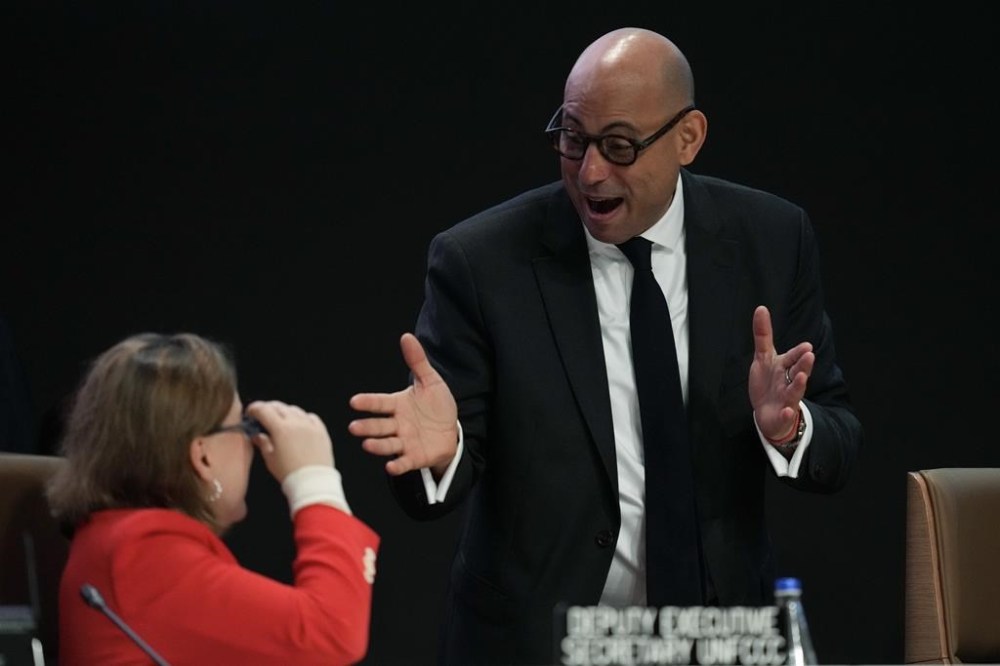
Simon Stiell, United Nations climate chief, speaks ahead of a plenary session at the COP29 U.N. Climate Summit, Monday, Nov. 18, 2024, in Baku, Azerbaijan. (AP Photo/Rafiq Maqbool)

Harjeet Singh, global engagement director for the Fossil Fuel Non-Proliferation Treaty Initiative, said G20 nations “cannot turn their backs on the reality of their historical emissions and the responsibility that comes with it.”

“They must commit to trillions in public finance,” he said.

Also on Monday, the Paris-based Organization for Economic Cooperation and Development has been mulling a proposal to cut public spending for foreign fossil fuel projects. The OECD — made up of 38 member countries including the United States, the United Kingdom, South Korea, Japan and Germany — are discussing a deal that could prevent up to $40 billion worth of carbon-polluting projects.

At COP29, activists are protesting the U.S., South Korea, Japan, and Turkey who they say are the key holdouts preventing that OECD agreement from being finalized.

“It’s of critical importance that President Biden comes out in support. We know it’s really important that he lands a deal that Trump cannot undo. This can be really important for Biden’s legacy,” said Lauri van der Burg, Global Public Finance Lead at Oil Change international. “If he comes around, this will help mount pressure on other laggards including Korea, Turkey and Japan.”

___
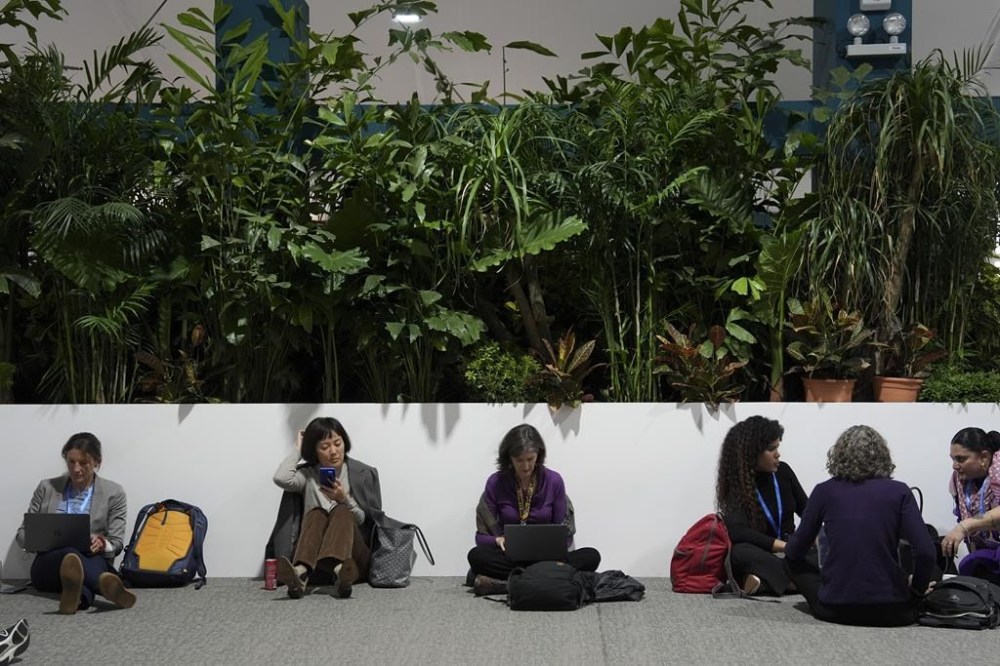
Attendees sit during a break while at the COP29 U.N. Climate Summit, Monday, Nov. 18, 2024, in Baku, Azerbaijan. (AP Photo/Joshua A. Bickel)

Associated Press journalist Ahmed Hatem in Baku contributed to this report.

___

The Associated Press’ climate and environmental coverage receives financial support from multiple private foundations. AP is solely responsible for all content. Find AP’s standards for working with philanthropies, a list of supporters and funded coverage areas at AP.org.

Report Error Submit a Tip

More Stories

Grieving child builds backyard rocket ship

Harriet Zaidman 4 minute read Yesterday at 2:01 AM CDT

I Built a Rocket Ship (Kids Can Press, 32 pages, hardcover, $22) by Winnipegger Anna Lazowski is a tender story for children ages 4-8 about a little girl trying to make sense of her mother’s death. The child engages in conversation with her late mom, agreeing and disagreeing about things said as she carries objects (and of course, the cat) to the backyard. There, she is building a rocket ship she will pilot into the skies to find her mom again.

Jennica Lounsbury’s varied perspectives show the range of emotions the little girl experiences.

● ● ●

Northwoods Lullaby by Mary Casanova (University of Minnesota Press, 32 pages, hardover, $25) is a bedtime book for readers up to age eight, perfect to bring a busy, happy day to a close. Just like children who are listening to adults reading the book, all the animal babies are being tucked into their nests and burrows by loving parents: “Thump and scamper,/nimble clover./ Soon it’s time to rest. Baby loon/ nestles in/as Papa floats along.”

Hellebuyck standoff caused by… Nathan MacKinnon?

Mike McIntyre 7 minute read Preview

Hellebuyck standoff caused by… Nathan MacKinnon?

Mike McIntyre 7 minute read Friday, Sep. 18, 2026

Looking for someone to blame in the Connor Hellebuyck fiasco and cast as public enemy No. 1? How about long-time Winnipeg Jets nemesis Nathan MacKinnon?

Allow us to explain as we fire up the time machine and head back to February in Italy.

Oh, what could have been if MacKinnon had been able to score on what appeared to be an open net late in the third period of the men’s gold medal game with Hellebuyck down and seemingly out of position.

Instead, the star forward fired wide, keeping the score deadlocked at 1-1 as the clock ticked down on regulation.

Read
Friday, Sep. 18, 2026

Cabernet Sauvignon star of wine festival

Ben Sigurdson 5 minute read Preview

Cabernet Sauvignon star of wine festival

Ben Sigurdson 5 minute read Yesterday at 3:00 AM CDT

The Winnipeg Wine Festival will celebrate the king of red wine grapes next weekend — the theme of this year’s festival, which takes place Sept. 25 and 26 at the RBC Convention Centre, is Cabernet Sauvignon.

Cab Sauv, as it’s also known, is the world’s most widely planted wine grape of any colour, first coming to prominence in the 1800s in France’s Bordeaux region, where the grape is still popular. Rather than single-variety wines, Bordeaux reds tend to be blends, with those coming from the left bank of the Gironde estuary being Cabernet-dominant, while right-bank wines are Merlot-dominant, with Cabernet Sauvignon playing a supporting role. Cabernet and Merlot work well together and many other countries have followed suit in blending the two.

A team at University of California Davis put Cabernet Sauvignon through a DNA test in 1996 and discovered its parent grapes are Cabernet Franc and Sauvignon Blanc — it’s likely that at some point the two varieties, planted next to each other in some vineyard, crossed and mutated and became the grape we know today. (Someone growing grapes in the 19th century must have had an inkling of what was up, as the grape has been called Cabernet Sauvignon since long before the DNA test.)

Flavour-wise, most Cabernet Sauvignon wines are big and bold, with a core of deep dark berry flavours, some graphite and spice notes and relatively bright acidity. It’s a grape that is well-suited to barrel aging, with most examples seeing at least some time in wood.

Read
Yesterday at 3:00 AM CDT

A quick look at where provinces and territories stand on time changes

The Canadian Press 2 minute read Preview

A quick look at where provinces and territories stand on time changes

The Canadian Press 2 minute read Friday, Sep. 18, 2026

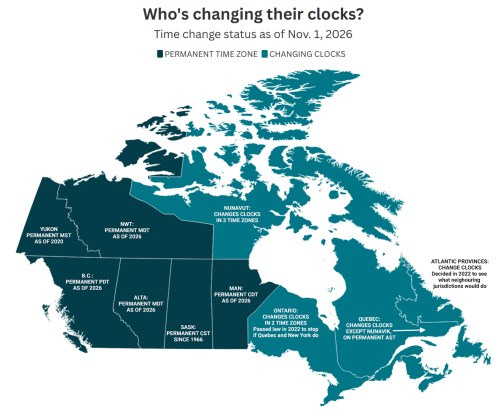
WINNIPEG - Manitoba's government said Thursday the province will be sticking with daylight time year-round, making it the latest jurisdiction to move away from twice-annual time changes. Here's a look at where things stand across Canada:

British Columbia said in March that it was moving to permanent Pacific daylight time. The change also means that parts of northeastern B.C., which have been on mountain standard time year round, are now in alignment with the rest of the province.

Alberta also switched to permanent daylight time this year in what it calls Alberta time. The change means it now has the same time as Saskatchewan year round.

Saskatchewan has been on permanent central standard time since 1966.

Read
Friday, Sep. 18, 2026

Klein has burned bridges with PM, Gillingham says

Joyanne Pursaga 3 minute read Preview

Klein has burned bridges with PM, Gillingham says

Joyanne Pursaga 3 minute read Friday, Sep. 18, 2026

One mayoral candidate accused another of writing a column so critical it could compromise his ability to work with the federal government.

Read
Friday, Sep. 18, 2026

American Hostage stars recall warmth of Winnipeggers during brutal winter

Randall King 7 minute read Preview

American Hostage stars recall warmth of Winnipeggers during brutal winter

Randall King 7 minute read Friday, Sep. 18, 2026

TORONTO — When you stream the eight-part series American Hostage, a sense of familiarity may strike.

That’s because the show was shot in Winnipeg — especially in the Exchange District — from November of last year to the beginning of February, with Winnipeg portraying Indianapolis circa 1977.

The whole world seemed to be watching that midwest American city that year as a hostage crisis unfolded involving one Tony Kiritsis, an angry man who goes ballistic when a mortgage brokerage was poised to foreclose on property he had dreamed of developing into a shopping centre.

Kiritsis kidnapped his mortgage broker, Richard Hall, wiring a shotgun to the back of his head, and demanded a public airing of his grievances, with the reluctant help of popular radio broadcaster Fred Heckman.

Read
Friday, Sep. 18, 2026