Alberta takes aim at GHG emissions cap, proposes rules on trespass and data gathering

Advertisement

Advertise with us

EDMONTON - Alberta Premier Danielle Smith says her government is eyeing a number of steps to challenge the proposed federal greenhouse gas emissions cap.

Read this article for free:


or

Already have an account? Log in here »

To continue reading, please subscribe:

Subscribe and receive a limited-edition Free Press branded hat or tote.

Digital Subscription

One year of digital access for only $205*

  • Enjoy unlimited reading on winnipegfreepress.com
  • Read the E-Edition, our digital replica newspaper
  • Access News Break, our award-winning app
  • Play interactive puzzles

*First annual payment billed as $205.00 + GST for one year. This annual subscription will automatically renew at $233.00 + GST every 52 weeks (10% off the regular annual price of $259.35). Offer available to new and qualified returning subscribers only. Cancel any time.

To continue reading, please subscribe:

Add Free Press access to your Brandon Sun subscription for only an additional

$1 for the first 4 weeks*

  • Enjoy unlimited reading on winnipegfreepress.com
  • Read the E-Edition, our digital replica newspaper
  • Access News Break, our award-winning app
  • Play interactive puzzles
Start now

*Your next Brandon Sun subscription payment will increase by $1.00 and you will be charged $17.95 plus GST for four weeks. After four weeks, your payment will increase to $24.95 plus GST every four weeks.

Hey there, time traveller!
This article was published 26/11/2024 (663 days ago), so information in it may no longer be current.

EDMONTON – Alberta Premier Danielle Smith says her government is eyeing a number of steps to challenge the proposed federal greenhouse gas emissions cap.

Announcing an upcoming motion under her Alberta Sovereignty within a United Canada Act on Tuesday, Smith said the government plans to challenge the cap in court when or if it becomes law, and that it will take the steps necessary to give the province exclusive authority and ownership of emissions data, ban federal employees from designated oil and gas facilities, and more.

“We’ve been very clear that we will use all means at our disposal to fight back against federal policies that hurt Alberta, and that’s exactly what we’re doing,” she said.
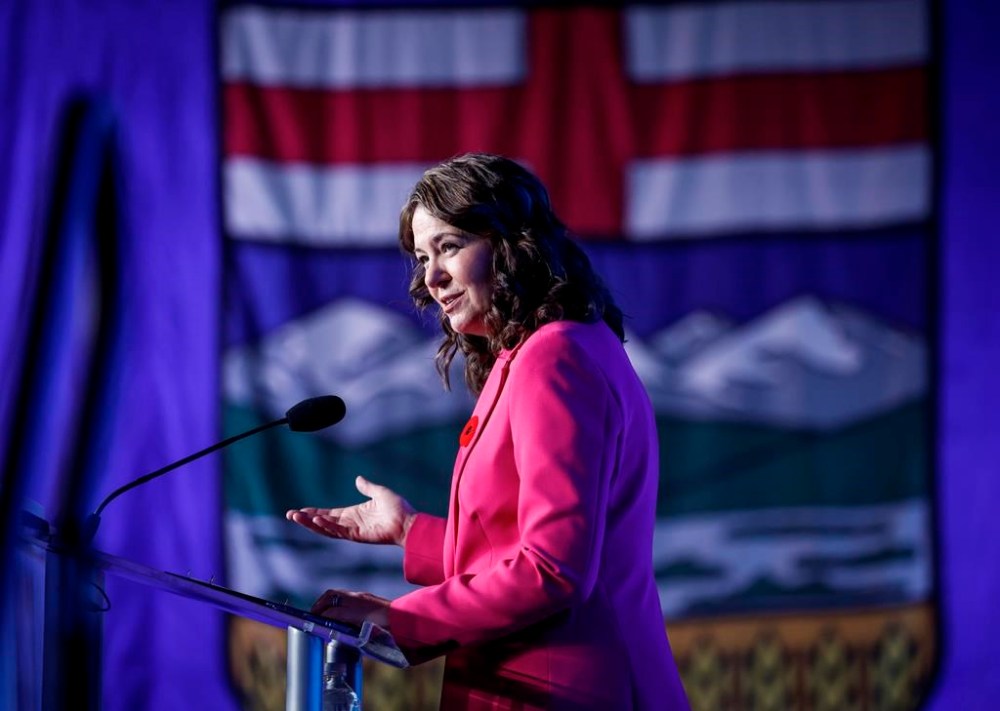
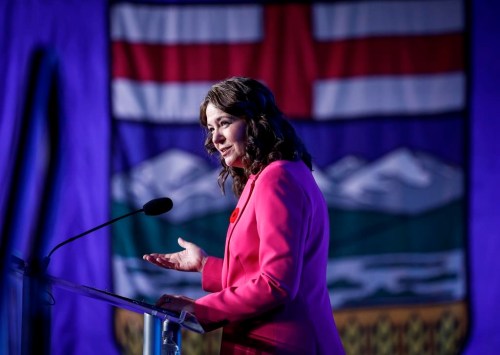
United Conservative Party Leader Danielle Smith addresses party members at their annual meeting in Red Deer, Alta., on Nov. 2, 2024. THE CANADIAN PRESS/Jeff McIntosh

Under the sovereignty act, the government must first put a motion forward in the legislative assembly identifying a federal matter at issue and outlining potential steps the government should take to overcome it.

Once the motion is passed in the assembly, the act stipulates that Smith’s cabinet will then determine the legality of the chosen measures before taking action.

Smith said other steps the government will consider in response to the cap include instructing provincial authorities, such as the Alberta Energy Regulator, not to enforce it; declaring oil and gas facilities owned by Alberta “interest holders” as essential infrastructure; and beefing up the government’s ability to sell oil and gas on behalf of industry.

“We are asserting our ownership over our oil and gas resources,” Smith told reporters, adding that she expects oil and gas companies to support the steps being considered.

The proposed federal emissions cap, which is still in draft form, would require oil and gas companies to cut emissions by 35 per cent before 2030 to 2032.

Smith has called the cap unconstitutional, and on Tuesday she said it would cripple Alberta’s oil and gas economy.

She also said the cap would lead to a drop in production to the tune of one million barrels per day, which she said would lead to a five per cent loss in royalty revenues for Alberta.

In a joint statement, federal Environment Minister Steven Guilbeault and Energy Minister Jonathan Wilkinson disputed Smith’s claims, saying they believe the emissions cap is constitutional and wouldn’t lead to a production cut.

“The pollution cap will drive the industry to invest record profits back into the sector helping to fuel Canadian-made clean technologies and creating jobs in the process,” the statement reads. “Production and jobs will increase under this policy while pollution goes down – that’s a win-win-win.”

Guilbeault and Wilkinson also said Smith is “manipulating and politicizing” emissions reporting.

Eric Adams, a professor and constitutional law expert at the University of Alberta, said in an interview that this attempt at using the sovereignty act seems “more muscular” than the motion the government proposed nearly a year ago in response to the federal government’s draft net-zero electricity grid goals, although the act has yet to be tested in court.

“It’s not simply declaring that a particular federal law is unconstitutional in the view of the Alberta legislature,” Adams said of Smith’s announcement Tuesday.

He said some of the measures outlined by Smith likely wouldn’t stand in court, such as the ban on federal officers entering oil and gas facilities. However, he said the provincial government does have an argument for the cap intruding on provincial jurisdiction.

“There’s arguments on both sides,” Adams said, explaining the province would likely argue jurisdictional points, while the federal government would counter that criminal law such as what’s being proposed under the emissions cap is within their authority

NDP Leader Naheed Nenshi called the evocation of the sovereignty act performative, although he agreed the federal emissions cap would be harmful for Alberta.

“It’s not good policy for Alberta,” he said, adding that he thought Alberta could have done more to work with the federal government to find a better solution.

“We would never have got to this point if Alberta hadn’t been such an unwilling partner to actually take on this issue,” said Nenshi.

Smith did not say when the motion will be put forward in the legislature.

The federal government’s finalized regulations are expected to be published next spring.

This report by The Canadian Press was first published Nov. 26, 2024.

Report Error Submit a Tip

More Stories

American Hostage stars recall warmth of Winnipeggers during brutal winter

Randall King 7 minute read Preview

American Hostage stars recall warmth of Winnipeggers during brutal winter

Randall King 7 minute read Yesterday at 6:13 PM CDT

TORONTO — When you stream the eight-part series American Hostage, a sense of familiarity may strike.

That’s because the show was shot in Winnipeg — especially in the Exchange District — from November of last year to the beginning of February, with Winnipeg portraying Indianapolis circa 1977.

The whole world seemed to be watching that midwest American city that year as a hostage crisis unfolded involving one Tony Kiritsis, an angry man who goes ballistic when a mortgage brokerage was poised to foreclose on property he had dreamed of developing into a shopping centre.

Kiritsis kidnapped his mortgage broker, Richard Hall, wiring a shotgun to the back of his head, and demanded a public airing of his grievances, with the reluctant help of popular radio broadcaster Fred Heckman.

Read
Yesterday at 6:13 PM CDT

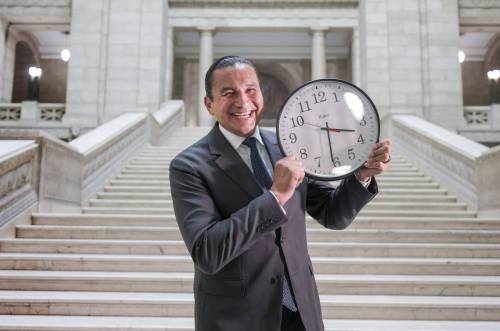
Manitoba abandoning spring, fall clock changes

Carol Sanders 8 minute read Preview

Manitoba abandoning spring, fall clock changes

Carol Sanders 8 minute read Updated: Yesterday at 8:48 AM CDT

Time’s up for the time change in Manitoba.

Manitobans won’t be setting their clocks back an hour in November. The province has decided to permanently stay on daylight time after surveying residents on the twice annual clock adjustment.

“We heard from Manitobans loud and clear — no more changing the clocks in Manitoba,” Premier Wab Kinew said in a news release Thursday.

Most of the 72,000 votes submitted in an online EngageMB survey — 92 per cent — said they would like to see the practice end. The survey asked if they preferred earlier sunrises in winter with standard time or the later sunsets in summer with daylight time. More than half of survey participants (58 per cent) indicated a preference to stay on permanent daylight time; 34 per cent voted to eliminate the time change but stay on standard time.

Read
Updated: Yesterday at 8:48 AM CDT

Canada-U.S. trade relationship is broken, but the damage can — and will — be repaired

Tom Brodbeck 5 minute read Preview

Canada-U.S. trade relationship is broken, but the damage can — and will — be repaired

Tom Brodbeck 5 minute read Thursday, Sep. 17, 2026

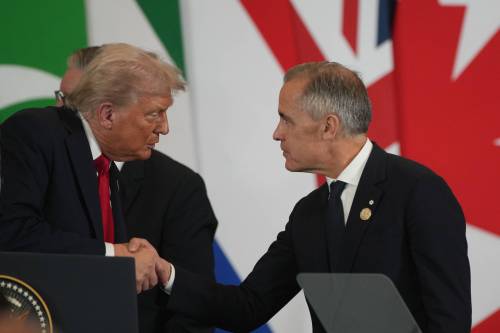
Canada needs to get serious about diversifying its trade beyond the United States. But at the same time, Canadians should expect relations with the U.S. to normalize after Donald Trump is no longer in the White House.

For generations, Canada-U.S. trade was considered almost a fact of geography. The two countries share the world’s longest undefended border, deeply integrated supply chains and a century of commercial relationships.

Canadian manufacturers depend on American customers. American manufacturers depend on Canadian suppliers. Energy, agriculture, automotive production and countless other industries operate across the border as though it barely exists.

That isn’t going to change dramatically, even in the midst of a bitter trade war unleashed by the U.S. president.

Read
Thursday, Sep. 17, 2026

United Way, other charities fight for dollars as donor base shrinks

Scott Billeck 7 minute read Preview

United Way, other charities fight for dollars as donor base shrinks

Scott Billeck 7 minute read Yesterday at 2:00 AM CDT

Winnipeg’s charitable sector is being squeezed from both sides: demand for help is growing while the pool of donors to meet that need is shrinking.

The imbalance is increasingly being carried by a relatively small group of deep-pocketed donors. Last year, 600 people — about three per cent of United Way Winnipeg’s individual donors — accounted for roughly $8 million, or 55 per cent of individual donations.

The fundraising pitch isn’t getting any easier.

Homelessness and public drug use have become increasingly visible, household budgets remain strained and the problems charities are trying to address can seem so entrenched that donors may reasonably wonder what difference another contribution can make.

Read
Yesterday at 2:00 AM CDT

Give-and-take relationship of Roman leaders takes centre stage in Harris’s historical fiction

Reviewed by Kathryne Cardwell 4 minute read Preview

Give-and-take relationship of Roman leaders takes centre stage in Harris’s historical fiction

Reviewed by Kathryne Cardwell 4 minute read 2:01 AM CDT

British novelist Robert Harris’s latest work is a reflection on tyranny, corruption and betrayal among all-powerful political leaders.

You might be forgiven for thinking it’s a contemporary thriller — it’s actually historical fiction set in ancient Rome.

A former BBC journalist, Harris debuted as a novelist in 1992 with Fatherland, an alternative history where Nazi Germany won the Second World War.

Since then, the prolific author has become best-known for his works of historical fiction, especially his ancient Rome trilogy released from 2006-2015 and the novel Conclave, which was published in 2016 and was made into the film of the same name in 2024.

Read
2:01 AM CDT

Alberta takes aim at GHG emissions cap, proposes rules on trespass and data gathering

Jack Farrell, The Canadian Press 4 minute read Preview

Alberta takes aim at GHG emissions cap, proposes rules on trespass and data gathering

Jack Farrell, The Canadian Press 4 minute read Tuesday, Nov. 26, 2024

EDMONTON - Alberta Premier Danielle Smith says her government is eyeing a number of steps to challenge the proposed federal greenhouse gas emissions cap.

Announcing an upcoming motion under her Alberta Sovereignty within a United Canada Act on Tuesday, Smith said the government plans to challenge the cap in court when or if it becomes law, and that it will take the steps necessary to give the province exclusive authority and ownership of emissions data, ban federal employees from designated oil and gas facilities, and more.

"We've been very clear that we will use all means at our disposal to fight back against federal policies that hurt Alberta, and that's exactly what we're doing," she said.

Under the sovereignty act, the government must first put a motion forward in the legislative assembly identifying a federal matter at issue and outlining potential steps the government should take to overcome it.

Read
Tuesday, Nov. 26, 2024