WEATHER ALERT

The spring equinox is here. What does that mean?

Advertisement

Advertise with us

Spring is almost here — officially, at least.

Read this article for free:

or

Already have an account? Log in here »

To continue reading, please subscribe:

Subscribe and receive a limited-edition Free Press branded hat or tote.

Digital Subscription

One year of digital access for only $205*

  • Enjoy unlimited reading on winnipegfreepress.com
  • Read the E-Edition, our digital replica newspaper
  • Access News Break, our award-winning app
  • Play interactive puzzles

*First annual payment billed as $205.00 + GST for one year. This annual subscription will automatically renew at $233.00 + GST every 52 weeks (10% off the regular annual price of $259.35). Offer available to new and qualified returning subscribers only. Cancel any time.

To continue reading, please subscribe:

Add Free Press access to your Brandon Sun subscription for only an additional

$1 for the first 4 weeks*

  • Enjoy unlimited reading on winnipegfreepress.com
  • Read the E-Edition, our digital replica newspaper
  • Access News Break, our award-winning app
  • Play interactive puzzles
Start now

*Your next Brandon Sun subscription payment will increase by $1.00 and you will be charged $17.95 plus GST for four weeks. After four weeks, your payment will increase to $24.95 plus GST every four weeks.

Hey there, time traveller!
This article was published 19/03/2025 (497 days ago), so information in it may no longer be current.

Spring is almost here — officially, at least.

The vernal equinox arrives on Thursday, marking the start of the spring season for the Northern Hemisphere and the fall in the Southern Hemisphere. On the equator, the sun will be directly overhead at noon. Equinoxes are the only time when both the north and south poles are lit by sunshine at the same time.

The events have been marked and celebrated around the world for centuries. Nowruz, the Iranian New Year, is based on the spring equinox, for example. And at the Mayan site Chichen Itza in Mexico, people gather during the equinox to watch the sun create a shadow pattern that resembles a serpent descending a building called El Castillo.

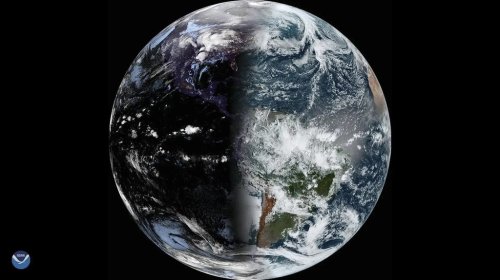
This image provided by NOAA on March 19, 2025 shows Earth. (NOAA via AP)

But what is happening in the heavens? Here’s what to know about how we split up the year using the Earth’s orbit.

What is the equinox?

As the Earth travels around the sun, it does so at an angle.

For most of the year, the Earth’s axis is tilted either toward or away from the sun. That means the sun’s warmth and light fall unequally on the northern and southern halves of the planet.

During the equinox, the Earth’s axis and its orbit line up so that both hemispheres get an equal amount of sunlight.

The word equinox comes from two Latin words meaning equal and night. That’s because on the equinox, day and night last almost the same amount of time — though one may get a few extra minutes, depending on where you are on the planet.

The Northern Hemisphere’s spring — or vernal — equinox can land between March 19 and 21, depending on the year. Its fall – or autumnal — equinox can land between Sept. 21 and 24.

What is the solstice?

The solstices mark the times during the year when the Earth is at its most extreme tilt toward or away from the sun. This means the hemispheres are getting very different amounts of sunlight — and days and nights are at their most unequal.

During the Northern Hemisphere’s summer solstice, the upper half of the earth is tilted in toward the sun, creating the longest day and shortest night of the year. This solstice falls between June 20 and 22.

Meanwhile, at the winter solstice, the Northern Hemisphere is leaning away from the sun — leading to the shortest day and longest night of the year. The winter solstice falls between December 20 and 23.

What’s the difference between meteorological and astronomical seasons?

These are just two different ways to carve up the year.

While astronomical seasons depend on how the Earth moves around the sun, meteorological seasons are defined by the weather. They break down the year into three-month seasons based on annual temperature cycles. By that calendar, spring starts on March 1, summer on June 1, fall on Sept. 1 and winter on Dec. 1.

___

The Associated Press Health and Science Department receives support from the Howard Hughes Medical Institute’s Science and Educational Media Group. The AP is solely responsible for all content.

Report Error Submit a Tip

More Stories

A small step among troubling signs

Editorial 4 minute read Preview

A small step among troubling signs

Editorial 4 minute read Updated: Yesterday at 8:02 AM CDT

There’s no getting around the fact — to many people, downtown Winnipeg is unsafe. Period.

Read
Updated: Yesterday at 8:02 AM CDT

Anishinaabe Days teepee poles vandalized

Nicole Buffie 4 minute read Preview

Anishinaabe Days teepee poles vandalized

Nicole Buffie 4 minute read Sunday, Jul. 26, 2026

An act of vandalism to a teepee at the Treaty One Development Corp’s Anishinaabe Days did not stop the celebrations from continuing over the weekend.

Someone deliberately cut the poles used to erect the site’s teepee before the event began, Treaty One executive director Jason Whitford said Sunday.

The family responsible for overseeing the teepee and its construction at the site, Naawi-Oodena  on Kenaston Boulevard, went to the site on Friday to erect the teepee when they noticed someone had taken a saw and cut all 15 of its poles in half.

“They were stored in a safe place, and they were stored properly as per protocol,” Whitford said. “They were in an area where there was no construction so they were isolated from any activity.”

Read
Sunday, Jul. 26, 2026

Visitors from across Canada make Somerset restaurant’s social media challenge a success

Zoe Pierce 3 minute read Preview

Visitors from across Canada make Somerset restaurant’s social media challenge a success

Zoe Pierce 3 minute read Saturday, Jul. 25, 2026

There may not be another restaurant in Manitoba that can say it has welcomed visitors from as many communities across the province and beyond as the Somerset Food Bar & Lounge has this summer.

In just over a two week span, visitors from more than 100 towns have come out to the family-owned restaurant tucked away in Somerset, a community of roughly 450 people in the Pembina Valley 130 kilometres southwest of Winnipeg.

It started as a challenge, “60 Towns in 60 Days,” where the restaurant wanted to document how many different places they could reach, as it often sees people travelling across Canada stop at the restaurant. The goal was also to encourage people to make a drive they normally wouldn’t.

“The more we started sharing, the more people really started getting behind it, and it turned into this really big thing fairly quickly,” said Jay Friesen, restaurant manager.

Read
Saturday, Jul. 25, 2026

Fences to be installed at Whiteshell park site where brothers drowned

Tyler Searle 4 minute read Preview

Fences to be installed at Whiteshell park site where brothers drowned

Tyler Searle 4 minute read 6:13 PM CDT

The Manitoba government will install fences and signs to restrict access to a popular natural attraction in Whiteshell Provincial Park, where two brothers drowned this month and others have died in recent years.

“My heart goes out to the family. We recognize the hardship and the tragedies that are taking place, and so we’re responding as quickly as we can to secure the site,” Environment Minister Mike Moyes said Tuesday, referring to Sturgeon Falls.

“People will still be able to view the falls. They’re still going to be able to enjoy the beauty of that area of Manitoba, but they’re going to be able to do it in a way that ensures that they’re going to remain safe.”

The falls are located between Nutimik and Numao lakes on the Winnipeg River system. Visitors can reach them by hiking a 1.9-kilometre trail that begins at the Nutimik Lake campground.

Read
6:13 PM CDT

‘Eight credible threats’ against Hydro employees: CEO

Chris Kitching 6 minute read Preview

‘Eight credible threats’ against Hydro employees: CEO

Chris Kitching 6 minute read Updated: Yesterday at 4:32 PM CDT

Manitoba Hydro president and CEO Allan Danroth took aim at critics and revealed he and staff members have been threatened while defending the Crown corporation’s plan for three new combustion turbines Monday.

Without identifying individuals, Danroth said “constant, uninformed criticism” of Hydro and misinformation has eroded public trust and contributed to hostilities and an unsafe workplace for employees.

“Manitoba Hydro is currently managing eight credible threats against our employees, five of them directed at me personally,” Danroth told a Public Utilities Board hearing in Winnipeg.

“More troubling is these threats are increasingly affecting our front-line workforce. In the last year, my employees have been threatened with weapons, including guns, while performing their duties, and in one recent incident a homeowner directed his dogs to attack one of our meter readers.”

Read
Updated: Yesterday at 4:32 PM CDT

The spring equinox is here. What does that mean?

The Associated Press 3 minute read Preview

The spring equinox is here. What does that mean?

The Associated Press 3 minute read Wednesday, Mar. 19, 2025

Spring is almost here — officially, at least.

The vernal equinox arrives on Thursday, marking the start of the spring season for the Northern Hemisphere and the fall in the Southern Hemisphere. On the equator, the sun will be directly overhead at noon. Equinoxes are the only time when both the north and south poles are lit by sunshine at the same time.

The events have been marked and celebrated around the world for centuries. Nowruz, the Iranian New Year, is based on the spring equinox, for example. And at the Mayan site Chichen Itza in Mexico, people gather during the equinox to watch the sun create a shadow pattern that resembles a serpent descending a building called El Castillo.

But what is happening in the heavens? Here's what to know about how we split up the year using the Earth's orbit.

Read
Wednesday, Mar. 19, 2025