Early human ancestors used their hands to both climb trees and make tools, new study shows

Advertisement

Advertise with us

WASHINGTON (AP) — Our hands can reveal a lot about how a person has lived – and that’s true for early human ancestors, too.

Read this article for free:


or

Already have an account? Log in here »

To continue reading, please subscribe:

Subscribe and receive a limited-edition Free Press branded hat or tote.

Digital Subscription

One year of digital access for only $205*

  • Enjoy unlimited reading on winnipegfreepress.com
  • Read the E-Edition, our digital replica newspaper
  • Access News Break, our award-winning app
  • Play interactive puzzles

*First annual payment billed as $205.00 + GST for one year. This annual subscription will automatically renew at $233.00 + GST every 52 weeks (10% off the regular annual price of $259.35). Offer available to new and qualified returning subscribers only. Cancel any time.

To continue reading, please subscribe:

Add Free Press access to your Brandon Sun subscription for only an additional

$1 for the first 4 weeks*

  • Enjoy unlimited reading on winnipegfreepress.com
  • Read the E-Edition, our digital replica newspaper
  • Access News Break, our award-winning app
  • Play interactive puzzles
Start now

*Your next Brandon Sun subscription payment will increase by $1.00 and you will be charged $17.95 plus GST for four weeks. After four weeks, your payment will increase to $24.95 plus GST every four weeks.

Hey there, time traveller!
This article was published 14/05/2025 (465 days ago), so information in it may no longer be current.

WASHINGTON (AP) — Our hands can reveal a lot about how a person has lived – and that’s true for early human ancestors, too.

Different activities such as climbing, grasping or hammering place stress on different parts of our fingers. In response to repeated stress, our bones tend to thicken in those areas.

To study how ancient humans used their hands, scientists used 3D scanning to measure and analyze the bone thickness of fingers.
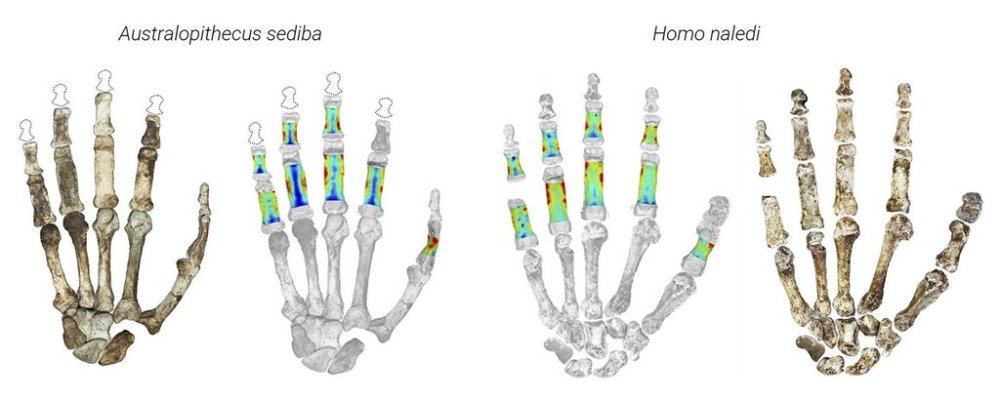
This artist rendering shows hands of early human ancestors, called Australopithecus sediba and Homo naledi, found in South Africa. The left images show photos of the bones, and the right images show how the fingers absorbed stress during daily activities. Red areas absorbed more stress than blue ones, which scientists can tell based on bone thickness. (Tracy Kivell via AP)

They focused on the fossil hands of two early human ancestor species recovered from excavations in southern Africa, called Australopithecus sediba and Homo naledi. The individuals lived around 2 million years ago and around 300,000 years ago, respectively.

Both ancient human species showed signs of simultaneously using their hands to move around – such as by climbing trees – as well as to grasp and manipulate objects, a requirement to being able to make tools.

“They were likely walking on two feet and using their hands to manipulate objects or tools, but also spent time climbing and hanging,” perhaps on trees or cliffs, said study co-author and paleoanthropologist Samar Syeda of the American Museum of Natural History.

The research was published Wednesday in Science Advances.

The findings show there wasn’t a simple “evolution in hand function where you start off with more ‘ape-like’ and end up more ‘human-like,’” said Smithsonian paleoanthropologist Rick Potts, who was not involved in the study.

Complete fossil hands are relatively rare, but the specimens used in the study gave an opportunity to understand the relative forces on each finger, said Chatham University paleontologist Erin Marie Williams-Hatala, who was not involved in the study.

“Hands are one of the primary ways we engage with world around us,” she said.

___

The Associated Press Health and Science Department receives support from the Howard Hughes Medical Institute’s Science and Educational Media Group and the Robert Wood Johnson Foundation. The AP is solely responsible for all content.

Report Error Submit a Tip

More Stories

ER wait times have hit all-time highs in Winnipeg and are impacting nearly all aspects of hospital operations

Tom Brodbeck 17 minute read Preview

ER wait times have hit all-time highs in Winnipeg and are impacting nearly all aspects of hospital operations

Tom Brodbeck 17 minute read Yesterday at 6:00 AM CDT

On most days at Health Sciences Centre’s adult emergency department, all 58 treatment beds are filled with sick patients. Another dozen or so brought in by ambulance line the hallways on stretchers, with only one nurse to look after them.

Out in the waiting room, about 30 or 40 people — sometimes more — are slouched in chairs in pain or discomfort, waiting hours to see a doctor. Most have been assessed by a triage nurse, but many will have to wait 10 to 20 hours to be examined by a physician because there’s no room for them in the treatment area.

Some patients leave because they can no longer tolerate the excruciating wait, only to return days later, sicker than they were before.

Welcome to the emergency department at Manitoba’s largest hospital, where some of the highest-acuity patients seek medical care but now face delays that were unimaginable a few years ago.

Read
Yesterday at 6:00 AM CDT

Rural residents ‘outraged’ property owner charged after shots fired during confrontation with alleged thieves: MLA

Zoe Pierce 5 minute read Preview

Rural residents ‘outraged’ property owner charged after shots fired during confrontation with alleged thieves: MLA

Zoe Pierce 5 minute read Thursday, Aug. 20, 2026

A rural Manitoba MLA says he has heard from constituents who are “shocked and outraged” that a 66-year-old man is facing charges after he fired shots at a group of people accused of stealing from his property.

Read
Thursday, Aug. 20, 2026

Residents fear mailbox crime sprees

Morgan Modjeski 5 minute read Preview

Residents fear mailbox crime sprees

Morgan Modjeski 5 minute read 2:01 AM CDT

Some North End residents are concerned new community mailboxes will become a target for vandalism and crime after the base of one was recently lit ablaze — before it was even installed.

The community mailboxes started to show up on Andrews Street within the last two weeks. Some have been installed, while at other locations, only the concrete foundation is in place.

“They just dumped them on the boulevard,” said Stephen Giesbrecht, who lives beside one of the boxes in the St. John’s neighbourhood. “They dumped them on the corner and then they were gone.”

One of the concrete slabs has already played host to a fire and some of the hardware needed to install the mailbox melted.

Read
2:01 AM CDT

Don’t buy U.S. booze if, when it’s back on Liquor Mart shelves: Kinew

Chris Kitching 6 minute read Preview

Don’t buy U.S. booze if, when it’s back on Liquor Mart shelves: Kinew

Chris Kitching 6 minute read Updated: Yesterday at 10:25 AM CDT

Manitoba hasn’t agreed to put American liquor back on shelves despite Prime Minister Mark Carney’s request while his government finalizes a trade deal with the U.S. to avoid new tariffs.

Read
Updated: Yesterday at 10:25 AM CDT

Wait times for MRIs getting worse in Brandon, Dauphin

Rylee Gerrard 4 minute read 2:01 AM CDT

BRANDON — Wait times for MRI scans have surged in the Prairie Mountain Health region during the last two years.

Despite a campaign promise by the NDP in September 2023 to increase the number of allied health professionals capable of administering diagnostic imaging in northern and rural areas, wait times for MRIs have increased dramatically in Brandon and Dauphin.

Median imaging wait times tripled at Dauphin Regional Health Centre between 2024 and 2026, increasing from eight to 24 weeks, according to the province’s wait time dashboard.

The Brandon Regional Health Centre median wait times for MRI scans more than doubled during the same period, from nine to 23 weeks.

Plenty of alternatives to U.S. wines on the shelves

Ben Sigurdson 5 minute read Preview

Plenty of alternatives to U.S. wines on the shelves

Ben Sigurdson 5 minute read 6:00 AM CDT

In February 2025, Manitoba (and most other provinces) pulled American liquor from store shelves as part of the ongoing trade dispute with the United States.

Then in December, the province followed a similar course to others and put American booze that was already on hand back on shelves, selling off inventory that had been wasting away in warehouses for months, and directing proceeds from those sales to charities.

Lineups sprung up at numerous stores as consumers snapped up bestselling American products — think Maker’s Mark, Jack Daniel’s, Apothic Red and the like. After that initial rush, what was left has been languishing on shelves ever since, with many products eventually being drastically discounted for a quick sale, lest they become too long in the tooth.

I decided early on not to write about/review U.S. products in this space until things were well and truly sorted. But a few months back, I found myself in the mood for a big, oaky red wine and — in a moment of weakness, or nostalgia, or maybe just curiosity — I picked up a $30-ish California Cabernet Sauvignon.

Read
6:00 AM CDT