From obscurity to a cultural icon
Play lovingly rendered but incomplete look at longtime Cercle Molière leader

Advertisement
Read this article for free:
or
Already have an account? Log in here »
To continue reading, please subscribe:

Digital Subscription
One year of digital access for only $205*
- Enjoy unlimited reading on winnipegfreepress.com
- Read the E-Edition, our digital replica newspaper
- Access News Break, our award-winning app
- Play interactive puzzles
*First annual payment billed as $205.00 + GST for one year. This annual subscription will automatically renew at $233.00 + GST every 52 weeks (10% off the regular annual price of $259.35). Offer available to new and qualified returning subscribers only. Cancel any time.
To continue reading, please subscribe:
Add Free Press access to your Brandon Sun subscription for only an additional
$1 for the first 4 weeks*
- Enjoy unlimited reading on winnipegfreepress.com
- Read the E-Edition, our digital replica newspaper
- Access News Break, our award-winning app
- Play interactive puzzles
*Your next Brandon Sun subscription payment will increase by $1.00 and you will be charged $17.95 plus GST for four weeks. After four weeks, your payment will increase to $24.95 plus GST every four weeks.
Read unlimited articles for free today:
or
Already have an account? Log in here »
Hey there, time traveller!
This article was published 28/10/2025 (326 days ago), so information in it may no longer be current.
A pioneering force of Franco-Manitoban theatre is recalled for her humility, talent and collaborative spirit in Pauline Boutal: Entres Les Toiles et Les Planche, the opening production of Théâtre Cercle Molière’s centennial season.
In slightly less than two hours, playwright Lise Gaboury-Diallo’s straightforward script covers more than four decades of her titular character’s (well-played by Maryse Gagné) personal and professional lives, spheres which overlap to lend emotional heft to a piece that looks to admire the constellation as much as the star.
Gaboury-Diallo’s faithful text resists excessive flattery, presenting Boutal — a fashion illustrator, scenic designer, portraitist, award-winning actor and the artistic director of Le Cercle Molière from 1941 to 1968 — as a prodigious creative mind with access to myriad skills. In the play’s era, the question isn’t whether Boutal has talent, but whether, as a woman, she could get the requisite opportunity to show it while receiving appropriate recognition: Boutal and her fellow illustrators for the Eaton’s Catalogue rarely signed their work.
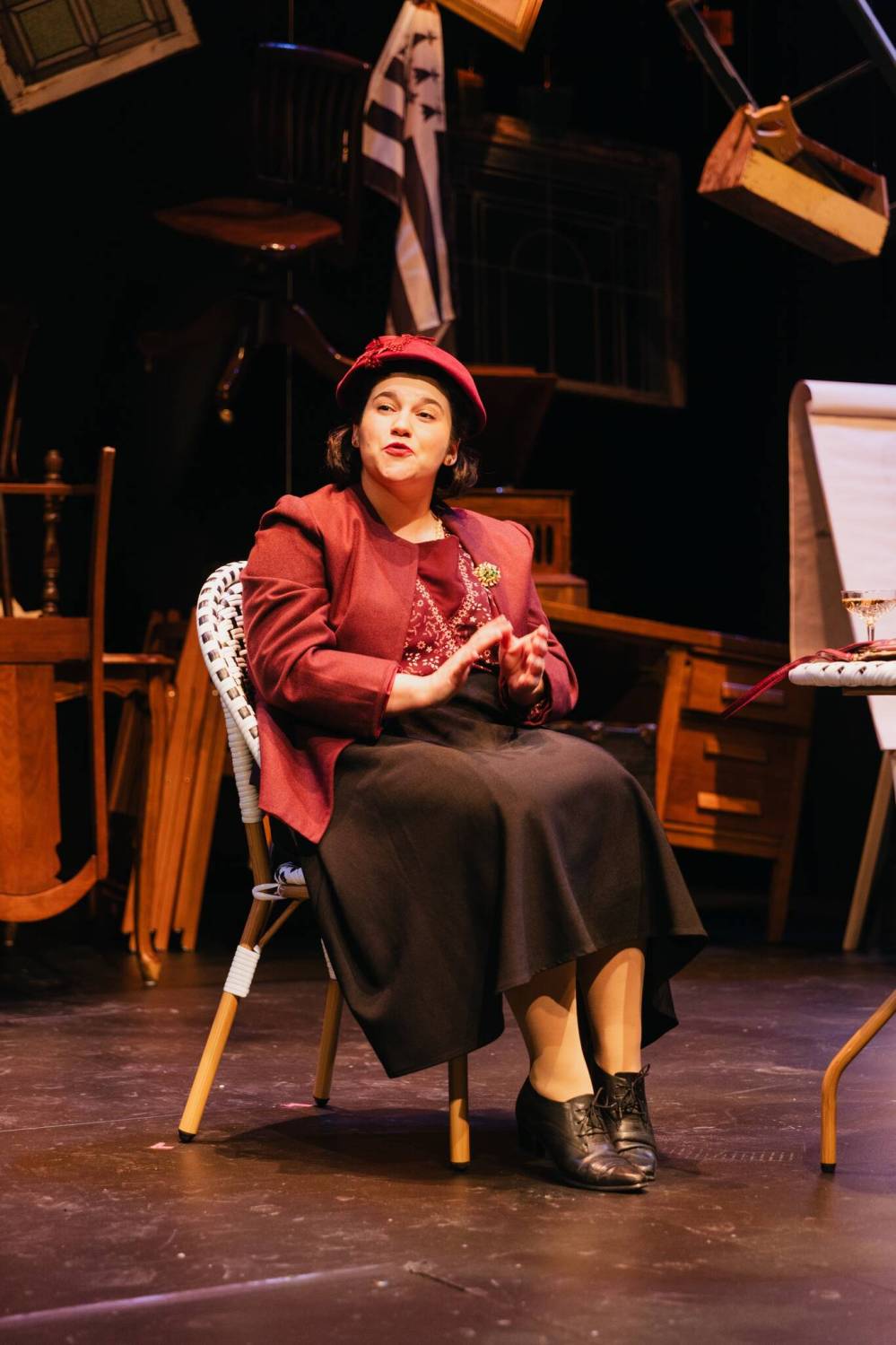
VINCENT BLAIS PHOTO
Maryse Gagné as Pauline Boutal.
Under director Simon Miron, Pauline Boutal plays as a surprisingly egalitarian origin story wherein creative equals — dressed immaculately by costume designer Brenda McLean — find their match.
After seeing an all-male production of Le Malade Imaginaire, French playwright Molière’s final comedy, the young Pauline Le Goff’s creative life enjoys its first sparks. By the age of 15, she set to work for her future husband Arthur Boutal’s (Colin Remillard) newspaper. Recognizing her talent, on bended knee, Arthur proposes to pay for Pauline’s art classes, so long as she’ll do some illustrations for the paper when called on. By 1925, Pauline Boutal would be designing lively costumes and lavish sets for a burgeoning theatre company, using the blank space offered by a fresh beginning to leave her mark.
As in Louise Duguay’s 2016 biography Pauline Boutal: An Artist’s Destiny, the married couple is presented as intellectual equals, guiding forces belonging to an elite set of St. Boniface artists, both trained and self-taught. Per Duguay, the home the Boutals owned near Horace Street was referred to by author and Cercle Molière actor Gabrielle Roy (one of three roles played by Jodi Kristjanson) as La Péninsule.
Other frequent visitors to the Boutals’ universe include Pauline’s sisters, her parents Jean-Francois (Tobias Hughes, wearing a moustache that could rival General Pétain) and Louise (Caroline Touchette, one of three roles) and founding TCM president Louis-Philippe Gagnon (Jack Maier).
Domestic scenes in the Le Goff household and La Péninsuleare are left mostly to the imagination by designer Kara Pankiw. The is composed of dozens of chairs, frames, portraits and flowers intricately strung in a sweeping brushstroke above the set, spiralling upward from Boutal’s easel in a torrent of creative output, or else toward it in a twirl of inspiration. The tenuously hanging objects hint at the play’s overtones of war and grief, forces evoking weightlessness and gravity that Gaboury-Diallo shows best through poetic asides.
“I feel your presence printed on the white pain of my memory,” Pauline says, drawing strength from her husband after his death.
One of the challenges Miron is repeatedly confronted by is how to show the audience Boutal’s talents rather than relying on compliments delivered by other characters (for evidence of Boutal’s talent, see the exhibit in Centre Culturel Franco-Manitobain, where several of her set designs, costume drawings and stylistic posters are on display until January).
The opening scene of the second act positions Gagné standing almost within the audience as she commands her charges to take their places for a rehearsal: these flashbacks to rehearsals and glimpses at Cercle Molière’s classic productions — at times peppy, emotive and melodramatic — are fun and spirited while giving the audience an abbreviated education in pre-modern acting technique.
More of the energy that fills those cutaways could enrich the production framing them, as would additional stakes granted to Boutal beyond the considerable grief she suffered following her husband’s deployment in the First World War and his death in 1941. This might be achieved by exploring in more detail a single production during her transition to artistic director, perhaps Boutal’s balancing act during 1944’s staging of La Chienne du Roi, a show which she directed, designed the set, conceived of the costumes and played a starring role.
Boutal is a fascinating subject, but upon leaving the theatre, there’s a feeling of having glimpsed a sketch — lovingly rendered, but with space to shed more light beneath the shade.
ben.waldman@freepress.mb.ca
Ben Waldman is a National Newspaper Award-nominated reporter on the Arts & Life desk at the Free Press. Born and raised in Winnipeg, Ben completed three internships with the Free Press while earning his degree at Ryerson University’s (now Toronto Metropolitan University’s) School of Journalism before joining the newsroom full-time in 2019. Read more about Ben.
Every piece of reporting Ben produces is reviewed by an editing team before it is posted online or published in print — part of the Free Press‘s tradition, since 1872, of producing reliable independent journalism. Read more about Free Press’s history and mandate, and learn how our newsroom operates.
Our newsroom depends on a growing audience of readers to power our journalism. If you are not a paid reader, please consider becoming a subscriber.
Our newsroom depends on its audience of readers to power our journalism. Thank you for your support.
Theatre Review
Pauline Boutal, entre les toiles et les planches
● Théâtre Cercle Molière, 340 Provencher Blvd.
● to Nov. 1
★★★ out of five
Ben Waldman is a National Newspaper Award-nominated reporter on the Arts & Life desk at the Free Press. Born and raised in Winnipeg, Ben completed three internships with the Free Press while earning his degree at Ryerson University’s (now Toronto Metropolitan University’s) School of Journalism before joining the newsroom full-time in 2019. Read more about Ben.
Every piece of reporting Ben produces is reviewed by an editing team before it is posted online or published in print — part of the Free Press‘s tradition, since 1872, of producing reliable independent journalism. Read more about Free Press’s history and mandate, and learn how our newsroom operates.
Our newsroom depends on a growing audience of readers to power our journalism. If you are not a paid reader, please consider becoming a subscriber.
Our newsroom depends on its audience of readers to power our journalism. Thank you for your support.
Advertisement Advertise With Us
Advertisement Advertise With Us