How Canada can regain its measles elimination status
Advertisement
Read this article for free:
or
Already have an account? Log in here »
To continue reading, please subscribe:

Digital Subscription
One year of digital access for only $205*
- Enjoy unlimited reading on winnipegfreepress.com
- Read the E-Edition, our digital replica newspaper
- Access News Break, our award-winning app
- Play interactive puzzles
*First annual payment billed as $205.00 + GST for one year. This annual subscription will automatically renew at $233.00 + GST every 52 weeks (10% off the regular annual price of $259.35). Offer available to new and qualified returning subscribers only. Cancel any time.
To continue reading, please subscribe:
Add Free Press access to your Brandon Sun subscription for only an additional
$1 for the first 4 weeks*
- Enjoy unlimited reading on winnipegfreepress.com
- Read the E-Edition, our digital replica newspaper
- Access News Break, our award-winning app
- Play interactive puzzles
*Your next Brandon Sun subscription payment will increase by $1.00 and you will be charged $17.95 plus GST for four weeks. After four weeks, your payment will increase to $24.95 plus GST every four weeks.
Read unlimited articles for free today:
or
Already have an account? Log in here »
Hey there, time traveller!
This article was published 11/11/2025 (331 days ago), so information in it may no longer be current.
TORONTO – Infectious disease experts say Canada’s loss of measles elimination status shows how badly investment is needed in public health, rebuilding vaccine confidence and solving the primary care crisis.
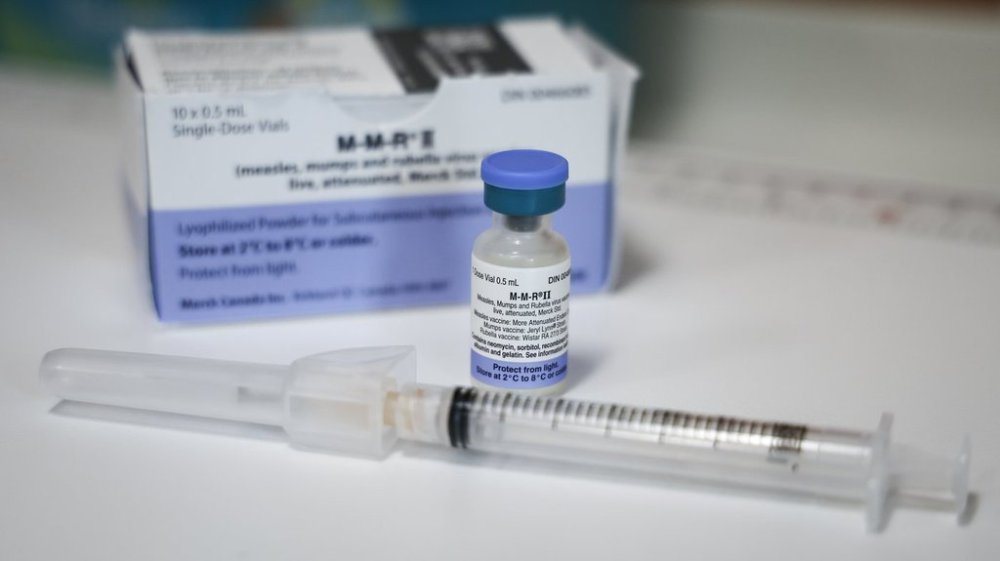
On Monday, the Pan American Health Organization (PAHO) revoked the measles-free status Canada has had since 1998 because an outbreak of the virus across several provinces has lasted for more than a year.
Dawn Bowdish, an immunologist and professor at McMaster University, said cuts to public health funding, the lack of a national vaccine registry and a shortage of family doctors — all while misinformation about vaccines is circulating widely — have contributed to the rise of measles.
“There’s no two ways about this. This will take money — a lot of money — and a lot of investment. And it will take a lot of political will,” Bowdish said
Public health workers don’t have the resources they need to do enough vaccination outreach to communities and bump up surveillance to quickly identify cases and stop transmission, she said.
Not having a national vaccine registry means many people can’t easily find out if they’re up-to-date on their immunizations if they were vaccinated in another province or country, Bowdish added.
Matthew Miller, scientific director of the Michael G. DeGroote Institute for Infectious Disease Research at McMaster University, said a national vaccine registry would be “the Holy Grail,” but setting up electronic provincial registries that can share data with each other would be the next best — and possibly more realistic — thing.
In addition to showing where there are gaps in vaccination, the registries could help parents stay up-to-date on their children’s immunizations by sending automated reminders, Miller said.
“Although it is the case that a lot of measles transmission is happening in under-vaccinated communities who are specifically vaccine-hesitant or anti-vaccine, there are lots of people who miss shots not because they’re anti-vaccine but just because they forget.”
Completing a national electronic vaccine record system would be an important step for Canada in its fight against measles, said Dr. Daniel Salas, executive manager of PAHO’s Special Program for Comprehensive Immunization.
The Public Health Agency of Canada is currently working with the provinces and territories on a system called STARVAX that would produce standardized reports on vaccination. At the moment, the system only includes five provinces and one territory.
The primary care crisis in Canada is another challenge that needs to be addressed to improve measles vaccination, Bowdish said.
If families don’t have a primary care doctor or nurse practitioner, their kids are at risk of missing vaccinations since pharmacies don’t do measles, mumps and rubella immunizations for very young children, she said.
“Inevitably, if you don’t have good consistent care, these are the kind of things that get dropped.”
Measles, one of the most contagious diseases in the world, requires 95 per cent vaccination coverage to obtain herd immunity.
Bowdish said tougher enforcement of school vaccination policies, essentially restricting exemptions to valid medical reasons, is critical to stopping the spread.
“One of the things that my colleagues and I have been saying for a long time is many of the provinces, including Alberta and Ontario — the epicentre of these outbreaks — we’re way too liberal with our exemption rules. And that has contributed to falling vaccine rates.”
Bowdish said vaccination is “really the only way out” of endemic measles in Canada.
“It’s just that contagious. And if we don’t close in on these exemption rules and don’t really do good quality outreach to these under-vaccinated communities, especially religious communities, it’s going to be an almost insurmountable challenge to stop this.”
To get its elimination status back, Canada will not only need to stamp out the transmission of the current strain for at least 12 months — it will also need to show that it has beefed up its surveillance systems and ability to quickly stop outbreaks if measles cases arise, the Pan American Health Organization said on Monday.
Bowdish said the return of measles in Canada “shows how many systems will have to be fixed for us to get this under control.”
“We’ve been trying really, really hard for over a year and I don’t disparage any of my colleagues in public health because I know they’ve been losing sleep trying to do the best they can with the resources they have,” she said.
Miller said he hopes the loss of elimination status will be “a call to action.”
“When there’s sort of international attention drawn to this as there is in the case of measles elimination, then it really, I think, serves to motivate governments and public health authorities and hopefully communities and the public as well,” he said, noting that the pervasiveness of anti-vaccine misinformation and anti-science attitudes in the U.S. are complicating factors.
Dr. Monika Naus, a professor in the School of Population and Public Health at the University of British Columbia, said it’s critical to sort out what’s happening in communities with low vaccination rates, including determining whether children were immunized but their records are missing or if they are actually unvaccinated.
“That really is something that the public health community should be able to get a handle on,” she said.
PAHO also recommended presenting a corrective plan to continue breaking down barriers to understand the perspectives of the close-knit unvaccinated communities where measles has spread.
Naus, who previously served as chair of the National Advisory Committee on Immunization and as medical director of vaccine preventable diseases at the BC Centre for Disease Control, said those targeted efforts are critical and make a difference.
“It’s probably false to consider that people who are resistant to vaccination will never be vaccinated under any circumstances,” she said.
“Even in communities with low uptake rates, there are probably (public health) improvements that can be made.”
This report by The Canadian Press was first published Nov. 11, 2025.
Canadian Press health coverage receives support through a partnership with the Canadian Medical Association. CP is solely responsible for this content.

Advertisement Advertise With Us
Advertisement Advertise With Us