She helped save countless lives
Trailblazing scientist with love of nature worked to end deadly disease in infants
Advertisement
Read this article for free:
or
Already have an account? Log in here »
To continue reading, please subscribe:

Digital Subscription
One year of digital access for only $205*
- Enjoy unlimited reading on winnipegfreepress.com
- Read the E-Edition, our digital replica newspaper
- Access News Break, our award-winning app
- Play interactive puzzles
*First annual payment billed as $205.00 + GST for one year. This annual subscription will automatically renew at $233.00 + GST every 52 weeks (10% off the regular annual price of $259.35). Offer available to new and qualified returning subscribers only. Cancel any time.
To continue reading, please subscribe:
Add Free Press access to your Brandon Sun subscription for only an additional
$1 for the first 4 weeks*
- Enjoy unlimited reading on winnipegfreepress.com
- Read the E-Edition, our digital replica newspaper
- Access News Break, our award-winning app
- Play interactive puzzles
*Your next Brandon Sun subscription payment will increase by $1.00 and you will be charged $17.95 plus GST for four weeks. After four weeks, your payment will increase to $24.95 plus GST every four weeks.
Read unlimited articles for free today:
or
Already have an account? Log in here »
Hey there, time traveller!
This article was published 07/02/2026 (228 days ago), so information in it may no longer be current.
Dr. Marion Lewis, whose work helped lead to the effective treatment and prevention of Rh disease, saving the lives of countless newborns, was a pioneering Winnipeg scientist whose influence extended well beyond the laboratory.
Born on Sept. 21, 1925, Lewis moved from Windsor, Ont., to Winnipeg with her parents and siblings in 1936. She went to Laura Secord School, Gordon Bell High School and United College before enrolling in a one-year medical laboratory technology course at the University of Manitoba, which she completed in 1944.
Despite only having a year of lab technician training, she so impressed pioneering pediatrician Dr. Bruce Chown that he recruited her to help develop an Rh laboratory in Winnipeg.
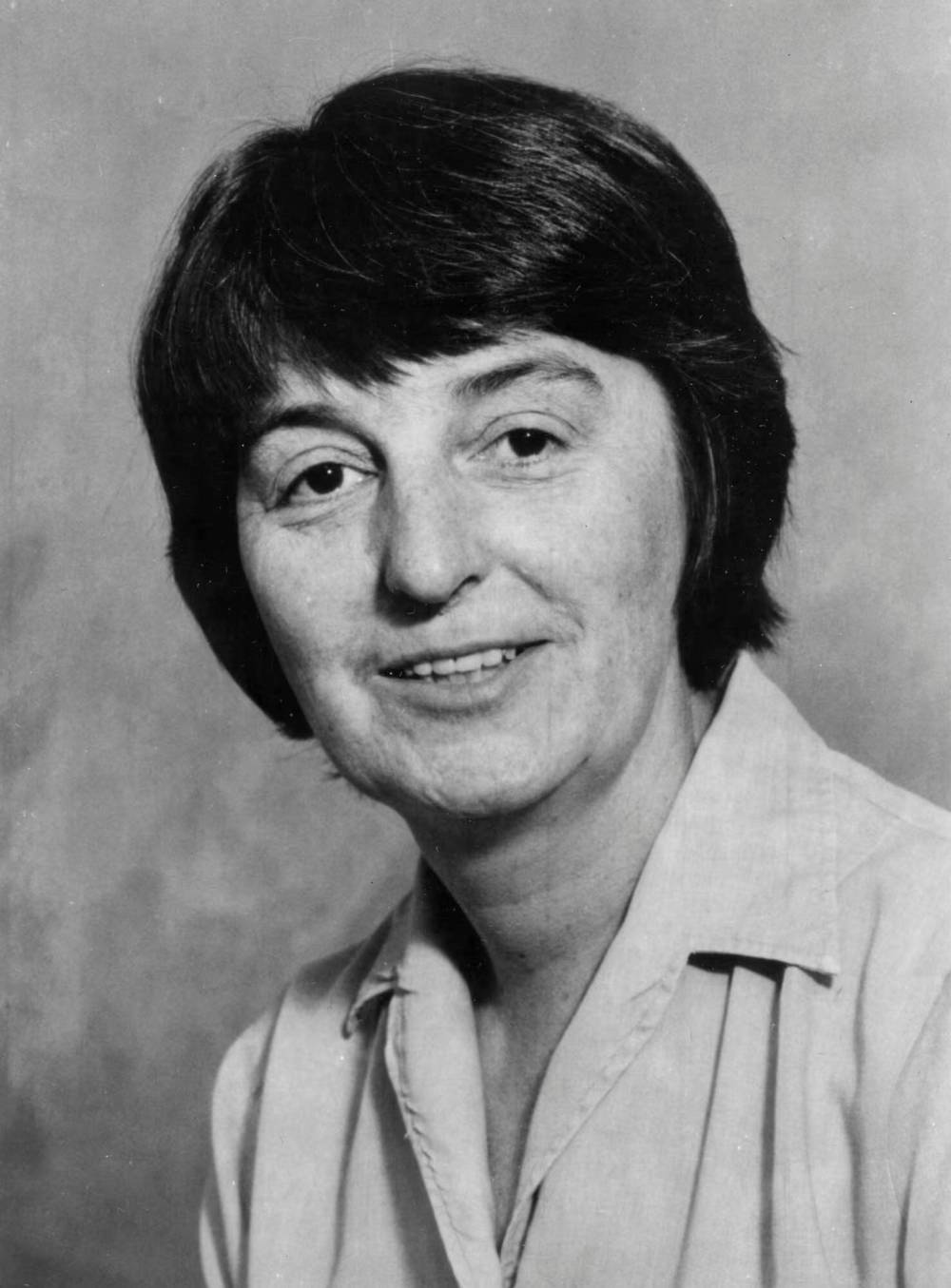
Winnipeg Tribune / University of Manitoba Archives
Dr. Marion Lewis, seen here in 1971, died in October at the age of 100.
“I think he really saw her full potential and he gave her a lot of … freedom to develop it,” Lewis’s niece Beth Regehr said. “He encouraged it, he made opportunities available to her. She really took those opportunities and ran with it.”
“Rh” refers to a protein found in some people’s blood. The “Rh” is short for “rhesus monkey,” the species in which the protein was first discovered; it later became apparent that the protein sometimes existed in human blood as well.
Rh disease can occur when a mother is Rh-negative but is carrying an Rh-positive fetus. In such a situation, the mother’s immune system will sometimes recognize the fetus as a foreign substance and produce antibodies to attack it, causing complications ranging from jaundice to stillbirth.
Lewis went on, with Chown, David Bowles and Dr. J.M. Bowman to found the Winnipeg Rh Institute in 1969.
Through their work, the team at the Rh lab developed what was effectively a cure for the condition.
Lewis became a leader in the field of hematology and was a member of many scientific societies.
She was also a pioneering researcher in the field of blood-group gene mapping.
“I know she did some work with the Inuit and she was up north, in the far north. I know sometimes she travelled by dog sled to the communities,” Regehr said. “She was studying the blood groups.”
Despite only having a bachelor’s degree, Lewis’s expertise led to her appointment as a professor at the University of Manitoba in the departments of pediatrics and human genetics.
She was awarded an honorary doctorate from the University of Winnipeg in 1986.
Dr. Arnold Naimark, dean emeritus of the Max Rady College of Medicine at the University of Manitoba, said the Rh lab was a picture of spartan simplicity.
“In 1956-57, I was a medical student rotating through the Women’s Pavilion of the then-Winnipeg General Hospital and out of curiosity went up to the top floor to see where the Rh lab was located and exchanged a few words with her,” Naimark said. “We never met after that first encounter. But I did learn an enduring lesson — namely, that great achievements may come from remarkably modest physical surroundings.”
Naimark said Lewis’s work was foundational to much of what came after.
“Her work contributed to and was one of the building blocks of the ensuing decades of interest and development at the university of world-class studies in health and disease.”
Supplied
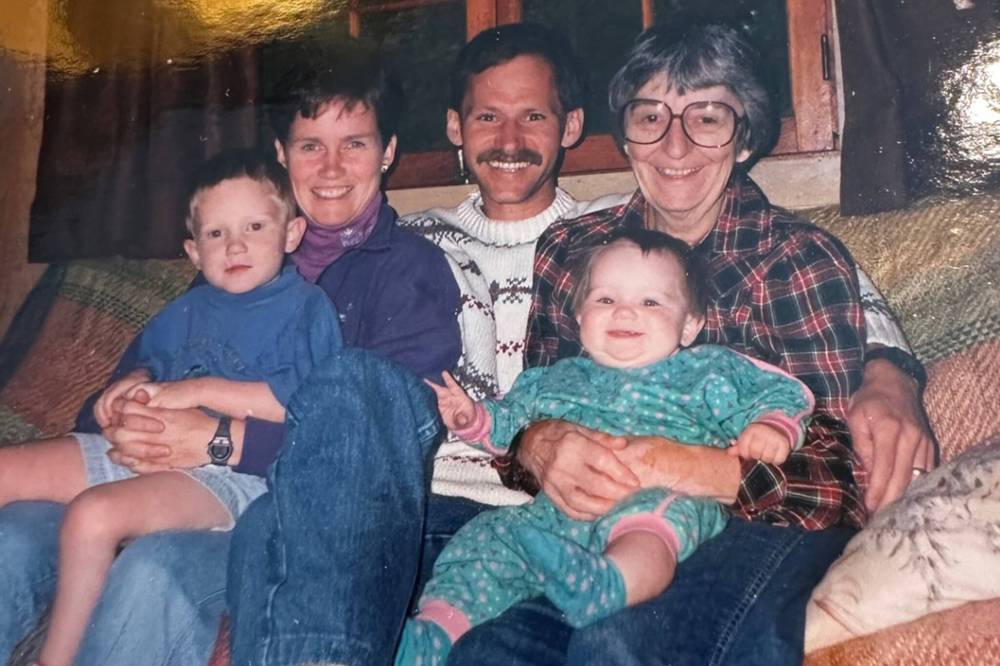
From left: Brydan Regehr, Beth Regehr, Dave Regehr, Marion Lewis and Sara Regehr (the baby on Marion’s lap). The photo was taken at Marion’s (now Beth’s) cottage at Falcon Lake.
Naimark also explained the importance of understanding the history of scientific achievements in order to understand how and why scientific innovations happen.
“I think the legacy (of Marion Lewis) is diffuse and diluted and spread over,” he said. “There is so much interest in ‘What’s tomorrow? What’s the next best thing?’ No one looks at the roots of the knowledge, but it’s the place where you can identify what you should be aiming for in the future.
“Otherwise, you’re just chasing what’s momentarily popular.”
Lewis’s nephew, Dan Lewis, described his aunt as a polymath, knowledgeable in a huge range of topics.
“Conversations with her were amazing,” Dan said. “So far-ranging and just so many topics; we could just talk for hours and hours and hours (about) everything, ranging from our family heritage to literature to nature. You know, everything.
“She’s just incredibly intelligent and gifted at languages.”
For Lewis’s contributions, she was appointed to the Order of Canada in 2019 and made an officer of the Order of Manitoba in 2020.
Despite her grand accomplishments in life, Dan said, his aunt was, at heart, a down-to-earth person.
“(She was) very humble,” he said, “very connected to nature.”
He said she appreciated nature, culture and was able to see beauty in simplicity. She also loved Labrador retrievers.
“She loved her gardens, she loved her property on the banks of the Red River, she loved the birds. She knew every bird, she had feeders and she watched those feeders all the time,” Dan said.
Regehr said that her aunt became a locavore before it was cool.
“The garden could have fed an army,” she said. “This garden, she would seek out the Harrowsmith seed catalogue every year. She was back to the earth. She grew all the food she ate and canned and preserved it for all winter. That’s why, I think, she lived to 100.”
Lewis was generous, sharing the fruits of her labour with friends.
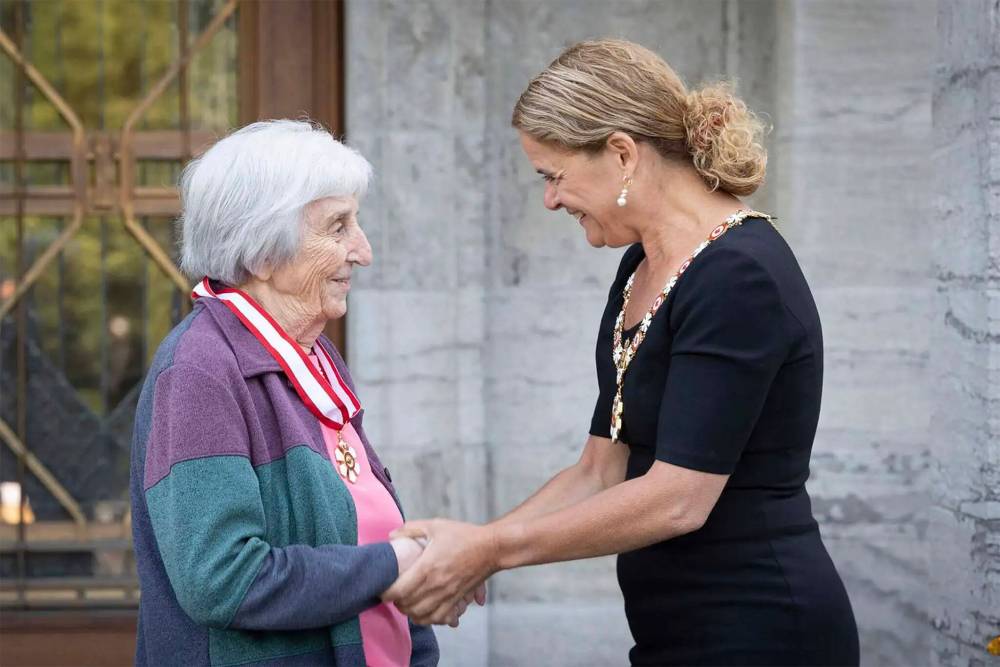
Johanie Maheu / Rideau Hall
Julie Payette, Governor General of Canada, presents the Officer insignia of the Order of Canada to Marion Lewis during a ceremony at Rideau Hall.
“She invited all her friends on the street to come over. She would tell them when the lettuce or the spinach or the beets, potatoes, when they would come in,” Regehr explained.
Dan said his aunt had a love of nature that inspired his own life path.
“One thing she did that I’m proudest of her (for) is that in 1992 she signed the original… World Scientists Warning to Humanity,” Dan said, “She signed that in 1992, and it was scientists like her that could see that the climate crisis was going to threaten life on Earth.”
Dan eventually became an environmental activist in British Columbia. He helped organize the Clayoquot Sound protests of 1993.
Lewis gave Dan the ability to see aspects of Winnipeg people overlook.
“Living in B.C., people are like ‘Oh, Winnipeg,’” Dan said, “and I’m like, oh no, Winnipeg is amazing. There’s so much culture.

“She was a patron of the arts. She would go to all of those events; whenever I visited her, we’d be going out every night to some performance. She supported the ballet, the symphony, all the theatre companies.”
Regehr mirrored her brother’s thoughts.
“I live in Vernon, B.C,. and we don’t have as much going on as Winnipeg, but I look for plays and music and music events. I definitely enjoy them and I feel it’s because of an early introduction by my aunt.”
Lewis died on Oct. 18 at the age of 100, leaving a legacy of scientific achievement, cultural appreciation and tireless intellectual curiosity.
fpcity@freepress.mb.ca