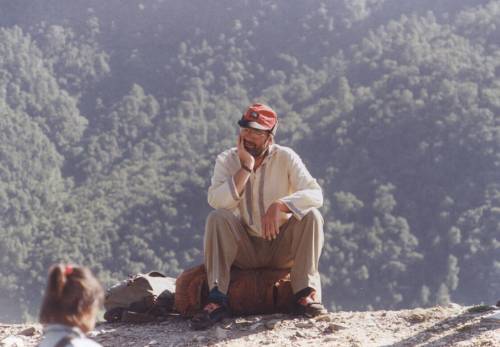
Whether it’s a mini-sabbatical or an adult gap year, more people are taking extended work breaks
Advertisement
Read this article for free:
or
Already have an account? Log in here »
To continue reading, please subscribe:

Digital Subscription
One year of digital access for only $205*
- Enjoy unlimited reading on winnipegfreepress.com
- Read the E-Edition, our digital replica newspaper
- Access News Break, our award-winning app
- Play interactive puzzles
*First annual payment billed as $205.00 + GST for one year. This annual subscription will automatically renew at $233.00 + GST every 52 weeks (10% off the regular annual price of $259.35). Offer available to new and qualified returning subscribers only. Cancel any time.
To continue reading, please subscribe:
Add Free Press access to your Brandon Sun subscription for only an additional
$1 for the first 4 weeks*
- Enjoy unlimited reading on winnipegfreepress.com
- Read the E-Edition, our digital replica newspaper
- Access News Break, our award-winning app
- Play interactive puzzles
*Your next Brandon Sun subscription payment will increase by $1.00 and you will be charged $17.95 plus GST for four weeks. After four weeks, your payment will increase to $24.95 plus GST every four weeks.
Read unlimited articles for free today:
or
Already have an account? Log in here »
Hey there, time traveller!
This article was published 15/02/2026 (217 days ago), so information in it may no longer be current.
If you daydream about getting a break from work, you might picture two weeks of vacation or a long weekend getaway. But some people dare to imagine something bigger and find ways to get a substantial breather from stress or their day-to-day routines.
Mini-sabbaticals. Adult gap years. Micro-retirement. Extended career breaks go by many names and take many forms, from using the time between jobs to explore or taking an employer-approved leave to becoming a digital nomad or saving up for a monthslong adventure. Creating space for a reset, whether mental, physical or spiritual, is the common thread.
Cost, personal responsibilities and fears of being judged by colleagues, friends and family members are some of the obstacles that prevent people from hitting pause on their work lives and setting out in search of new perspectives, according to sabbatical experts and people who have taken sabbaticals.

No longer just for academics
American attitudes toward taking time off are different from the ones in much of Europe, where free time and rest are prioritized, said Kira Schrabram, an assistant professor of management at the University of Washington’s business school who studies meaningful and sustainable work. In the European Union, workers are entitled by law to at least 20 days of paid vacation a year.
But more companies are allowing weeks or months of paid or unpaid leave as a way to retain valued employees, according to Schrabram. Seven years ago, she brought her experience researching burnout to the Sabbatical Project, an initiative founded by Harvard Business School Senior Lecturer DJ DiDonna that promotes sabbaticals as “a sacred human ritual” to which more people should have access.
Schrabram, DiDonna and University of Notre Dame Professor Emeritus Matt Bloom interviewed 50 U.S. professionals who took an extended break from non-academic jobs. From the responses, they identified three types of sabbaticals: working holidays that involved pursuing a passion project; “free dives” that combined exciting adventures with periods of rest; and quests undertaken by burned-out people who engaged in life-changing explorations once they had recovered sufficiently.
More than half of the interview subjects self-funded their hiatuses. In an article for the Harvard Business Review, the researchers made a case for sabbaticals as a tool employers could use to recruit, keep and foster talented workers. But since extended paid leaves are not common, “we’re really pushing back on the idea that a sabbatical needs to be sponsored by an employer,” Schrabram said of the Sabbatical Project, which created a network of coaches and mentors to encourage the sabbatical-curious.
Leading by example
Roshida Dowe was 39 years old and working as a corporate lawyer in California when she got laid off in 2018. Instead of seeking a new job right away, she decided to spend a year traveling. Struck by how many how many people asked how she managed it, Dowe decided to decided to try working as an online career-break coach.
She and Stephanie Perry, a former pharmacy technician who also took a gap year to travel and found a calling in coaching, co-founded ExodUS Summit, a virtual conference for Black women to talk about taking a sabbatical or moving abroad. Speakers at the event discuss both practical considerations like finances, safety and health care, and more philosophical topics like the value of rest and breaking free of intergenerational trauma.
Showcasing women who set off to see the world is powerful because “a lot of us aren’t open to possibilities we haven’t been shown before,” said Dowe, who moved to Mexico City as part of her own reinvention.
“When I coach women who are looking to take a sabbatical, the main thing they’re looking for is permission,” she said.
For Perry, a 2014 vacation in Brazil served as a catalyst for when she met people staying in her hostel who were traveling for months, not days. She researched budget travel and found people making it work on $40 a day.
Prior to that, “I thought for sure people who traveled long term were all trust fund babies,” she said.
Funding the dream
Cost is a common obstacle for people considering a break. There are creative ways around that, said Perry, who has legal residency in Mexico and an apartment in Bogota, Colombia.
“Housesitting is the reason I can work very little and travel a lot,” she said.
Perry, who has a YouTube channel where she posts videos about traveling or becoming an expat as a Black American, raises money through her subscribers to sponsor Black women on sabbaticals.
When Ashley Graham took a break from her work at a nonprofit in Washington, D.C., she mapped out a road trip that included visiting friends with whom she could stay for free.
“It was a great way to connect with my past life,” said Graham, who subsequently relocated to New Orleans after loving the city during her sabbatical travels.

Taylor Anderson, is a certified financial planner based in Vancouver, Washington, specializes in helping clients plan for sabbaticals. She said many of the same principles apply to saving up for one as they do to saving for retirement. Both require financial discipline as well as a willingness to recognize when it’s safe to spend.
“We talk about money breathing. Sometimes it’s inhaling, sometimes it’s exhaling,” Anderson, who has experienced the benefits of a sabbatical reboot herself, said. “Often we find that people do have money saved, but they’re afraid to spend it.”
“The question of ‘What is enough?’ is really difficult,” she added.
Can everyone afford to take a month or more without a paycheck? Of course not. But for those who have built up a nest egg, “the cost is actually less than you might assume,” she said.
Risks and rewards
Artists Eric Rewitzer and Annie Galvin put two employees in charge of their San Francisco gallery in 2018 to spend the summer in France and Ireland.
“It was terrifying,” said Rewitzer, who described himself as having been a workaholic and control freak. “It was a huge exercise in trust.”
When they returned to San Francisco, Rewitzer saw the city differently. He felt his life had been out of balance — too much work and too little time in nature.
That shift in perspective led the couple to buy what they thought would be a weekend home in the Sierra Nevada. It turned into their full-time home when they shut down their gallery during the COVID-19 pandemic.
“It all comes back to that same place of being willing to take chances,” Rewitzer said.
A way of life
Taking a break from college to be a ski bum in Vail, Colorado, set Gregory Du Bois on a path of taking mini-sabbaticals throughout his corporate IT career. Each time he took a new job, he negotiated for extended time off, explaining to his managers that to perform at his best, he needed breaks to recharge.
“It’s such a way of life that I almost don’t think of it as sabbaticals,” said Du Bois, who retired from tech and began working as a life coach in Sedona, Arizona. “For me, it’s a spiritual regeneration.”
___
Colleen Newvine is the product manager of the AP Stylebook at The Associated Press. She is also a life and career coach, and the author of “Your Mini Sabbatical.” She and her husband have lived temporarily in New Orleans, San Francisco and Costa Rica’s Nicoya Peninsula, among other mini sabbatical locales.