One of the largest modern US infrastructure projects will soon burrow toward New York City

Advertisement

Advertise with us

NORTH BERGEN, N.J. (AP) — When the original train tunnel beneath the Hudson River connecting Manhattan to New Jersey was built more than a century ago, workers toiled with picks and shovels from each side until eventually meeting in the middle.

Read this article for free:


or

Already have an account? Log in here »

To continue reading, please subscribe:

Subscribe and receive a limited-edition Free Press branded hat or tote.

Digital Subscription

One year of digital access for only $205*

  • Enjoy unlimited reading on winnipegfreepress.com
  • Read the E-Edition, our digital replica newspaper
  • Access News Break, our award-winning app
  • Play interactive puzzles

*First annual payment billed as $205.00 + GST for one year. This annual subscription will automatically renew at $233.00 + GST every 52 weeks (10% off the regular annual price of $259.35). Offer available to new and qualified returning subscribers only. Cancel any time.

To continue reading, please subscribe:

Add Free Press access to your Brandon Sun subscription for only an additional

$1 for the first 4 weeks*

  • Enjoy unlimited reading on winnipegfreepress.com
  • Read the E-Edition, our digital replica newspaper
  • Access News Break, our award-winning app
  • Play interactive puzzles
Start now

*Your next Brandon Sun subscription payment will increase by $1.00 and you will be charged $17.95 plus GST for four weeks. After four weeks, your payment will increase to $24.95 plus GST every four weeks.

NORTH BERGEN, N.J. (AP) — When the original train tunnel beneath the Hudson River connecting Manhattan to New Jersey was built more than a century ago, workers toiled with picks and shovels from each side until eventually meeting in the middle.

A new tunnel, one of the largest U.S. mass transit projects in generations and which is expected to cost $16 billion, will take a decidedly modern approach.

Giant drilling machines nearly the length of two football fields armed with cutters harder than diamonds will chew through dense rock. A crew of about 40 will oversee a conveyor system hauling out debris as well as equipment to install the tunnel’s curved concrete lining.
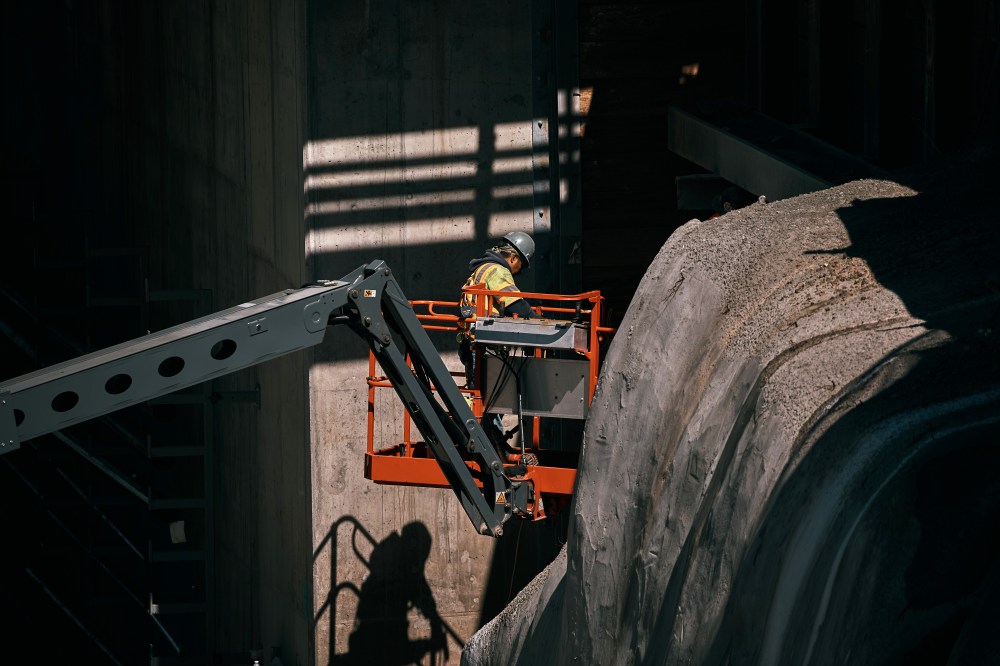
A worker stands on a crane while securing exposed rock along a wall at the Palisades Tunnel Project, part of the Gateway Program, on Tuesday, May 12, 2026, in North Bergen, N.J. (AP Photo/Andres Kudacki)

“This is a fully automated, underground factory,” said James Starace, chief of program delivery for the Gateway Development Commission, a public agency formed by New York and New Jersey that’s undertaking the tunnel project.

Wearing a hardhat and yellow safety vest, Starace stood Tuesday in a trench cut into the hills across the river from New York City. Behind him rose a two-story wall of solid rock where, if all goes as planned, by 2035 trains will speed in and out of the tunnel, easing a bottleneck on the busiest passenger rail corridor in the nation.

The tunnel-boring machines arrived “like Lego pieces” from Germany in nearly 100 different components, said Hamed Nejad, the project’s chief engineer. Outside the tunnel’s future entrance, sparks flew as a team of welders fused pieces of the massive cutterheads.

Danny Pearlstein, a spokesperson for the transit advocacy group Riders Alliance, said America has grown unaccustomed to building megaprojects at this scale, which has contributed to the cost.

“What’s astonishing about Gateway isn’t the size and scope of the project,” Pearlstein said, “but that it’s taken this long to get only so far.”

The machines are expected to take about a year to grind through the first section in the New Jersey Palisades, which is made of tough volcanic rock, once digging starts later this year, according to Starace. That’s about 30 feet of tunnel a day. Other machines will dig under the riverbed.

In full, the new tunnel with two train tracks inside will run almost 2.5 miles (4 kilometers). The original two-tracked tunnel, damaged by saltwater during Superstorm Sandy, will be renovated.

The ambitious project received key approvals and funding under the Biden administration, but nearly ground to a halt a few months ago.

The Trump administration froze funding during the recent federal government shutdown, citing concerns that the project was allocating funds based on diversity, equity and inclusion principles.

As funding neared depletion in February, a federal judge ordered the administration to release the funds. Money has continued flowing as a lawsuit brought by New York and New Jersey against the federal government plays out.

___

Follow Philip Marcelo at https://x.com/philmarcelo
Report Error Submit a Tip

More Stories

Today’s horoscope

Georgia Nicols 4 minute read Preview

Today’s horoscope

Georgia Nicols 4 minute read Yesterday at 2:01 AM CDT

MOON ALERT: After 12:15 a.m., there are no restrictions to shopping or important decisions today. The moon is in Capricorn.

ARIES (March 21-April 19)

This is a tricky day. Don’t be too ambitious. It’s totally OK to kick back and relax. But be aware that communications with parents and authority figures might be confused, vague or subject to misunderstandings. Nevertheless, romance is sweet and cosy!

TAURUS (April 20-May 20)

Read
Yesterday at 2:01 AM CDT

Canada must not accept another Iranian autocracy

David Matas 5 minute read Yesterday at 2:01 AM CDT

Iran is a state run by a radical government victimizing its citizens and its neighbours. How do we change that? Any regime change that repeats the mistakes of the past is not a solution.

What went wrong in the past which led to the current regime? One answer is the U.K. and American aided coup which led to the ouster in 1953 of a democratically elected government headed at the time by Mohammad Mossadegh and its replacement with an American friendly autocrat, the Shah of Iran, Mohammad Reza Pahlavi.

The Shah imposed his rule through the Iranian National Intelligence and Security Organization — SAVAK, the acronym of its Persian name. SAVAK systematically inflicted torture, arbitrary killings and extra-judicial killings on perceived opponents of the regime. It was only a matter of time before repression of a regime directed to serving foreign interests would be overthrown.

What replaced the regime of the Shah, in 1979, the current regime of the mullahs, is a regime as intolerant and violent as the regime of the Shah and then some. That was not inevitable. But neither was it surprising. The vicious nature of the current regime, following the example set by the Shah, and its hatred for the United States, reacting to the U.S. aided imposition of the Shah, both echoes and reacts to the past. In 1979, the U.S. reaped what it sowed in 1953.

Give-and-take relationship of Roman leaders takes centre stage in Harris’s historical fiction

Reviewed by Kathryne Cardwell 4 minute read Preview

Give-and-take relationship of Roman leaders takes centre stage in Harris’s historical fiction

Reviewed by Kathryne Cardwell 4 minute read Yesterday at 2:01 AM CDT

British novelist Robert Harris’s latest work is a reflection on tyranny, corruption and betrayal among all-powerful political leaders.

You might be forgiven for thinking it’s a contemporary thriller — it’s actually historical fiction set in ancient Rome.

A former BBC journalist, Harris debuted as a novelist in 1992 with Fatherland, an alternative history where Nazi Germany won the Second World War.

Since then, the prolific author has become best-known for his works of historical fiction, especially his ancient Rome trilogy released from 2006-2015 and the novel Conclave, which was published in 2016 and was made into the film of the same name in 2024.

Read
Yesterday at 2:01 AM CDT

Near-future U.S. the setting for surreal dual-world storyline

Reviewed by Morley Walker 4 minute read Preview

Near-future U.S. the setting for surreal dual-world storyline

Reviewed by Morley Walker 4 minute read Yesterday at 2:01 AM CDT

It’s not every day you encounter a seriously intended literary novel that attempts to dramatize a mind-bending physics theory like quantum entanglement.

But then the B.C.-born-and-raised Emily St. John Mandel is not your everyday Canadian literary writer.

In her late 40s, she has lived in the U.S. for her entire writing career. She is best known for her 2014 dystopian novel Station Eleven, about a Shakespearean acting troupe navigating a pandemic-ravaged America.

Her new outing, her seventh, Exit Party, shares DNA with detective and sci-fi genres more than with conventional literary fiction.

Read
Yesterday at 2:01 AM CDT

Winnipeg Jets at Edmonton Oilers

0 minute read Yesterday at 3:22 PM CDT

Cabernet Sauvignon star of wine festival

Ben Sigurdson 5 minute read Preview

Cabernet Sauvignon star of wine festival

Ben Sigurdson 5 minute read Yesterday at 3:00 AM CDT

The Winnipeg Wine Festival will celebrate the king of red wine grapes next weekend — the theme of this year’s festival, which takes place Sept. 25 and 26 at the RBC Convention Centre, is Cabernet Sauvignon.

Cab Sauv, as it’s also known, is the world’s most widely planted wine grape of any colour, first coming to prominence in the 1800s in France’s Bordeaux region, where the grape is still popular. Rather than single-variety wines, Bordeaux reds tend to be blends, with those coming from the left bank of the Gironde estuary being Cabernet-dominant, while right-bank wines are Merlot-dominant, with Cabernet Sauvignon playing a supporting role. Cabernet and Merlot work well together and many other countries have followed suit in blending the two.

A team at University of California Davis put Cabernet Sauvignon through a DNA test in 1996 and discovered its parent grapes are Cabernet Franc and Sauvignon Blanc — it’s likely that at some point the two varieties, planted next to each other in some vineyard, crossed and mutated and became the grape we know today. (Someone growing grapes in the 19th century must have had an inkling of what was up, as the grape has been called Cabernet Sauvignon since long before the DNA test.)

Flavour-wise, most Cabernet Sauvignon wines are big and bold, with a core of deep dark berry flavours, some graphite and spice notes and relatively bright acidity. It’s a grape that is well-suited to barrel aging, with most examples seeing at least some time in wood.

Read
Yesterday at 3:00 AM CDT