

Free condoms save money on health care: med students

Advertisement
Read this article for free:
or
Already have an account? Log in here »
To continue reading, please subscribe:

Digital Subscription
One year of digital access for only $205*
- Enjoy unlimited reading on winnipegfreepress.com
- Read the E-Edition, our digital replica newspaper
- Access News Break, our award-winning app
- Play interactive puzzles
*First annual payment billed as $205.00 + GST for one year. This annual subscription will automatically renew at $233.00 + GST every 52 weeks (10% off the regular annual price of $259.35). Offer available to new and qualified returning subscribers only. Cancel any time.
To continue reading, please subscribe:
Add Free Press access to your Brandon Sun subscription for only an additional
$1 for the first 4 weeks*
- Enjoy unlimited reading on winnipegfreepress.com
- Read the E-Edition, our digital replica newspaper
- Access News Break, our award-winning app
- Play interactive puzzles
*Your next Brandon Sun subscription payment will increase by $1.00 and you will be charged $17.95 plus GST for four weeks. After four weeks, your payment will increase to $24.95 plus GST every four weeks.
Read unlimited articles for free today:
or
Already have an account? Log in here »
UNIVERSITY medical students want the province to provide free condoms and better sex education as Manitoba contends with a public health emergency owing to escalating rates of HIV infection.
Kyla Goulet-Kilgour and a handful of classmates want to meet with Health Minister Uzoma Asagwara. On Monday, they presented their case to Progressive Conservative MLAs.
“I think we all saw what’s happening in Manitoba and firmly believe that we needed to address it,” said Goulet-Kilgour, a second-year medical student at the University of Manitoba.
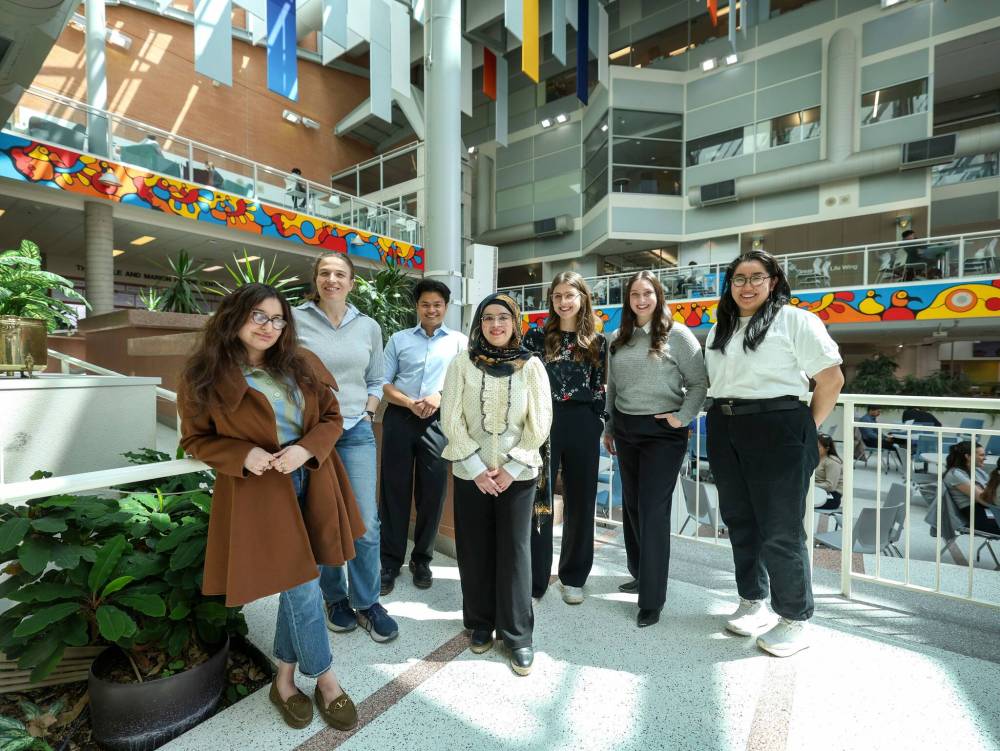
RUTH BONNEVILLE / FREE PRESS
University of Manitoba medical students advocacy committee members Humera Sadiq (from left), Kara Klassen, Russell Malabanan Noor Imran, Kyla Goulet-Kilgour, Kyra Cebula and JJ Mao. The committee is advocating for free condoms in pharmacies.
She joins roughly a dozen colleagues on a medical students advocacy committee. Each year, the group chooses a topic to highlight to local politicians. They decided on HIV last September after looking at rates of sexually transmitted and blood-borne infections in the province.
Last week, Manitoba’s chief provincial public health officer declared a public health emergency. Dr. Brent Roussin cited sexual intercourse as one of the main drivers behind rising HIV rates.
His announcement took place one day before the students were to meet with Manitoba Liberals.
“The timing was interesting,” said Goulet-Kilgour, 22. “We hope that having our advocacy efforts coincide with the … public health emergency will urge MLAs to take this matter seriously and implement evidence-based policies.”
Condoms are a “cost-effective” method to help stem sexually transmitted and blood-borne infections. In an advocacy campaign document, the students cite a study from the Netherlands in which researchers found €5.51 (CAD8.85) was saved for every euro ($1.60) that was spent on an initiative to provide free condoms in gay bars. The 2019 study was published in the National Institutes of Health’s National Library of Medicine.
Manitoba would save money on HIV medication, hospitalizations and the negative effect on the workforce related to sexually transmitted infections, Goulet-Kilgour said, if it were to provide free condoms in pharmacies.
“I personally believe that a good health-care system should be seen as a pocketbook issue and an economic issue for our province,” she said.
The committee pointed to France, which made condoms free to people under 26 as of 2023.
Manitoba funds safer sex supplies, including condoms, through regional health authorities and the Winnipeg-based Sexuality Education Resource Centre. The amount of funding allocated to such supplies wasn’t available Tuesday.
Still, pharmacies would be an ideal hub for free condoms because they’re accessible to rural Manitobans, said Jodh Ghuman, a committee member.
“This would provide a greater equitable access,” the first-year Max Rady College of Medicine student said, adding Manitoba could follow France’s model in which people are required to show their health card.
The Sexuality Education Resource Centre has distributed nearly 80,000 condoms over the last two years, said Tanya Smith, the centre’s administrative assistant. It ships in bulk to non-profits and events. People visiting its headquarters at 167 Sherbrook St., can take a pack home.
For-profit companies — including, often, pharmacies — are not part of the centre’s funding agreement with the province and Winnipeg Regional Health Authority, Smith explained.
The Winnipeg Regional Health Authority spends roughly $15,000 to $20,000 on free condoms annually, a spokesperson said. It’s been distributing the items for at least 25 years.
Some pharmacies are likely “willing and itching” to provide free condoms, Smith said.
“Whether or not it’s good for their bottom line, and whether or not the government can actually provide the funding for that — those are two really different, major issues,” she said.
Businesses selling condoms have a wider range of options than what’s provided at non-profits.
Smith has clocked a “slight uptick” in the number of condoms requested by organizations.
Liberal Leader Willard Reaves met the student advocacy committee last week. The Manitoba government isn’t doing enough to make people aware of sexually transmitted infections, he said.

“A simple mail drop of awareness about the sexually transmitted diseases should happen,” Reaves said. “Here in the city, we have internet, we have all of these things.
“As you get further and further away from the city of Winnipeg, you find out that the information train is not as plentiful as it would be here.”
The students are also advocating for greater education on sexually transmitted infections in schools. STIs and HIV are part of Grade 9 and 10 health curricula.
There may not be enough support to hit all curriculum points in a year, Goulet-Kilgour said.
gabrielle.piche@winnipegfreepress.com
Gabrielle Piché reports on business for the Free Press. She interned at the Free Press and worked for its sister outlet, Canstar Community News, before entering the business beat in 2021. Read more about Gabrielle.
Every piece of reporting Gabrielle produces is reviewed by an editing team before it is posted online or published in print — part of the Free Press‘s tradition, since 1872, of producing reliable independent journalism. Read more about Free Press’s history and mandate, and learn how our newsroom operates.
Our newsroom depends on a growing audience of readers to power our journalism. If you are not a paid reader, please consider becoming a subscriber.
Our newsroom depends on its audience of readers to power our journalism. Thank you for your support.
Gabrielle Piché reports on business for the Free Press. She interned at the Free Press and worked for its sister outlet, Canstar Community News, before entering the business beat in 2021. Read more about Gabrielle.
Every piece of reporting Gabrielle produces is reviewed by an editing team before it is posted online or published in print — part of the Free Press‘s tradition, since 1872, of producing reliable independent journalism. Read more about Free Press’s history and mandate, and learn how our newsroom operates.
Our newsroom depends on a growing audience of readers to power our journalism. If you are not a paid reader, please consider becoming a subscriber.
Our newsroom depends on its audience of readers to power our journalism. Thank you for your support.
Related Articles
Governments blasted for inaction as HIV rates rise



Advertisement Advertise With Us
Advertisement Advertise With Us