

Ryle perfect choice for Manitoba’s first associate chief judge for reconciliation

Advertisement
Read this article for free:
or
Already have an account? Log in here »
To continue reading, please subscribe:

Digital Subscription
One year of digital access for only $205*
- Enjoy unlimited reading on winnipegfreepress.com
- Read the E-Edition, our digital replica newspaper
- Access News Break, our award-winning app
- Play interactive puzzles
*First annual payment billed as $205.00 + GST for one year. This annual subscription will automatically renew at $233.00 + GST every 52 weeks (10% off the regular annual price of $259.35). Offer available to new and qualified returning subscribers only. Cancel any time.
To continue reading, please subscribe:
Add Free Press access to your Brandon Sun subscription for only an additional
$1 for the first 4 weeks*
- Enjoy unlimited reading on winnipegfreepress.com
- Read the E-Edition, our digital replica newspaper
- Access News Break, our award-winning app
- Play interactive puzzles
*Your next Brandon Sun subscription payment will increase by $1.00 and you will be charged $17.95 plus GST for four weeks. After four weeks, your payment will increase to $24.95 plus GST every four weeks.
Read unlimited articles for free today:
or
Already have an account? Log in here »
There’s a story told by my father, the late justice Murray Sinclair, about his first week on the job in March 1988 as the first Indigenous judge in Manitoba history.
It’s in his autobiography Who We Are. For anyone who wants to follow along, it’s on page 141.
“One of the things that I like to tell young Indigenous lawyers is that, shortly after I was appointed, within a week of that, I was in the judicial coffee room of the courthouse, and I made a comment about something, I can’t remember what it was.
“And one of the judges said what I think he meant to be kind of a joke, but he also had a reputation as being quite a sarcastic, bullying kind of person — he said in response to my comment, ‘Well, Sinclair, everybody knows you were appointed a judge because you’re a Native guy.’
“I said to him immediately, without thinking about it at all, I said, ‘Yeah, well, everybody knows you were appointed judge because you’re a white guy. So, where does that leave us?’”
Judges are human beings: they’re imperfect and, while intelligent, make mistakes.
They are also Canadians.
This means they experienced the same education I did — an education almost completely absent of anything but negative representations of Indigenous peoples.
Many completed their degrees in the decades before mandatory courses in law schools that would train them – in at least a rudimentary way — about Indigenous histories, rights, and the laws, practices, and policies that targeted Indigenous communities and imposed cycles and legacies of poverty, trauma, and addiction.
MIKE DEAL / FREE PRESS Judge Jerilee Ryle is sworn into the Provincial Court Friday afternoon at the Law Courts.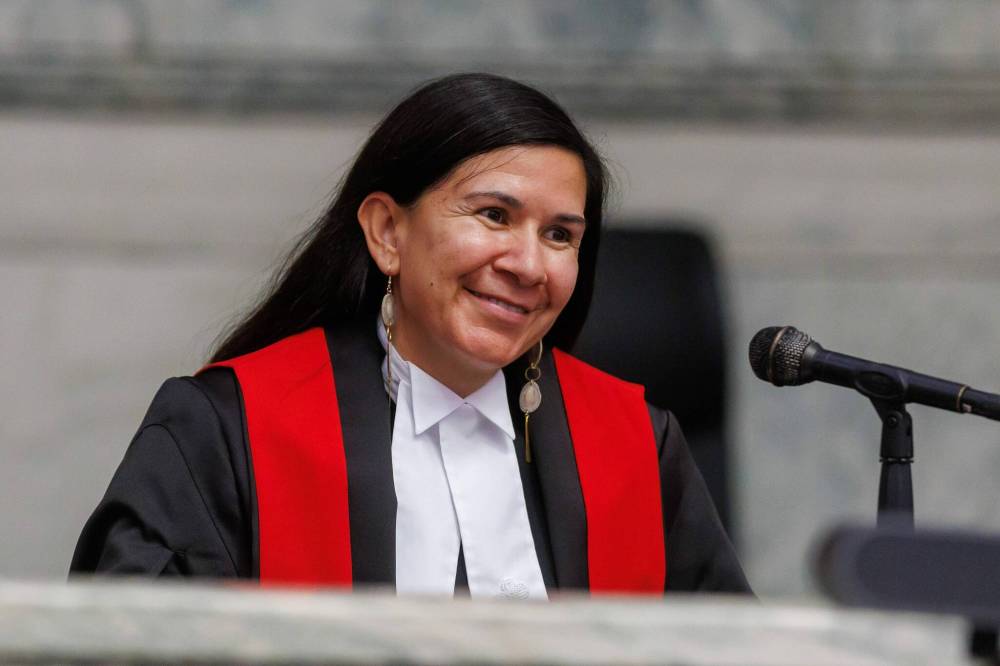
Judges were then inundated with the challenges of working in a justice system rife with uneducated, miseducated, and at times downright racist attitudes and beliefs by those who worked throughout the justice system.
As years have gone on and progressive attitudes and governments have mandated changes, judges have been tasked with trying to comprehend centuries of Indigenous knowledge and make competent decisions with little more than a few professional development opportunities.
I feel for them. I’ve been one of the individuals asked to give judges training on Indigenous rights and judicial practices. My experience is that while most judges work hard and want to know how to make Manitoba’s justice system better, they need help.
While most judges work hard and want to know how to make Manitoba’s justice system better, they need help.
My point: in a profession so influential and impactful in Manitoba’s justice system, knowledge surrounding the ways Indigenous peoples have been and currently are marginalized and mistreated, and how there are alternative and restorative judicial practices that serve Indigenous peoples more productively, could be the most essential thing judges need to know.
The fact judges have not been trained, resourced, and supported in how to appropriately work with the group who most often is charged with crimes in the justice system is, simply, criminal.
This is why Friday’s appointment of Judge Jerilee Ryle as the province’s first associate chief judge for reconciliation is as important as the appointment of my father nearly four decades ago.
Ryle’s resume is impressive.
She is Anishinaabe from Lake St. Martin First Nation and is a recent appointment to the provincial court after working as a Crown prosecutor and founding the Manitoba Prosecution Service’s Indigenous advisory council.
In some cases, less experience on the bench would mean there’s a steep learning curve, but this isn’t the case here.
Ryle is more qualified than the majority of Manitoba judges on the issue of how to best serve Indigenous peoples in Manitoba’s justice system.
Ryle is more qualified than the majority of Manitoba judges on the issue of how to best serve Indigenous peoples in Manitoba’s justice system.
The task to help judges fix a system that continues to over-police, over-incarcerate, and over-penalize Indigenous peoples is a tall order for Ryle.
Just the statistics surrounding incarceration alone are staggering. I could quote the Aboriginal Justice Inquiry, of which my father was co-commissioner in 1990, but here are a few modern ones.
For instance, Indigenous adults account for 78 per cent of all adult admissions to custody in Manitoba, despite representing only about 18 per cent of the province’s overall population.
Approximately 81 per cent of incarcerated boys and 82 per cent of incarcerated girls in Manitoba are Indigenous youth.
When charged with a crime, Indigenous adults in Manitoba are incarcerated at a rate 18 times higher than non-Indigenous adults.
Or, try this fact: today, around three-quarters of all inmates in Manitoba’s provincial custody are Indigenous and in remand – meaning they are being held awaiting trial and have not been convicted of a crime.
MIKE DEAL / FREE PRESS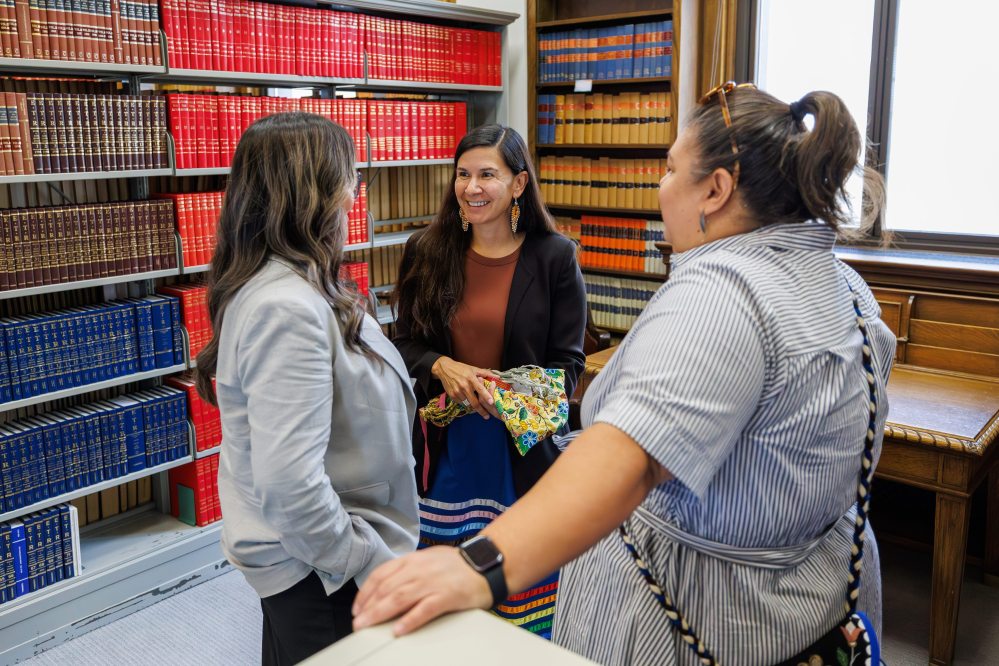
This means judges — competent or not — will see and make decisions about the fate of Indigenous peoples on their desks and in front of them every day next week multiple times.
Beginning July 2, Ryle will be available for the next seven years to support judges, help guide judicial education and training, and be a voice in developing policy.
Of any group, perhaps no one more than judges need more support in working with Indigenous peoples in Manitoba and they have a new colleague to stand with them.
That’s a good thing.
niigaan.sinclair@freepress.mb.ca
Niigaan Sinclair is Anishinaabe from Peguis First Nation and a professor in the Department of Indigenous Studies at the University of Manitoba. He’s been a columnist for the Free Press since 2018. Read more about Niigaan.
Every piece of writing Niigaan produces is reviewed by an editing team before it is posted online or published in print — part of the Free Press‘s tradition, since 1872, of producing reliable independent journalism. Read more about Free Press’s history and mandate, and learn how our newsroom operates.
Our newsroom depends on a growing audience of readers to power our journalism. If you are not a paid reader, please consider becoming a subscriber.
Our newsroom depends on its audience of readers to power our journalism. Thank you for your support.
Niigaan Sinclair is Anishinaabe from Peguis First Nation and a professor in the Department of Indigenous Studies at the University of Manitoba. He’s been a columnist for the Free Press since 2018. Read more about Niigaan.
Every piece of writing Niigaan produces is reviewed by an editing team before it is posted online or published in print — part of the Free Press‘s tradition, since 1872, of producing reliable independent journalism. Read more about Free Press’s history and mandate, and learn how our newsroom operates.
Our newsroom depends on a growing audience of readers to power our journalism. If you are not a paid reader, please consider becoming a subscriber.
Our newsroom depends on its audience of readers to power our journalism. Thank you for your support.
Related Articles
Unmoved by young offender’s progress, Manitoba judge ordered prison term; Indigenous man later chose death

Advertisement Advertise With Us
Advertisement Advertise With Us