

Wolseley residents put down roots to save elms
Challenge other neighbourhoods to preserve mature trees

Advertisement
Read this article for free:
or
Already have an account? Log in here »
To continue reading, please subscribe:

Digital Subscription
One year of digital access for only $205*
- Enjoy unlimited reading on winnipegfreepress.com
- Read the E-Edition, our digital replica newspaper
- Access News Break, our award-winning app
- Play interactive puzzles
*First annual payment billed as $205.00 + GST for one year. This annual subscription will automatically renew at $233.00 + GST every 52 weeks (10% off the regular annual price of $259.35). Offer available to new and qualified returning subscribers only. Cancel any time.
To continue reading, please subscribe:
Add Free Press access to your Brandon Sun subscription for only an additional
$1 for the first 4 weeks*
- Enjoy unlimited reading on winnipegfreepress.com
- Read the E-Edition, our digital replica newspaper
- Access News Break, our award-winning app
- Play interactive puzzles
*Your next Brandon Sun subscription payment will increase by $1.00 and you will be charged $17.95 plus GST for four weeks. After four weeks, your payment will increase to $24.95 plus GST every four weeks.
Read unlimited articles for free today:
or
Already have an account? Log in here »
A neighbourhood group that raised thousands of dollars to inoculate publicly owned trees against Dutch elm disease hopes others will follow their lead.
The Wolseley Residents Association fundraised about $20,000, then secured city grants to cover another $65,000 for the project. The $85,000 will pay for 150 American elms to be protected against the disease for about three years.
“My hope is that this will inspire other neighbourhoods to take similar action … (This) only came because of that citizen action that took place first,” said Ian Dyck, a member of the association’s tree committee.
MIKE DEAL / FREE PRESS
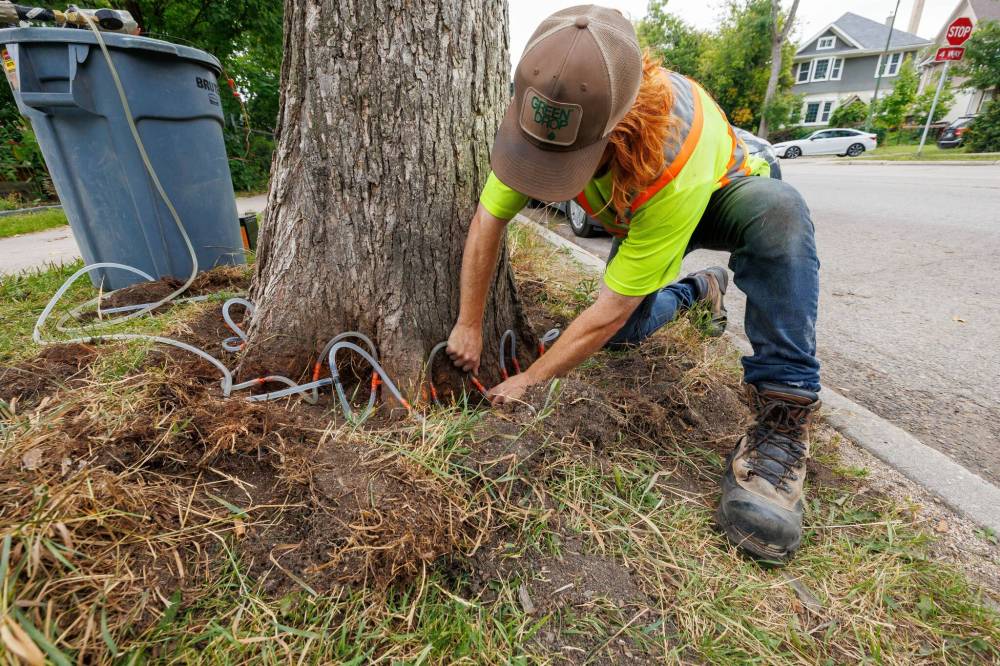
Sean Perkins, tree health care leader with Green Drop Tree Care, installs tubing to a tree that will deliver a fungicide to help protect the Westminster Avenue tree against dutch elm disease.
Green Drop Lawn Care is now completing the work, which began last year and will treat boulevard trees on Westminster and Wolseley avenues.
“The trees are really what makes this community so special. It’s a big reason why people live in Wolseley. I think the surge in Dutch elm disease here in the last couple of years is really eye-opening and frightening for people,” said Dyck. “People are just very attached to these trees … They love the tree that sits on the boulevard outside their house and it’s devastating once they see the orange dot go up (that marks an infected tree for removal).”
While the association got the city’s permission to treat the publicly owned trees, the municipal government’s own Dutch elm protection program focuses on monitoring and rapid removal of infected trees to stop the spread of disease.
Dyck said his community hopes to preserve existing mature trees for as long as possible, noting mature trees provide shade, cool homes and offer a connection to nature.
“It’s going to take decades, if ever, (for) one of these new trees to replace the benefits of a mature elm tree,” he said.
Further fundraising would be needed to continue treatments in the future, with the next dose required in about three years.
Simon Peacock, an arborist with Green Drop, said the effort involves injecting healthy trees with a fungicide called Arbotect 20-S.
“In the simplest terms, we drill holes in the root flare at the very bottom of the tree and then insert these tubes that … use a pump to flow the product through and the tree just naturally takes it up through the holes … If the fungus is to enter the tree above ground anywhere, it would be stopped because this fungicide is inside the tree to stop it from getting sick,” said Peacock.
A little under half of the 150 trees were treated last year, while the company expects to complete the rest next week.
Peacock said his company has used this treatment for about 10 years, though it is rare for residents to pay for its use on publicly owned trees.
“It’s very unusual for a whole community to band together like this,” he said.
He noted some Riverview residents have also expressed interest in the inoculation option.
The city forester said the Wolseley project offers a “great partnership.”
“They’re able to do a focused effort in their neighbourhood to slow the spread (of Dutch elm disease) … That actually gives more time to retain some of the canopy as the new trees being replaced are … growing,” said Martha Barwinsky.
The city did inoculate about 200 high-value elm trees in the past but stopped doing so about 20 years ago, when Dutch elm disease rates increased, said Barwinsky.
“Our (current) program is focused on sanitation for Dutch elm disease. We’ve got over 190,000 American elms in the city … About 50,000 of those trees are on streets and in parks. And, so, when we look at the cost and the resources required to do that kind of preventative treatment, it would take away from the sanitation efforts,” she said.
She noted inoculations on so many trees would be “very expensive.”

The city will spend about $7 million, including $1 million from the province, on its sanitation effort this year, which includes surveillance of trees for Dutch elm disease symptoms, ensuring elm firewood is properly disposed of and removing diseased trees as soon as possible.
“The most effective means of controlling Dutch elm disease is with early removals and so that’s what we’ve been striving to achieve over the past several years and we’re starting to see a reduction in incidence now,” said Barwinsky.
Tree replacement is part of a separate replanting budget.
joyanne.pursaga@freepress.mb.ca
X: @joyanne_pursaga
Joyanne is city hall reporter for the Winnipeg Free Press. A reporter since 2004, she began covering politics exclusively in 2012, writing on city hall and the Manitoba Legislature for the Winnipeg Sun before joining the Free Press in early 2020. Read more about Joyanne.
Every piece of reporting Joyanne produces is reviewed by an editing team before it is posted online or published in print — part of the Free Press‘s tradition, since 1872, of producing reliable independent journalism. Read more about Free Press’s history and mandate, and learn how our newsroom operates.
Our newsroom depends on a growing audience of readers to power our journalism. If you are not a paid reader, please consider becoming a subscriber.
Our newsroom depends on its audience of readers to power our journalism. Thank you for your support.
Joyanne is city hall reporter for the Winnipeg Free Press. A reporter since 2004, she began covering politics exclusively in 2012, writing on city hall and the Manitoba Legislature for the Winnipeg Sun before joining the Free Press in early 2020. Read more about Joyanne.
Every piece of reporting Joyanne produces is reviewed by an editing team before it is posted online or published in print — part of the Free Press‘s tradition, since 1872, of producing reliable independent journalism. Read more about Free Press’s history and mandate, and learn how our newsroom operates.
Our newsroom depends on a growing audience of readers to power our journalism. If you are not a paid reader, please consider becoming a subscriber.
Our newsroom depends on its audience of readers to power our journalism. Thank you for your support.
Related Articles
Province officially recognizes arboriculture as a trade
Advertisement Advertise With Us
Advertisement Advertise With Us