Hedley frontman’s gushing thanks to fans flies in face of reality
Hedley's Jacob Hoggard under police investigation

Advertisement
Read this article for free:
or
Already have an account? Log in here »
To continue reading, please subscribe:

Digital Subscription
One year of digital access for only $205*
- Enjoy unlimited reading on winnipegfreepress.com
- Read the E-Edition, our digital replica newspaper
- Access News Break, our award-winning app
- Play interactive puzzles
*First annual payment billed as $205.00 + GST for one year. This annual subscription will automatically renew at $233.00 + GST every 52 weeks (10% off the regular annual price of $259.35). Offer available to new and qualified returning subscribers only. Cancel any time.
To continue reading, please subscribe:
Add Free Press access to your Brandon Sun subscription for only an additional
$1 for the first 4 weeks*
- Enjoy unlimited reading on winnipegfreepress.com
- Read the E-Edition, our digital replica newspaper
- Access News Break, our award-winning app
- Play interactive puzzles
*Your next Brandon Sun subscription payment will increase by $1.00 and you will be charged $17.95 plus GST for four weeks. After four weeks, your payment will increase to $24.95 plus GST every four weeks.
Read unlimited articles for free today:
or
Already have an account? Log in here »
Hey there, time traveller!
This article was published 18/03/2018 (3106 days ago), so information in it may no longer be current.
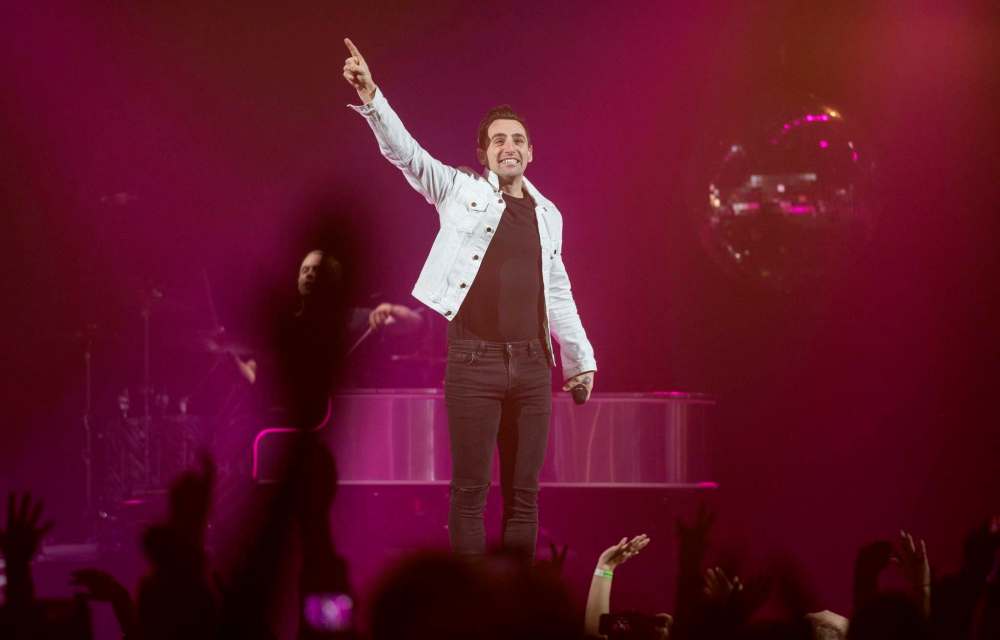
The intro music, dramatic, thrums over the concrete bones of Bell MTS Place. Fans leap to their feet and press their bodies against the stage, cheering as video screens flash images of each of the band’s four members.
They save the loudest cheers for last. For Jacob Hoggard, the band’s frontman, the star.
The curtain drops. Now he is jumping on top of a piano, and he is singing. It’s a tune from Hedley’s new record, Cageless. It’s about how Hoggard has “been down” and his life is “up in flames” because Hoggard himself lit it.

“Better days, better days, are not so far away,” he sings, and the crowd shouts the words with him.
Angst chased by resilience: this is pop-rock’s stock-in-trade. So too are the things he says over the next two hours about how much he loves Winnipeg, how glad he is that the few thousand fans here are still with them.
These are all standard entries in the arena concert playbook, familiar and expected. Yet now, with Hedley facing a flurry of sexual assault and misconduct allegations from former fans, they seem taut with discomfiting tension.
So this is not a review of Hedley’s Saturday show at Bell MTS Place. It is, instead, a reflection: on music, #MeToo, and what happens when the truth of pop-culture heroes clashes against their own constructions.
Because despite the allegations that have swirled in news and on social media, including of sexual pressure leveraged on underage fans and sexual assault, Hoggard maintains he has only ever had consensual sex.
Yet he has made several admissions. The first came in a Feb. 14 statement, where Hedley stated its members led an “unconventional” life as a touring rock band, one that included unspecified “certain rock’n’roll cliches.”
The next statement, arriving after the first of two sexual assault allegations, was more contrite. Then, Hoggard apologized for the “reckless and dismissive” way he treated women; one he agreed caused “significant harm.”
It is “time for me to change,” Hoggard continued, after noting that he had “mishandled” his power and position. With that, he announced he plans to take an indefinite hiatus after the tour ends this week in Kelowna, B.C.
By then, the band’s management had dropped them; so did radio stations and the Cageless tour’s opening bands. The fan base splintered into factions, engaged in passionate debates about who to believe, or forgive.
It’s true that if #MeToo opens the floodgates on rock’n’roll, the water will never stop pouring. The genre has always given refuge to lotharios and libertines, sexual exploitation and criminality; it celebrated that image.
The day before the Winnipeg show, Toronto police confirmed they have opened an investigation into the allegations.
Yet inside Bell MTS Place on Saturday, there was little overt hint of that turmoil: just a spackle of empty seats, and the subtext to Hoggard’s gushing thanks to fans who “supported us and stood by us from the beginning.”
It’s worth remembering who those fans are. Hedley’s audience is mostly female, and mostly from two age demographics: youthful, and younger. Some barely in their teens, others only a few years out of high school.
Now, they are having to grapple with allegations that once would have gone almost completely unnoticed. (Remember how Hedley first invoked rock’n’roll’s sexual “cliches” as a defence against the allegations.)
It’s true that if #MeToo opens the floodgates on rock’n’roll, the water will never stop pouring. The genre has always given refuge to lotharios and libertines, sexual exploitation and criminality; it celebrated that image.
Iggy Pop wrote a song about his sexual contact with Sable Starr, then around age 13. Jimmy Page directed his tour manager to kidnap 14-year-old Lori Maddox; Elvis Presley began a relationship with Priscilla when he was 24, and she was 14.
And it gets far worse. Motley Crue’s Vince Neil pleaded no contest to physically assaulting women and, before that, drove blotto drunk and killed Hanoi Rocks drummer Razzle Dingley; for that crime, he spent 15 days in jail.
Yet for all of these legends, and more, there was no great reckoning. There was little price to be paid, no grand debate by their fans about whether or not they — to use Hoggard’s word — “mishandled” their power and fame.
Now, as Hedley heads toward its hiatus, the question turns to what should happen next. If one goal of #MeToo is to warn of potential harm, that has been done; if it’s to create new maps of accountability, that is still in progress.
Times have changed. Social media has made a platform for people to speak out about those who hurt them. Navigating it can be messy: reports may be unverified and unverifiable. But we hear them, and must choose.
In Hedley, there is another dimension to consider, about the intersection of fame and sexual misbehaviour.
Classic rockers have so far escaped in part, perhaps, because they courted an image of overt sexual danger. But the image cultivated by Hoggard, and many other stars popular with young women, is almost the opposite.
The brand, as heard in their songs, is that of the immature but sweet-hearted cad. The man on the precipice of realizing that he needs to commit, to grow up; to beg the object of his affections, who has finally had enough.
In these songs, the singer may have experienced his lover’s body, yet what he really craves is their love.
Consider All Night, another new Hedley tune: “How many ways can I say I’m sorry?… I know that it’s bad, I know you don’t understand. Broken phone, Peter Pan, trying to grow up but I can’t… you wanna be alone.”
This is a constructed masculinity, engineered to be sexually defanged. It is the story some young women often wish they had: the lover who hurt them but, in this retold version, realized their value and came running back.
That power-flip is how artists such as Hoggard reel in the love of young fans. Through his songs, they can explore those feelings at a safe remove, insulated from the question of what else he might want, or take from them.
Most fans will eventually move on, whether that process is accelerated by the allegations against him or not. When they do, Hoggard’s livelihood will evaporate too, as will his platform, his social leverage, and his power.
One of the women who alleges that Hoggard sexually assaulted her showed a CBC reporter a journal entry she wrote after the Nov. 2017 encounter. “Because of who he is, I trusted him. I didn’t think he would hurt me.”
So what if, instead of that trusted figure, the real Hoggard is the one who was “reckless and dismissive” in his sexual interactions with women? The one who put hands around throats, and forced himself inside of them?
And what if the image of the puckish but gentle-hearted romantic gave cover to this mistreatment? Given those options, it’s no wonder that many fans choose to hold onto the first and gentler image they once fell in love with.
Now, as Hedley heads toward its hiatus, the question turns to what should happen next. If one goal of #MeToo is to warn of potential harm, that has been done; if it’s to create new maps of accountability, that is still in progress.
At the end of Saturday’s show, Hoggard delivered a line he’s uttered on this tour before. It felt pointed.
“Sometimes life sucks, and that’s why you got us,” he said, as fans lifted hands toward him in approval. “And Winnipeg, sometimes life sucks, that’s why we got you. So stay in our lives, and I promise we’ll stay in yours.”
The truth is, Hoggard needs his fans more than they need him, and in far more practical ways.
Most fans will eventually move on, whether that process is accelerated by the allegations against him or not. When they do, Hoggard’s livelihood will evaporate too, as will his platform, his social leverage, and his power.

For now, one last image: two young girls slip through the concourse at Bell MTS Place, clutching their mother’s hand. They are wide-eyed with excitement, engulfed by Hedley tour shirts that skim the tops of their knees.
They are not yet old enough to understand the tension whipping around this time, this show, this man.
If nothing else, one hopes that by the time they are grown, they will never have to choose to believe whether those they admire might also harm them. That by then, fame will have struck a healthier balance with safety.
History tells us it may not happen. But that ought not stop us from trying, and so the debate must go on.
melissa.martin@freepress.mb.ca
Melissa Martin
Reporter-at-large
Melissa Martin reports and opines for the Winnipeg Free Press.
Every piece of reporting Melissa produces is reviewed by an editing team before it is posted online or published in print — part of the Free Press‘s tradition, since 1872, of producing reliable independent journalism. Read more about Free Press’s history and mandate, and learn how our newsroom operates.
Our newsroom depends on a growing audience of readers to power our journalism. If you are not a paid reader, please consider becoming a subscriber.
Our newsroom depends on its audience of readers to power our journalism. Thank you for your support.
Melissa Martin
Reporter-at-large
Melissa Martin reports and opines for the Winnipeg Free Press.
Every piece of reporting Melissa produces is reviewed by an editing team before it is posted online or published in print — part of the Free Press‘s tradition, since 1872, of producing reliable independent journalism. Read more about Free Press’s history and mandate, and learn how our newsroom operates.
Our newsroom depends on a growing audience of readers to power our journalism. If you are not a paid reader, please consider becoming a subscriber.
Our newsroom depends on its audience of readers to power our journalism. Thank you for your support.
Related Articles
Fans stay 'Hedley Strong' despite accusations
Advertisement Advertise With Us
Advertisement Advertise With Us
History
Updated on Monday, March 19, 2018 12:16 AM CDT: Adds article to Opinion section.
Updated on Monday, March 19, 2018 1:35 PM CDT: Tweaks reference to Elvis and Priscilla.