Climate evangelist
Josiah Neufeld believes faith can be driving force in environmental activism

Advertisement
Read this article for free:
or
Already have an account? Log in here »
To continue reading, please subscribe:

Digital Subscription
One year of digital access for only $205*
- Enjoy unlimited reading on winnipegfreepress.com
- Read the E-Edition, our digital replica newspaper
- Access News Break, our award-winning app
- Play interactive puzzles
*First annual payment billed as $205.00 + GST for one year. This annual subscription will automatically renew at $233.00 + GST every 52 weeks (10% off the regular annual price of $259.35). Offer available to new and qualified returning subscribers only. Cancel any time.
To continue reading, please subscribe:
Add Free Press access to your Brandon Sun subscription for only an additional
$1 for the first 4 weeks*
- Enjoy unlimited reading on winnipegfreepress.com
- Read the E-Edition, our digital replica newspaper
- Access News Break, our award-winning app
- Play interactive puzzles
*Your next Brandon Sun subscription payment will increase by $1.00 and you will be charged $17.95 plus GST for four weeks. After four weeks, your payment will increase to $24.95 plus GST every four weeks.
Read unlimited articles for free today:
or
Already have an account? Log in here »
Hey there, time traveller!
This article was published 08/06/2023 (1159 days ago), so information in it may no longer be current.
Josiah Neufeld wants to believe the human race will do the right thing when it comes to saving the planet from ourselves.
He also believes there’s a higher power that has shaped our world and those who live on it.
Finding an intersection in his own life between faith and the facts about our climate crisis spurred the 42-year-old journalist to write his first book, The Temple at the End of the Universe: A Search for Spirituality in the Anthropocene. Published on June 6 by House of Anansi, Neufeld launches the book tonight at 7 p.m. at McNally Robinson Booksellers’ Grant Park location, where he’ll be joined in conversation with novelist Joan Thomas (Five Wives).
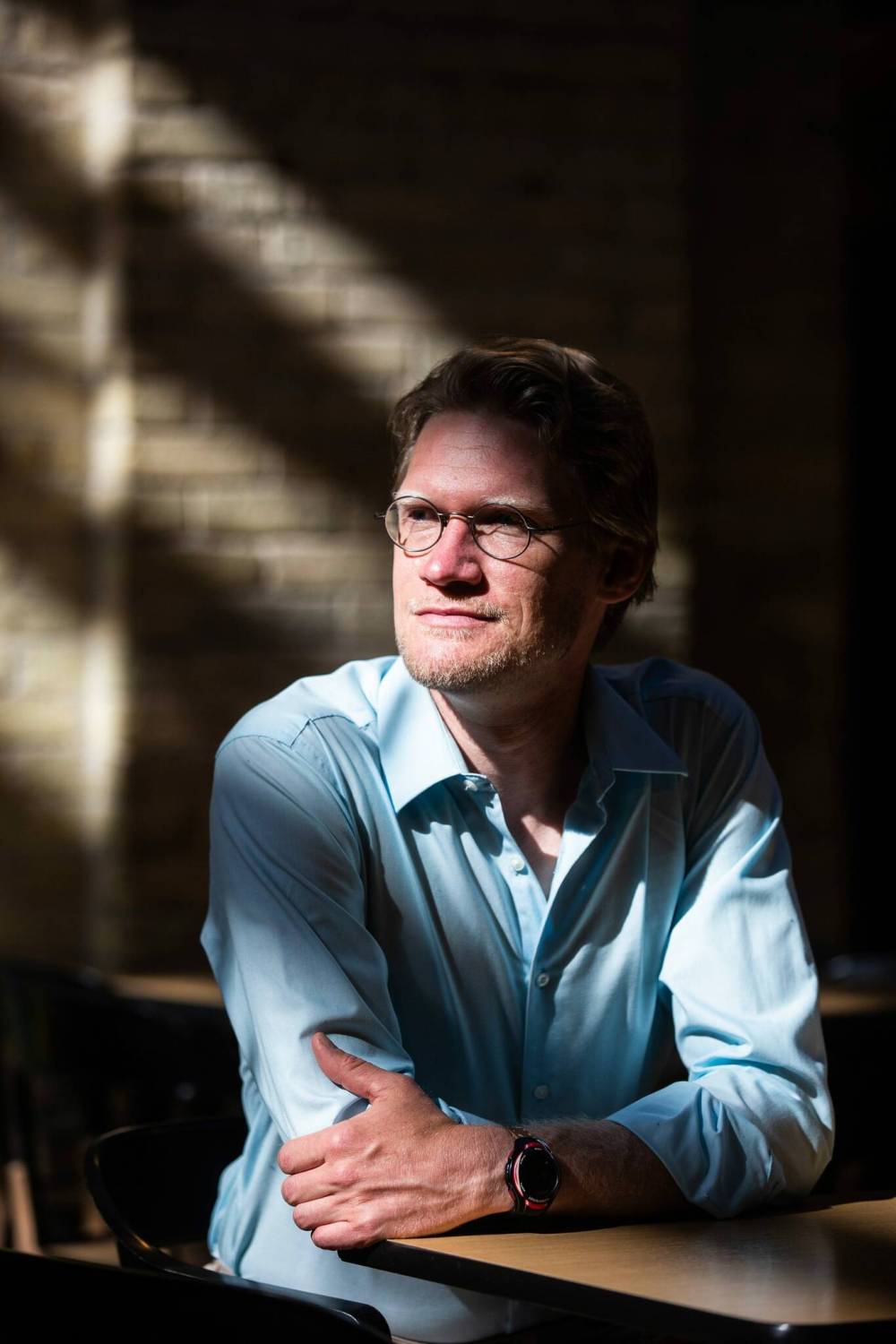
MIKAELA MACKENZIE / WINNIPEG FREE PRESS
Josiah Neufeld is a journalist who grew up a child of missionaries in West Africa.
The child of Christian missionaries, Neufeld spent the first few years of his life in Burkina Faso before his family moved back to Blumenort. (He now lives in Winnipeg with his partner and two children.)
“One of the things that really shaped my perspective of the world is growing up in the context of a very small village of farmers in West Africa… being so conscious of the disparity between what they had, in terms of financial resources, and what we had,” he says.
“In some ways, there was an unbridgeable class divide between us that really troubled me and shaped my whole perspective on the world. I grew up with this sense of global inequality.”
This feeling of inequality went beyond class, permeating his views on the way our actions impact the environment.
“When it came to thinking about climate change, I think about how this is affecting my community and friends that I grew up with in West Africa, in terms of drought and advancing desertification,” he explains. “Climate change is so connected to global inequality — the parts of the world that have produced the most emissions are most insulated from the immediate impacts of climate change. And the people who’ve produced the least emissions, globally, feel the effects first.”
Those effects are also being felt much closer to home.
“Even here in Manitoba, we have people living in hotels from northern communities, who’ve been forced to evacuate from fires and floods. They’ve been in hotels for years. These are climate refugees in our own province.”
The book’s genesis arose from a series of magazine interviews Neufeld conducted with people working in climate-related fields. He wanted to learn how the work was affecting their faith and spirituality, and vice-versa.
At the same time, however, his own struggles with faith, and its relationship to climate change, persisted. As a result, he began pulling together what would become The Temple at the End of the Universe — setting out to write the book just as U.S. Southern evangelicals helped promote Donald Trump and his anti-Paris Agreement stance into the White House in 2016.
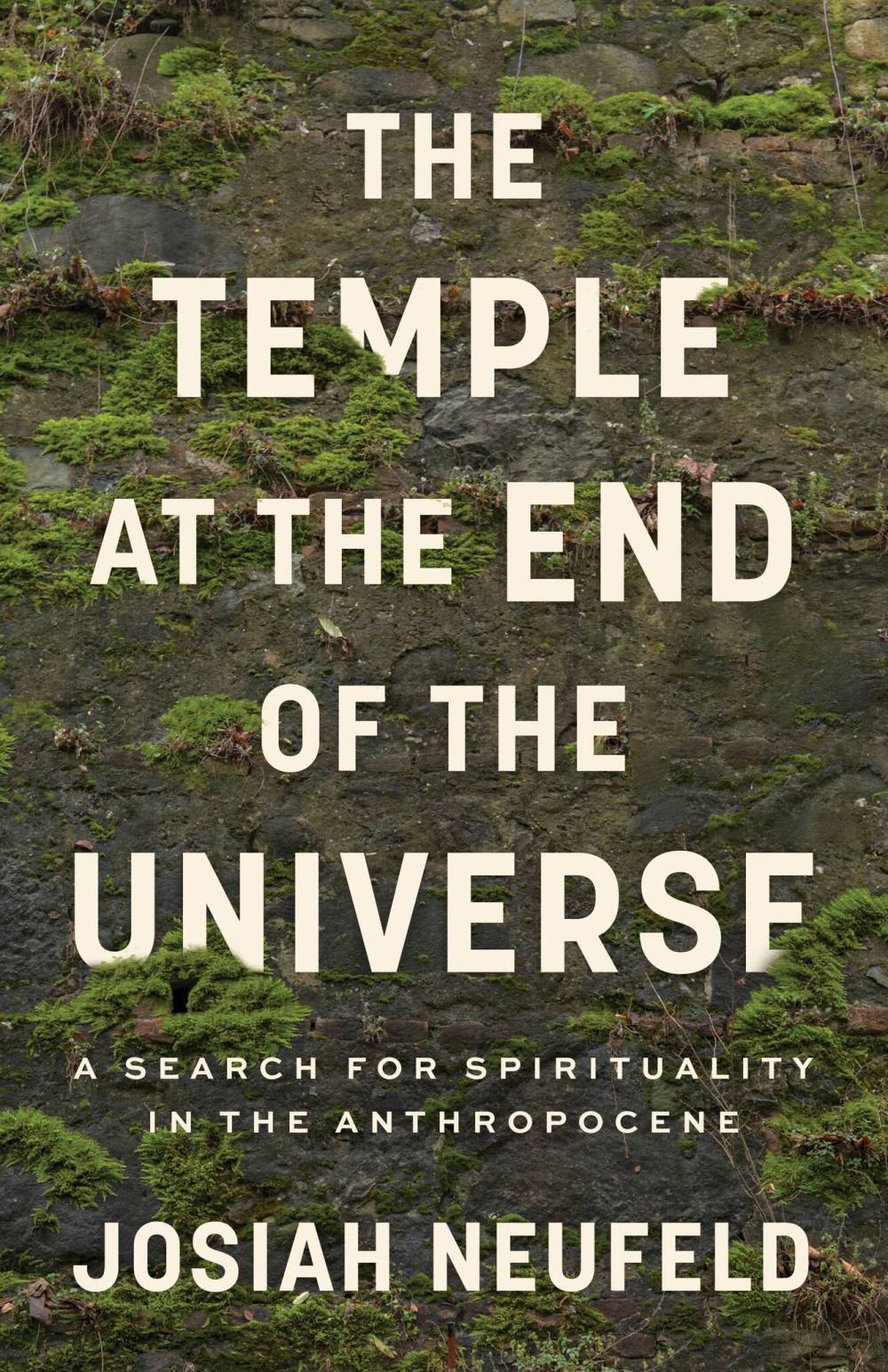
The Temple at the End of the Universe
The book features many of those he spoke with for the magazine articles, but at its core, it is Neufeld’s own spiritual journey.
“I think I knew all along that it was going to be a memoir, because this is a personal story for me,” he says. “I find some of the most affecting books that I’ve read are books where the author is going through the journey with the reader… I didn’t want it to feel didactic, like I’m telling the reader all these things that I know. I wanted to invite the reader along on this journey of discovery with me.”
Neufeld’s journey of discovery took him from Winnipeg to a gathering of church leaders in southwestern Wisconsin, to the frontlines of Wet’suwet’en First Nation actions in British Columbia against Coastal Gaslink pipeline work (which he found “very powerful and transformational”) and on a pilgrimage to an Arizona desert retreat, where he experienced a profound spiritual breakthrough.
The revelation, for Neufeld, involved the way he perceives a higher power, and the relationship that higher power has with both him and the planet.
“Maybe at a certain point in my life I believed in a God who was going to take care of everything, in the sense of making sure everything ends up OK,” he says. “My idea of God now is much more connected to the Earth, much more mystical than I would have grown up with. I guess I would describe my spirituality now as a belief in a force for good that pervades everything that exists — the photosynthesis in the trees, the way ecosystems have evolved, the balance within the natural world — and also something ineffable and mystical that I can’t understand.”
In addition to helping those struggling with a similar crisis between climate and faith, Neufeld sees the book benefiting those primarily concerned with one of the two issues.
“I wanted to invite people of faith to think more rigorously about the climate crisis and to come to the climate justice movements,” he says. “But I also wanted the non-religious people doing climate activism and policy work, people who are largely secular, to pay attention to the spiritual community as well.”
Neufeld and a group of like-minded locals have begun gathering to determine how they can engage civic leaders to come together on the climate crisis.
“I’m part of this interfaith group here in Winnipeg that started a few months ago. There’s Christians, Jews, Buddhists… it’s a group of people coming at climate change from a perspective of their faith — their faith is calling them to do the work,” he says. “We’ve been meeting with city councillors, asking them to implement Winnipeg’s climate plan showing how Winnipeg could get to net-zero emissions by 2050 (the Community Energy Investment Roadmap).
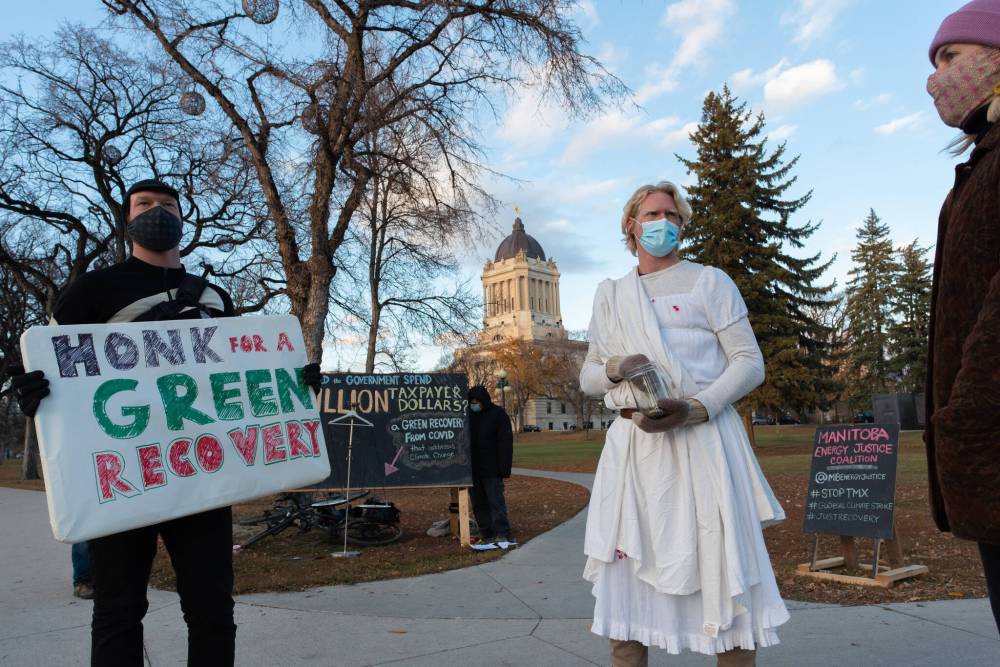
JESSE BOILY / WINNIPEG FREE PRESS FILES
Neufeld (center) with the Manitoba Energy Justice Coalition, one of several local activist groups

“We’ve been saying, ‘Hey, what are you doing about implementing this report? What can we expect to see in our next budget that shows you’re serious about this?’”
Regardless of one’s belief (or lack thereof) in a higher power, Neufeld feels there’s a sense of spirituality in anyone working to make the world a better place.
“Spirituality and faith are really about the stories we tell ourselves about what has meaning in the world,” he says.
“I think most people have a story or an understanding of the world that borders on the spiritual, whether they use religious language for it or not.”
ben.sigurdson@winnipegfreepress.com
The Free Press is committed to covering faith in Manitoba through our Religion in the News project. This reporting continues because readers like you step forward to fund it.
Donate now to support our reporting on religion.
Your donation is eligible for a charitable tax receipt.
BECOME A FAITH JOURNALISM SUPPORTER
Ben Sigurdson
Literary editor, drinks writer
Ben Sigurdson is the Free Press‘s literary editor and drinks writer. He graduated with a master of arts degree in English from the University of Manitoba in 2005, the same year he began writing Uncorked, the weekly Free Press drinks column. He joined the Free Press full time in 2013 as a copy editor before being appointed literary editor in 2014. Read more about Ben.
In addition to providing opinions and analysis on wine and drinks, Ben oversees a team of freelance book reviewers and produces content for the arts and life section, all of which is reviewed by the Free Press’s editing team before being posted online or published in print. It’s part of the Free Press‘s tradition, since 1872, of producing reliable independent journalism. Read more about Free Press’s history and mandate, and learn how our newsroom operates.
Our newsroom depends on a growing audience of readers to power our journalism. If you are not a paid reader, please consider becoming a subscriber.
Our newsroom depends on its audience of readers to power our journalism. Thank you for your support.
Book launch preview
An evening with Josiah Neufeld
Launching The Temple at the End of the Universe: A Search for Spirituality in the Anthropocene
In conversation with Joan Thomas
● McNally Robinson Booksellers Grant Park location
● Tonight, 7 p.m.
The Free Press is committed to covering faith in Manitoba through our Religion in the News project. This reporting continues because readers like you step forward to fund it.
Donate now to support our reporting on religion.
Your donation is eligible for a charitable tax receipt.
BECOME A FAITH JOURNALISM SUPPORTER
Ben Sigurdson
Literary editor, drinks writer
Ben Sigurdson is the Free Press‘s literary editor and drinks writer. He graduated with a master of arts degree in English from the University of Manitoba in 2005, the same year he began writing Uncorked, the weekly Free Press drinks column. He joined the Free Press full time in 2013 as a copy editor before being appointed literary editor in 2014. Read more about Ben.
In addition to providing opinions and analysis on wine and drinks, Ben oversees a team of freelance book reviewers and produces content for the arts and life section, all of which is reviewed by the Free Press’s editing team before being posted online or published in print. It’s part of the Free Press‘s tradition, since 1872, of producing reliable independent journalism. Read more about Free Press’s history and mandate, and learn how our newsroom operates.
Our newsroom depends on a growing audience of readers to power our journalism. If you are not a paid reader, please consider becoming a subscriber.
Our newsroom depends on its audience of readers to power our journalism. Thank you for your support.
Related Articles
Canadian site could mark Anthropocene start
Advertisement Advertise With Us
Advertisement Advertise With Us
The Free Press acknowledges the financial support it receives from members of the city’s faith community, which makes our coverage of religion possible.