Thrilling dynamics in pre-visionist play
Theatre’s last production of season examines how quickly people don uniform of separatism

Advertisement
Read this article for free:
or
Already have an account? Log in here »
To continue reading, please subscribe:

Digital Subscription
One year of digital access for only $205*
- Enjoy unlimited reading on winnipegfreepress.com
- Read the E-Edition, our digital replica newspaper
- Access News Break, our award-winning app
- Play interactive puzzles
*First annual payment billed as $205.00 + GST for one year. This annual subscription will automatically renew at $233.00 + GST every 52 weeks (10% off the regular annual price of $259.35). Offer available to new and qualified returning subscribers only. Cancel any time.
To continue reading, please subscribe:
Add Free Press access to your Brandon Sun subscription for only an additional
$1 for the first 4 weeks*
- Enjoy unlimited reading on winnipegfreepress.com
- Read the E-Edition, our digital replica newspaper
- Access News Break, our award-winning app
- Play interactive puzzles
*Your next Brandon Sun subscription payment will increase by $1.00 and you will be charged $17.95 plus GST for four weeks. After four weeks, your payment will increase to $24.95 plus GST every four weeks.
Read unlimited articles for free today:
or
Already have an account? Log in here »
Hey there, time traveller!
This article was published 12/04/2024 (862 days ago), so information in it may no longer be current.
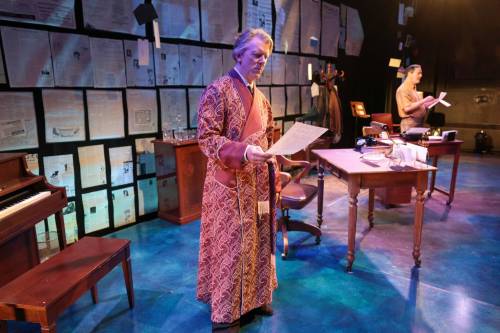
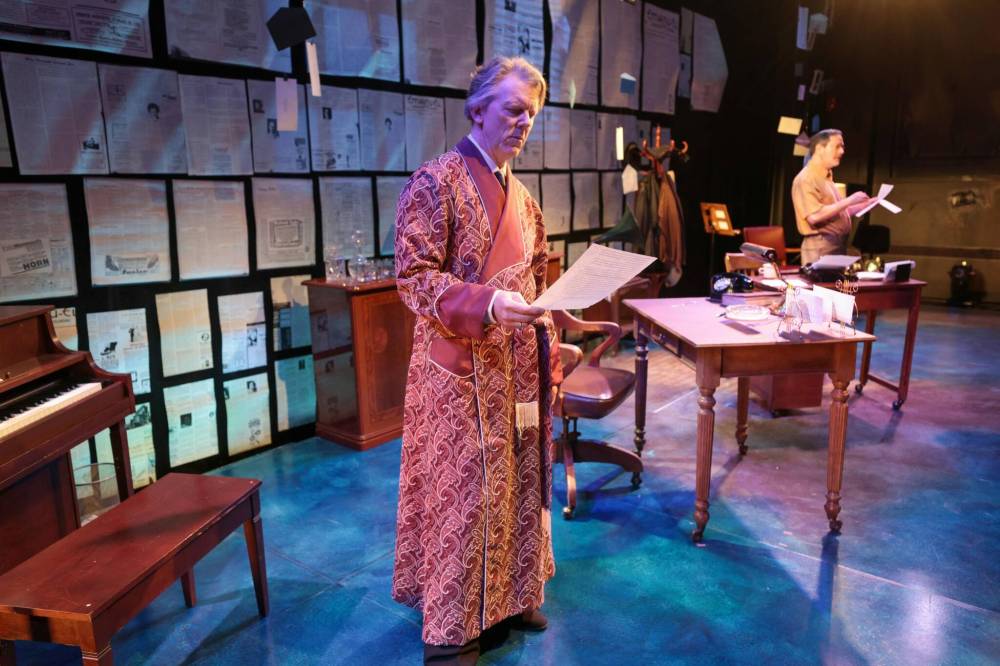
When he receives his first communiqué from Max Eisenstein, a German expat in San Francisco, a quietly gleeful Martin Schulse (Arne MacPherson) is in a state of domestic repose, lounging in his München living room in a silken, paisley robe — the ornamentation of a man not in any great rush to change.
It’s November 1932, which situates the characters of Address Unknown, the final play of the Winnipeg Jewish Theatre season, at a crossroads of personal and national decision making. On one side, the hyperinflation of cash and nationalistic misery; on the other, the supreme explosion of human ego and greed as typified by a little man with a tiny moustache and enormous plans for global domination.
A pre-visionist history written in the 1930s by American novelist Kathrine Kressman Taylor, Address Unknown is a play about the clothes we wear according to a new emperor’s instruction, and more pointedly, about the rapidity with which humans volunteer to dress themselves in the uniform of separatism.
Ruth Bonneville / Free Press
Arne MacPherson (left) and Amitai Kedar play business partners separated by more than an ocean in Address Unknown.
An epistolary production, Address Unknown is a story of cruelty writ small, defined by reception and ignorance.
On the Pacific Coast, Eisenstein (Amitai Kedar) is dressed in palazzo pants and a brown shirt, his collar pinned down. While Schulse, Eisenstein’s partner in an art dealership, has returned to das Heimatland, the Jewish Eisenstein remains in America to tend to that realm of business affairs.
“Back in Germany! How I envy you,” Eisenstein writes in his first cross-continental transmission, his tone collegial and nostalgic.
In director Dan Petrenko’s brisk treatment of Kressman Taylor’s original dialogue, the purposeful mixed messaging between these two characters is mostly well-communicated, bolstered by the scenic design of Ksenia Broda-Milian, who gives the space a stamp of well-observed authenticity.
It is important to note that while the structure of the production is defined by the written word — the only means of communication available to either character — the lead actors don’t ever exist in the same room. Each character lingers in the other’s psyche as they vacillate between friendship and rivalry.
This dynamic allows the actors to trade solos, with the disquieted party left only to their posture, their facial expression and their stage position to emphasize their responses as they receive the new information in tandem with the audience.
MacPherson is especially adept at this type of gestural work, leaning his hands on his desk as Eisenstein’s letters become more incessant, at least in Schulse’s opinion. When he learns of the death of a dear relation, Kedar receives the news in a rotating chair, his back to the audience at the moment his soul cracks. In hiding his face, Kedar allows the audience members to assess the rough lines of their own.
MacPherson, a Winnipeg theatrical staple, and Kedar, a Tel Aviv resident, make for a distinctly odd couple, a fact that elevates the work during times of disconnect but sometimes makes it hard to imagine their characters having been friends in the first place, let alone business partners.
This is a chemical challenge mostly related to Kressman Taylor’s text, which picks up in 1932 and doesn’t provide much insight into the origins of the Schulse-Eisenstein union. Still, both actors bring their distinctive approaches and emotionality to their characters, giving the audience an exciting opportunity to see the two men mesh.
Broda-Milian’s set and prop design offer a backdrop of history, covering the rear wall with empty frames, dangling envelopes and a patchwork of newspaper articles from the Emanu-El Journal, a San Francisco publication founded in 1895, now known as the Jewish News of Northern California. Costume designer Julia Kroft, who is also the voice for an unseen character, dresses the characters in the fabric of history unfolding.
A key omission from this set — the domicile of men who make their living in the trade of fine art — is any fine art itself. This could be a functional choice, meant to force the eye to the actor, but it does also feel like a missed opportunity to enhance the visual language of the production by incorporating one or two pieces of work from topical painters contemporary to the time period and to the Munich Academy.
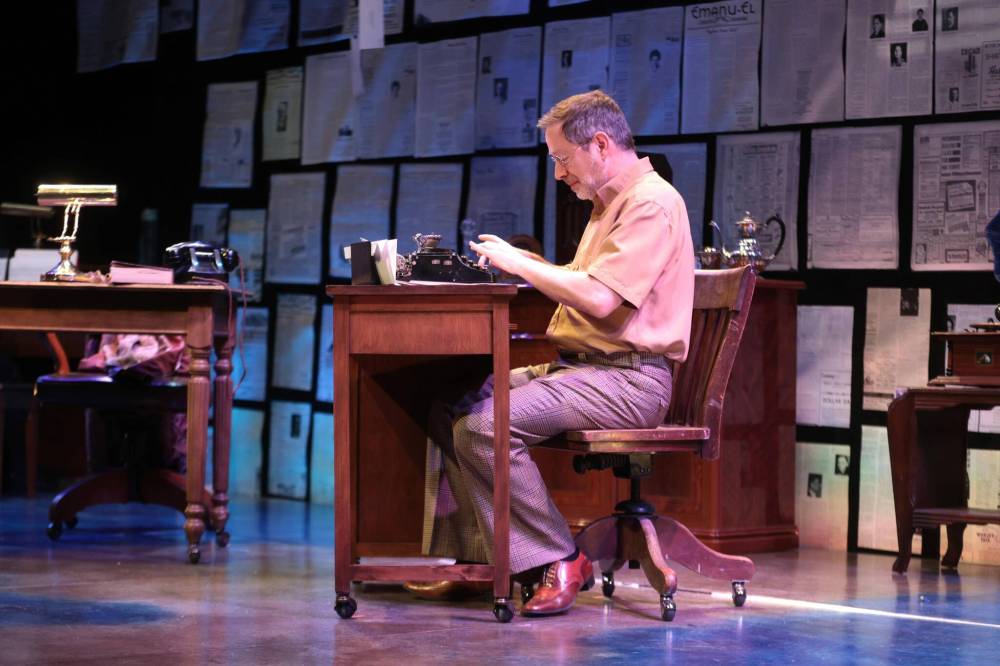
Ruth Bonneville / Free Press
Amitai Kedar as Max Eisenstein in Address Unknown.
Considering that Thursday night’s performance occurred in a preview format, there are a few elements of audio turbulence that must be noted and accounted for during the remainder of the production’s run. Several times during the performance, Kedar’s lavalier microphone boomed with interference, a technical difficulty that should have been remedied; without the aid of technology, Kedar certainly could have projected his voice loudly enough to reach the back row of the Berney Theatre while his character pleaded with MacPherson’s Martin for a touch of fraternity.
To the credit of Kressman Taylor, whose work was lauded during her lifetime as prescient, her writing retains the potential for surprise — a necessity in a work of speculative or revisionist fiction, especially if the predicted events have already, famously and calamitously, occurred.

There is a thrilling element to the shifting dynamic of these two ordinary men as they’re influenced by the tinder of national hatred, moved in Eisenstein’s case toward disbelief and in Schulse’s toward shocking acceptance of antisemitism and xenophobia in all of its developing stages as a means of self-protection.
“As for the stern measures that so distress you, I myself did not like them at first, but I have come to see their painful necessity,” he says, ditching his robe for a black jacket embellished with brass buttons and epaulettes, laying the blame for Eisenstein’s suffering at his own people’s feet.
“Alas, Max, this will pain you, I know, but you must realize the truth,” he goes on. “There are movements far bigger than the men who make them up. As for me, I am a part of the movement.”
Message received.
ben.waldman@winnipegfreepress.com
Ben Waldman is a National Newspaper Award-nominated reporter on the Arts & Life desk at the Free Press. Born and raised in Winnipeg, Ben completed three internships with the Free Press while earning his degree at Ryerson University’s (now Toronto Metropolitan University’s) School of Journalism before joining the newsroom full-time in 2019. Read more about Ben.
Every piece of reporting Ben produces is reviewed by an editing team before it is posted online or published in print — part of the Free Press‘s tradition, since 1872, of producing reliable independent journalism. Read more about Free Press’s history and mandate, and learn how our newsroom operates.
Our newsroom depends on a growing audience of readers to power our journalism. If you are not a paid reader, please consider becoming a subscriber.
Our newsroom depends on its audience of readers to power our journalism. Thank you for your support.
Theatre review
Address Unknown
Winnipeg Jewish Theatre
● Berney Theatre, 123 Doncaster St.
● To April 21
★★★½ out of five
Ben Waldman is a National Newspaper Award-nominated reporter on the Arts & Life desk at the Free Press. Born and raised in Winnipeg, Ben completed three internships with the Free Press while earning his degree at Ryerson University’s (now Toronto Metropolitan University’s) School of Journalism before joining the newsroom full-time in 2019. Read more about Ben.
Every piece of reporting Ben produces is reviewed by an editing team before it is posted online or published in print — part of the Free Press‘s tradition, since 1872, of producing reliable independent journalism. Read more about Free Press’s history and mandate, and learn how our newsroom operates.
Our newsroom depends on a growing audience of readers to power our journalism. If you are not a paid reader, please consider becoming a subscriber.
Our newsroom depends on its audience of readers to power our journalism. Thank you for your support.
Related Articles
Pen pals become enemies in WJT’s epistolary play
Advertisement Advertise With Us
Advertisement Advertise With Us