Moving pictures
Rosemary Gallery designed to travel

Advertisement
Read this article for free:
or
Already have an account? Log in here »
To continue reading, please subscribe:

Digital Subscription
One year of digital access for only $205*
- Enjoy unlimited reading on winnipegfreepress.com
- Read the E-Edition, our digital replica newspaper
- Access News Break, our award-winning app
- Play interactive puzzles
*First annual payment billed as $205.00 + GST for one year. This annual subscription will automatically renew at $233.00 + GST every 52 weeks (10% off the regular annual price of $259.35). Offer available to new and qualified returning subscribers only. Cancel any time.
To continue reading, please subscribe:
Add Free Press access to your Brandon Sun subscription for only an additional
$1 for the first 4 weeks*
- Enjoy unlimited reading on winnipegfreepress.com
- Read the E-Edition, our digital replica newspaper
- Access News Break, our award-winning app
- Play interactive puzzles
*Your next Brandon Sun subscription payment will increase by $1.00 and you will be charged $17.95 plus GST for four weeks. After four weeks, your payment will increase to $24.95 plus GST every four weeks.
Read unlimited articles for free today:
or
Already have an account? Log in here »
Hey there, time traveller!
This article was published 10/10/2024 (711 days ago), so information in it may no longer be current.
Rosemary Gallery recently opened its doors to an exhibition space bound to rove.
Hosted until Nov. 27 in a narrow, inviting room at 226 Main St., the travelling gallery will soon spring up in new milieus where it can once again hold space for BIPOC artists and shed light on the history of its surroundings.
This is the novel vision of Rosemary’s co-curators Jaimie Isaac and Suzanne Morrissette, young leaders in the country’s contemporary and Indigenous art scenes.
MIKE DEAL / FREE PRESS
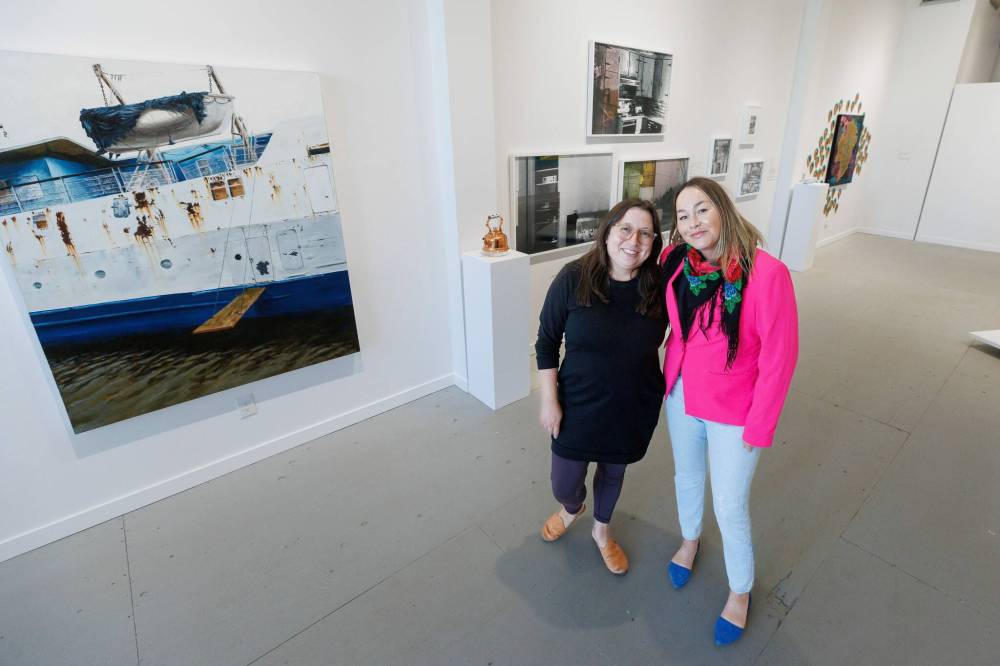
Curators Suzanne Morrissette (left) and Jaimie Isaac envision the Rosemary Gallery moving place to place.
“We’re designed to exist for short periods of time in different locations,” says Morrissette.
“How we’re thinking of it right now is roving in migratory ways that can respond to really important things that are happening, whether in this city or another city,” says Isaac.
Beside its neighbour, Times Change(d) High & Lonesome Club, the Main Street site faces one of North America’s most famous meeting places, the junction of the Red and Assiniboine rivers, a site of trade, gathering and migration for Indigenous peoples for thousands of years before French fur trader La Vérendrye built Fort Rouge.
Rosemary’s first show, Confluence, honours the Forks’ enduring significance for Indigenous peoples.
“The confluence of the rivers becomes a really great metaphor for the coming and going of people from this territory,” says Morrissette.
“Our proximity to the rivers is (also) a way of storytelling about our city’s relationship to its people, and how some of that is histories of profound violence.”
Visitors to Confluence are first met with the exhibit’s brown, hand-painted didactic — reminiscent of the Forks’ “muddy waters” (in Cree “Winipihk”), which is Winnipeg’s namesake according to Cree oral history.
“We were doing it right until 5:30. The opening was at 6,” laughs Isaac.
Next, you’ll see two of Ian August’s paintings of rusting Red River riverboats, as colourful as they are stark.
A few steps away, in the gallery’s centre, you’ll encounter KC Adams’s striking recreation of a traditional clay pot, drawing on her expertise in ancestral pottery practices on the prairies.
Perched among sand and pottery fragments uncovered by Adams in Lockport, her piece excavates beneath the roads, railways and modern life surrounding the gallery to point to another lifeworld on the prairies.
Claire Johnston’s work in Confluence offers a somewhat experimental take on traditional craft, using wood carvings to create intricate beadwork-style patterns.
A little deeper into the gallery, visitors will see a map-like piece by Pat Lazo recreating his dozens of murals around town in their relation to the Assiniboine and Red. You may be surprised to learn how many memorable murals belong to this graffiti artist, whose strokes and sprays practically form a dialect in the visual language of urban Winnipeg’s surfaces.
On the back wall, to highlight one more piece, stands a maquette by Kent Monkman, a mock-up for a work in his Urban Rez series that depicted heartrending North End scenes with his signature Renaissance sweep.
Winnipeggers used to Monkman’s grandeur will find this little sketch curious; a seed for one of the overwhelming tableaus that the Winnipeg Art Gallery exhibited a few years ago.
Despite Rosemary Gallery’s roving nature, “roots” is an obvious watchword for the exhibition. Like those artists already mentioned, the others on display — Casey Koyczan, Bret Parenteau, Chukwudubem Ukaigwe and Rhayne Vermette — all have connections to Winnipeg.
This is also true of the Rosemary’s co-directors, whose maternal grandmothers’ names, Rose and Mary, blend to make the gallery’s name.
Isaac, from Sagkeeng First Nation, is a former curator of Contemporary and Indigenous Art at the WAG, and more recently was chief curator at the Art Gallery of Greater Victoria.
Morrissette, a Red River Métis artist, scholar and curator, splits her time between Winnipeg, where she grew up, and Toronto, where she’s an assistant professor at OCAD University.

The duo is waiting to unveil the next stop for the gallery, but they see its moving nature as an overall advantage.
“We’re thinking about a model that can help us to remain nimble, but might also help us to avoid becoming the kind of institutions we’re thinking about,” says Morrissette.
“We wanted to create Rosemary as its own model, building community in a way that’s without the colonial impositions of a structure or institutional space,” says Isaac.
Confluence is open Tuesday to Saturday from 11 a.m. to 2 p.m. until Nov. 27.
conrad.sweatman@freepress.mb.ca
Conrad Sweatman is an arts reporter and feature writer. Before joining the Free Press full-time in 2024, he worked in the U.K. and Canadian cultural sectors and freelanced for outlets including The Walrus, VICE and Prairie Fire. Read more about Conrad.
Our newsroom depends on a growing audience of readers to power our journalism. If you are not a paid reader, please consider becoming a subscriber.
Our newsroom depends on its audience of readers to power our journalism. Thank you for your support.
Conrad Sweatman is an arts reporter and feature writer. Before joining the Free Press full-time in 2024, he worked in the U.K. and Canadian cultural sectors and freelanced for outlets including The Walrus, VICE and Prairie Fire. Read more about Conrad.
Our newsroom depends on a growing audience of readers to power our journalism. If you are not a paid reader, please consider becoming a subscriber.
Our newsroom depends on its audience of readers to power our journalism. Thank you for your support.
Advertisement Advertise With Us
Advertisement Advertise With Us