Out of the cold
Decreased blood circulation leads to frozen extremities for people with Raynaud’s

Advertisement
Read this article for free:
or
Already have an account? Log in here »
To continue reading, please subscribe:

Digital Subscription
One year of digital access for only $205*
- Enjoy unlimited reading on winnipegfreepress.com
- Read the E-Edition, our digital replica newspaper
- Access News Break, our award-winning app
- Play interactive puzzles
*First annual payment billed as $205.00 + GST for one year. This annual subscription will automatically renew at $233.00 + GST every 52 weeks (10% off the regular annual price of $259.35). Offer available to new and qualified returning subscribers only. Cancel any time.
To continue reading, please subscribe:
Add Free Press access to your Brandon Sun subscription for only an additional
$1 for the first 4 weeks*
- Enjoy unlimited reading on winnipegfreepress.com
- Read the E-Edition, our digital replica newspaper
- Access News Break, our award-winning app
- Play interactive puzzles
*Your next Brandon Sun subscription payment will increase by $1.00 and you will be charged $17.95 plus GST for four weeks. After four weeks, your payment will increase to $24.95 plus GST every four weeks.
Read unlimited articles for free today:
or
Already have an account? Log in here »
Hey there, time traveller!
This article was published 10/02/2025 (597 days ago), so information in it may no longer be current.
Maylee Jacob has had “frozen fingers” for as long as she can remember.
In the wintertime, or even in an overly air conditioned room, the tips of her fingers would turn white and go numb.
“I never knew what it was,” Jacob says. “I eventually figured out from Google that it was Raynaud’s.”
MIKE DEAL / FREE PRESS
Raynaud’s is a neurovascular condition that causes small blood vessels supplying the extremities to temporarily constrict in reaction to cold or stress. It commonly affects circulation in the fingers and toes — causing the digits to turn white or blue — but can also occur in the ears, nose, chin, tongue and elsewhere.
The return of blood can bring on pain, swelling and redness.
“It’s basically an overreaction to the cold,” says Dr. Annaliese Tisseverasinghe, a rheumatologist, clinician researcher and assistant professor of medicine at the University of Manitoba.
“It’s the body’s way of protecting the heart and the brain and other important internal organs by shutting off blood supply to the peripheries.”
Named after Maurice Raynaud — a French physician who first described the phenomenon in 1862 — the condition affects more women than men by a four-to-one ratio. Despite some data suggesting Raynaud’s may impact 20 per cent of the female population, the root cause of the disorder remains unclear and few targeted treatment options exist.
Primary Raynaud’s
February is Raynaud’s Awareness Month and a chilly time of year when Winnipeg sufferers are acutely aware of their circulatory issues.
“My body’s just not built for this climate,” Jacob, 37, jokes.
After some online sleuthing, Jacob asked her doctor about her symptoms and was referred to a rheumatologist for an official diagnosis of primary Raynaud’s — the most common form of the condition, which occurs on its own without an underlying cause.
NIKLAS D / WIKIMEDIA COMMONS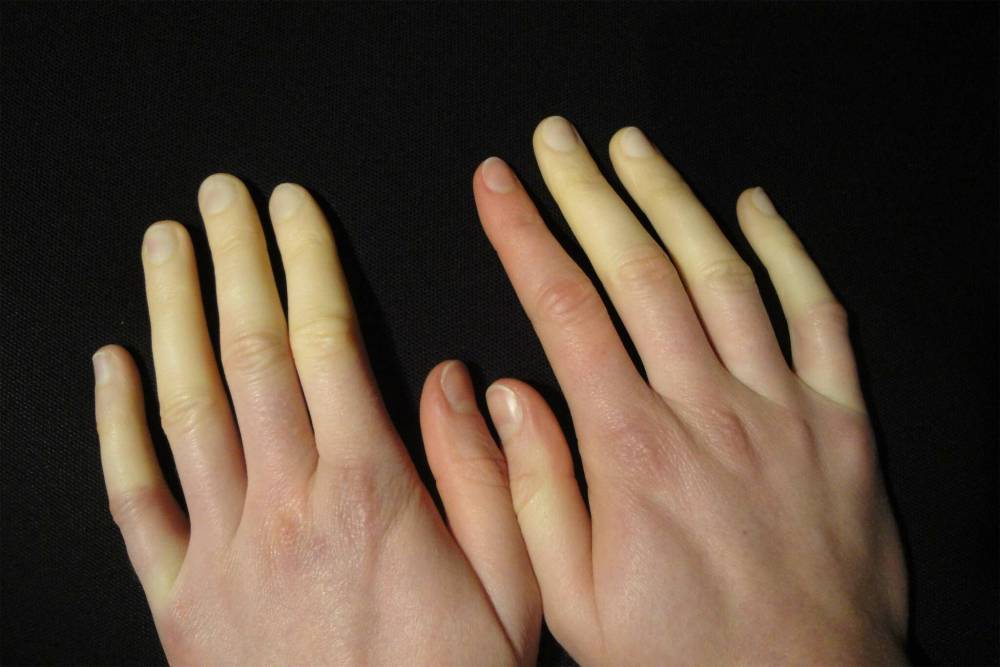
Secondary Raynaud’s often appears as a symptom of connective tissue or autoimmune diseases, such as arthritis or lupus.
During an episode, Jacob’s fingers turn completely white and become stiff and tingly, making tasks requiring dexterity, such as typing, difficult.
“It’s really hard to do anything with my hands at that point because my fingers are so uncomfortable,” she says, adding it can take 20 minutes of running her hands under lukewarm water for the blood flow to return.
In addition to frequent discoloration and numbness, her knuckles would occasionally swell with chilblains — red dots of inflamed skin that can develop from exposure to the cold.
Since being diagnosed several years ago, Jacob has found success managing her symptoms by taking a calcium channel blocker, commonly used to treat hypertension, daily during the winter. She still wears warm mitts, uses hand warmers and avoids the outdoors during extreme cold, but feels lucky the condition hasn’t seriously impacted her lifestyle.
Lisa Merkeley, 74, tries to avoid the cold completely.
Since retiring, the Winnipeg snowbird and her husband have spent a few months every winter down south, in part to alleviate her Raynaud’s symptoms.
“It’s freeing, you don’t have to think twice about going outside,” she says over Zoom from a balcony in Mexico.
Back home, Merkeley is highly sensitive to the cold — her fingers can turn white simply by opening the fridge — and spends most of her time indoors to avoid the painful episodes.
“I hide pretty well,” she says.
“I’ve given up going out for fun in the snow; I just can’t handle it.”– Lisa Merkeley
She was diagnosed about 20 years ago and watched her mother struggle with the same issue. Merkeley has tried all kinds of hand warmers, fancy heated gloves and is on blood-pressure medication, but nothing has made a difference.
Opting out of the cold has meant missing out on family activities, such as tobogganing with her grandkids or watching their hockey games.
“I’ve given up going out for fun in the snow; I just can’t handle it,” she says.
While she’s talked to her doctor about the condition in passing, the physician hasn’t offered many solutions. She also hasn’t pressed the issue. Like many women the Free Press spoke with, Raynaud’s is something Merkeley is resigned to tolerate.
Primary Raynaud’s tends to appear between the ages of 15 and 30, and because the symptoms are usually relatively mild and temporary, many sufferers don’t seek diagnosis or treatment.
“They just assume they have a very severe form of cold intolerance,” Tisseverasinghe says, adding it’s one of the reasons there has been relatively little research on the topic.
“It’s not been well studied, partly because people with primary Raynaud’s don’t come to medical attention, so there’s not as much investment in treating it.”
That’s slowly starting to change.

Scientists in London and Berlin recently identified specific genes linked to primary Raynaud’s in the largest genetic study of the condition to date. After combing through health records of more than 440,000 people in the UK Biobank, researchers found variations of two genes that predisposed participants to Raynaud’s: an overactive adrenaline receptor that causes small vessels to contract in response to stress or danger, and a DNA-binding protein that regulates the ability of blood vessels to dilate, or relax.
The findings, published in Nature Communications in 2023, help explain the mechanisms behind the blood vessel contractions, or vasospasms, and point to possible new treatment options — such as drugs targeting the adrenaline receptor directly.
Still, mysteries remain.
It’s unclear, for example, why the condition impacts more women than men, but some researchers suspect hormones may play a role. Primary Raynaud’s can be hereditary, but isn’t always. It’s typically a lifelong issue that can improve or get worse with age. And there’s no blood work or imaging that can confirm Raynaud’s.
Instead, doctors rely on medical history and physical appearance for diagnosis.
Tisseverasinghe recommends taking photos of the affected digits during and after an episode to share with a primary care doctor who can assess the severity and determine if referral to a rheumatologist is necessary.
A mild case might only affect part of one finger, while a severe case could involve all of the fingers and toes.
Primary Raynaud’s can typically be managed with warm clothing and lifestyle changes.
“The main treatment is keeping the core body warm and taking away triggers,” says Tisseverasinghe.
MIKE DEMBECK / THE CANADIAN PRESS
If discomfort remains, calcium channel blockers and angiotensin receptor blockers — blood pressure medications that dilate the blood vessels — are the first-line therapy for primary Raynaud’s. The drugs can cause dizziness and may not be suitable for those with low blood pressure.
In those cases, topical creams or patches called vasodilators — which are used to treat heart diseases by relaxing the blood vessels — may be an option. Because stress is a contributing factor, certain antidepressants can help improve symptoms, Tisseverasinghe adds.
Lindsay Ridgley, 39, was diagnosed with Raynaud’s after undergoing chemotherapy for Hodgkin’s lymphoma in her early 20s. Her doctor suggested nerve surgery could improve the erratic circulation in her hands and feet, but the treatment felt like overkill at the time.
Sympathectomy, a procedure that involves destroying or blocking the nerves connected to the affected blood vessels, is occasionally used to treat Raynaud’s, but can come with undesirable side effects.
“I certainly haven’t forgotten that it’s a potential option, but I’ve been able to manage it and it seems to be going OK. Hopefully it stays that way,” Ridgley says.
She spends a lot of time thinking about the quality of her socks and gloves, and is hesitant about prolonged outdoor activities, such as walking her cold-loving dogs during the winter.
Secondary Raynaud’s
Marion Pacy enjoyed being a Winnipeg Transit bus driver but was forced to transfer to a desk job to protect her hands.
Pacy, 72, was diagnosed with systemic sclerosis, or scleroderma, and secondary Raynaud’s at 40 years old. The latter is a common, and sometimes preceding, symptom of the rare autoimmune disease, which causes hardening of the skin and connective tissue and can damage internal organs.
Like many of the diseases associated with secondary Raynaud’s, scleroderma affects far more women than men.

Pacy’s circulation issues manifest in her hands, feet and nose, which turn blue, then white, then red in response to minor temperature changes. As a bus driver, opening the door to let passengers on and off would trigger vasospasms.
“The Raynaud’s got so bad with our lovely winters here in Winnipeg being so cold that I couldn’t handle it anymore,” Pacy says.
Secondary Raynaud’s is usually diagnosed later in life and, due to its comorbidities, can be more serious and permanent than the primary form of the condition.
“It can be so severe to the point where you can get digital ischemia — tiny pieces of the skin, especially in your finger pads, can become necrotic and die off,” Tisseverasinghe says.
Painful ulcers are common and extreme cases can be limb-threatening. The medical interventions for secondary Raynaud’s are varied and need to be tailored to the patient and their underlying disease.
Pacy manages her symptoms through attire. She keeps a pair of mitts next to the fridge, has spent hundreds of dollars on heated clothing and wears gloves through the spring and fall. As the past president of Scleroderma Manitoba, she’s noticed more awareness about both conditions since being diagnosed 32 years ago.
Scleroderma Manitoba is a volunteer-run organization that shares information about the disease, runs an online forum and offers support groups for sufferers.
“I think the disability from Raynaud’s is under-emphasized. Most people think, ‘Oh, your hands are just cold,’ but it’s kind of like having a heart attack for your fingers.”– Dr. Annaliese Tisseverasinghe
“The support group is very important,” says Debbie Robitaille, 68, who started attending meetings after being diagnosed in 2016 and now co-ordinates the group as a board member.
“People need to talk to other people that are experiencing some of the same things: how they handle it, what their doctors have suggested, what medications they might have tried.”
Raynaud’s is a common topic of discussion with members trading tips about useful products and commiserating over a condition that can be socially isolating.
Robitaille swears by a pair of puffy insulated booties — “the kind mountain guys use in their tents when they’re camping in the winter” — and a heated steering wheel to keep her hands and feet warm and pain-free.
Still, the issue is hard to avoid, since peeling cold vegetables or handling frozen ingredients can trigger an episode.
While the symptom of primary and secondary Raynaud’s are manageable, Tisseverasinghe notes the condition isn’t entirely benign.
“I think the disability from Raynaud’s is under-emphasized,” she says. “Most people think, ‘Oh, your hands are just cold,’ but it’s kind of like having a heart attack for your fingers, it can be very painful, and if it’s very mild, even then it’s an uncomfortable situation.”
eva.wasney@winnipegfreepress.com
Eva Wasney covers environmental issues in Manitoba for The Narwhal in partnership with the Winnipeg Free Press. Read more about Eva.
Every piece of reporting Eva produces is reviewed by an editing team before it is posted online or published in print — part of the Free Press‘s tradition, since 1872, of producing reliable independent journalism. Read more about Free Press’s history and mandate, and learn how our newsroom operates.
Our newsroom depends on a growing audience of readers to power our journalism. If you are not a paid reader, please consider becoming a subscriber.
Our newsroom depends on its audience of readers to power our journalism. Thank you for your support.
Tips for managing Raynaud’s
● Avoid extreme temperatures and prolonged exposure to the cold.
● Prevent heat loss by keeping the core warm and head covered, in addition to wearing thick socks and mitts. Disposable or rechargeable heat packs and battery-powered heated socks and mitts can be helpful.
● Keep your hands and feet dry, and care for your skin with moisturizer.
● Help stave off stress-related episodes by getting enough sleep, practising relaxation techniques, exercising and addressing emotional needs.
● Avoid triggers such as caffeine, nicotine, beta blockers and stimulant medications — like those used to treat ADHD — which can worsen flareups.
● Warm the affected area quickly but carefully during an attack. Place your hands or feet in warm, not hot, water, use a heating pad and move your limbs to encourage blood flow.
Eva Wasney covers environmental issues in Manitoba for The Narwhal in partnership with the Winnipeg Free Press. Read more about Eva.
Every piece of reporting Eva produces is reviewed by an editing team before it is posted online or published in print — part of the Free Press‘s tradition, since 1872, of producing reliable independent journalism. Read more about Free Press’s history and mandate, and learn how our newsroom operates.
Our newsroom depends on a growing audience of readers to power our journalism. If you are not a paid reader, please consider becoming a subscriber.
Our newsroom depends on its audience of readers to power our journalism. Thank you for your support.
Advertisement Advertise With Us
Advertisement Advertise With Us
History
Updated on Monday, February 10, 2025 8:59 AM CST: Adds link
Updated on Monday, February 10, 2025 10:04 AM CST: Corrects reference to Hodgkin’s lymphoma