Interest develops for Black artist’s century-old photographs

Advertisement
Read this article for free:
or
Already have an account? Log in here »
To continue reading, please subscribe:

Digital Subscription
One year of digital access for only $205*
- Enjoy unlimited reading on winnipegfreepress.com
- Read the E-Edition, our digital replica newspaper
- Access News Break, our award-winning app
- Play interactive puzzles
*First annual payment billed as $205.00 + GST for one year. This annual subscription will automatically renew at $233.00 + GST every 52 weeks (10% off the regular annual price of $259.35). Offer available to new and qualified returning subscribers only. Cancel any time.
To continue reading, please subscribe:
Add Free Press access to your Brandon Sun subscription for only an additional
$1 for the first 4 weeks*
- Enjoy unlimited reading on winnipegfreepress.com
- Read the E-Edition, our digital replica newspaper
- Access News Break, our award-winning app
- Play interactive puzzles
*Your next Brandon Sun subscription payment will increase by $1.00 and you will be charged $17.95 plus GST for four weeks. After four weeks, your payment will increase to $24.95 plus GST every four weeks.
Read unlimited articles for free today:
or
Already have an account? Log in here »
Hey there, time traveller!
This article was published 03/03/2025 (559 days ago), so information in it may no longer be current.
When Alyssa Fearon moved from Scarborough, Ont., to Brandon to curate the Art Gallery of Southern Manitoba, one of her first instincts was to look backward in search of starting points.
“That’s what led me to stumble upon the work of Billy Beal,” says Fearon, who was floored by the Black artist’s century-old photographic work — about 50 fragile glass-plate negatives captured between 1915 and 1925.
The Massachusetts-born William Sylvester Alpheus Beal, a trained sawmill engineer who moved to Manitoba in 1906, became known in the Swan River Valley for his wide-ranging interests, which included astronomy, philosophy, theatrical arts, medicine, clothing manufacturing, agricultural innovation — he built electrified fences for his cattle-farmer neighbours — and his photographic pursuits.
SUPPLIED
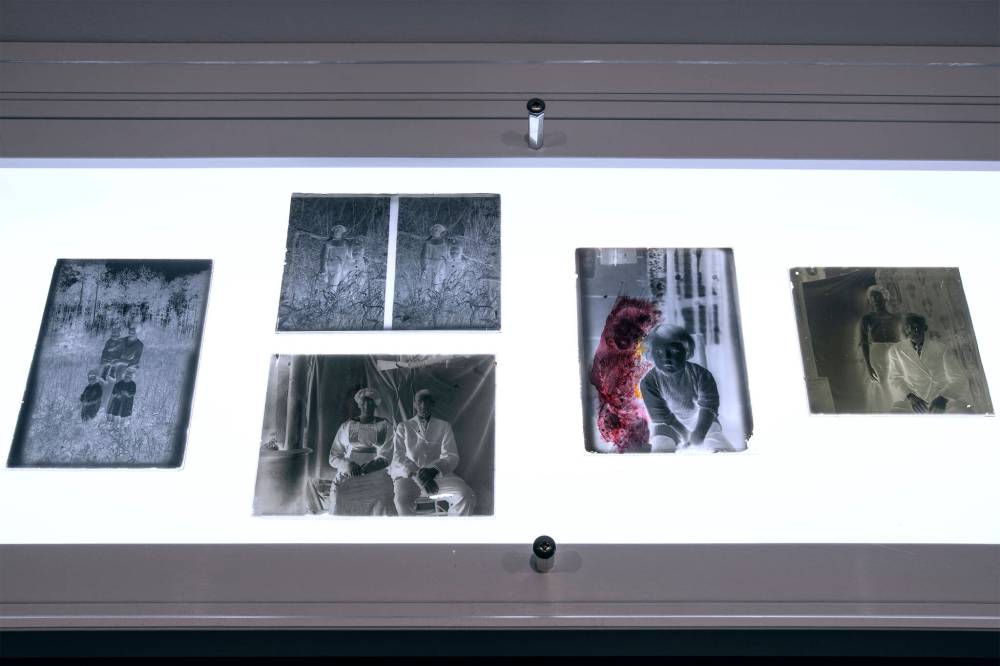
About 50 glass-plate negatives William Beal took between 1915 and 1925 are on display.
From behind the lens of his folding-box camera, Beal captured the fascinating perspective of a Black Prairie artist, whose subjects were usually the white European homesteaders tilling the land.
“He was the lone Black man at the time in that area. As a Black curator, that gave me a sense of grounding and a sense of being part of something larger,” says Fearon, who points out that Beal was a founder of the community’s library and the first secretary-treasurer of the Big Woody School Division, a role he held from 1912 to 1949.
As Fearon expected, there wasn’t much research or information available with regard to Beal’s life and work outside small local historical pockets.
Now in her post as director-curator of the Regina Public Library’s Dunlop Gallery, Fearon is hoping to right that wrong, centring Black artistic work from across the 20th and 21st century, establishing a cross-generational conversation between pre-Depression image makers such as Beal and contemporary Manitoban creatives such as Chukwudubem Ukaigwe, Anna Binta Diallo and Judah Iyunade.
Only one self-portrait of Beal remains, says Fearon, featuring the photographer dressed in a well-fitting suit.
“To me, it’s one of the most important images we have,” says Fearon, whose Black Prairies exhibition in Regina runs until May 14. “It’s his own self-perception that he wanted to capture, and that’s a lot different than the hyper-criminal or black-faced images (typical of the era).”
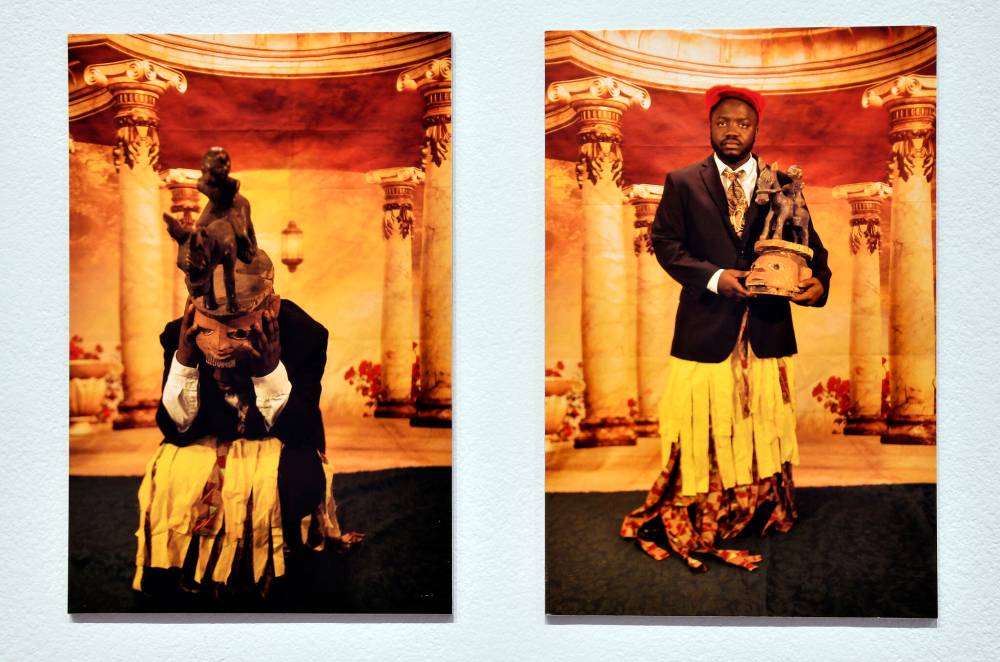
Winnipeg artist Judah Iyunade’s work brings ‘small histories’ to the forefront.
The self-image is a dynamic form of expression for Winnipeg’s Iyunade, whose work at the Dunlop builds on the performance-photography hybrid art of African studio photographers like Samuel Fosso, using an approach to masquerade in art called Gelede in the Yoruba language.
Fosso “uses himself as a vessel to confront political subjects,” says Iyunade, 26, who aims to do the same in his work. “The way history is constructed is very brutal to small histories. The only way to preserve those small histories as an artist is to not only reference them, but to bring them to the forefront.”
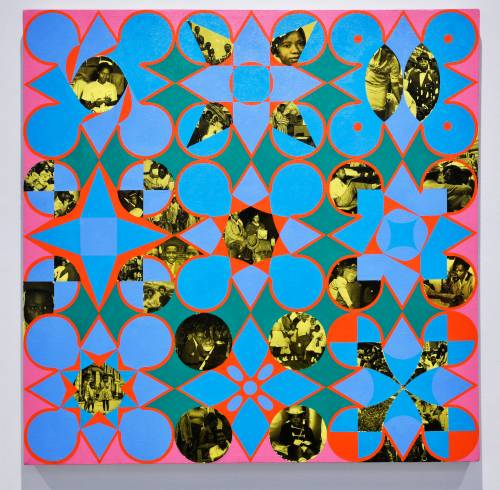
For his contribution to the exhibit, Ukaigwe, a multi-disciplinary artist, references the ongoing histories and patterns of Black labour migration, including the Windrush generation, says Fearon. Ukaigwe’s work uses black-and-white stock photos gel-transferred to canvas and matched in vibrancy by elaborate oil-painted mosaic patterns, rendered in a lattice of pink, red, green and red.

An assistant professor at her alma mater, the University of Manitoba’s School of Art, in her work Binta Diallo — born in Dakar, raised in St. Boniface — married graphic-novel imagery with computerized collage techniques to reflect on the immigration experiences of her father, who moved to Winnipeg from Senegal in 1982.
The Sobey Art Award long-listed artist’s work draws from the North American fiction in which her father first encountered visual representations of Canada: western-themed comic book series such as Mustang, Yuma and Jim Canada.
As for Beal’s negatives, Fearon and her staff elected to display them mounted atop custom lightboxes, images that have survived in stasis, midway through an early Prairie artist’s development.
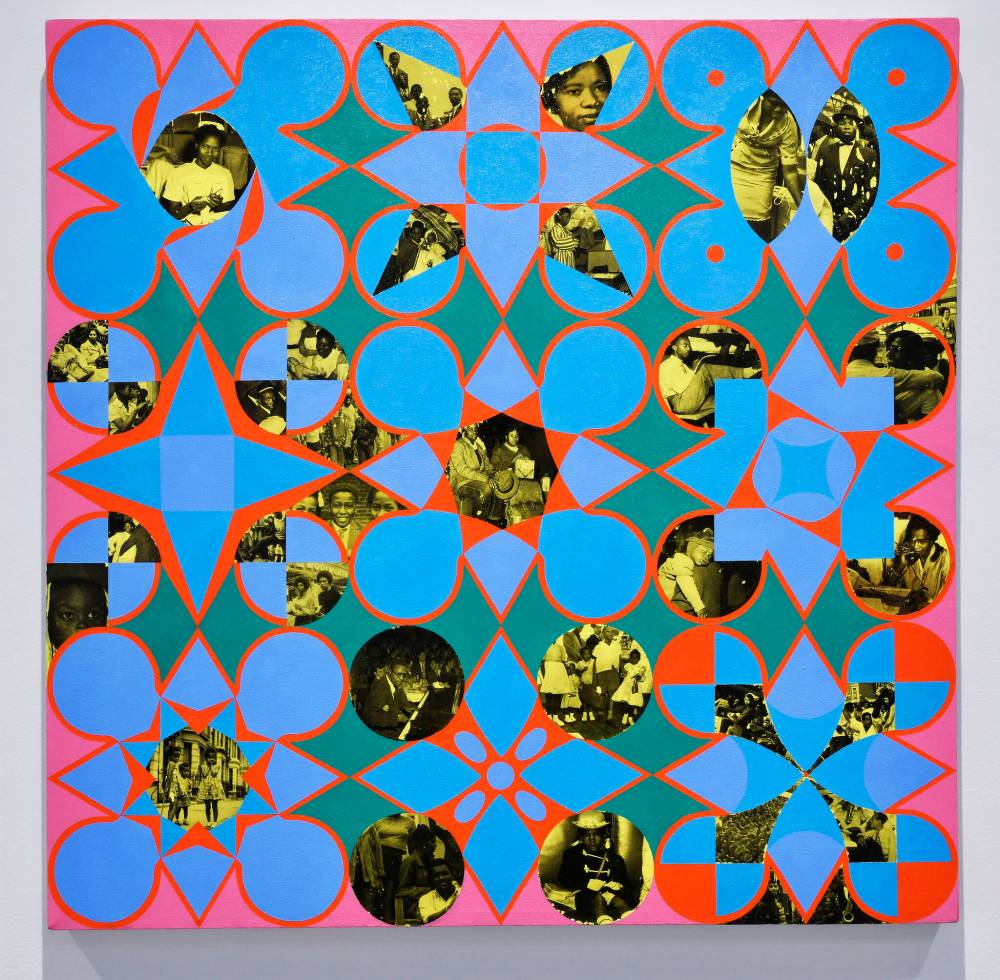
Chukwudubem Ukaigwe’s Untitled (Windrush 1), 2023-2024, oil paint and gel image transfer on canvas.
“I wanted people to really appreciate the effort that Beal put into the creation of this body of work. I wanted people to appreciate the sustained commitment to his artistic practice,” she says.
ben.waldman@winnipegfreepress.com
Ben Waldman is a National Newspaper Award-nominated reporter on the Arts & Life desk at the Free Press. Born and raised in Winnipeg, Ben completed three internships with the Free Press while earning his degree at Ryerson University’s (now Toronto Metropolitan University’s) School of Journalism before joining the newsroom full-time in 2019. Read more about Ben.
Every piece of reporting Ben produces is reviewed by an editing team before it is posted online or published in print — part of the Free Press‘s tradition, since 1872, of producing reliable independent journalism. Read more about Free Press’s history and mandate, and learn how our newsroom operates.
Our newsroom depends on a growing audience of readers to power our journalism. If you are not a paid reader, please consider becoming a subscriber.
Our newsroom depends on its audience of readers to power our journalism. Thank you for your support.
Ben Waldman is a National Newspaper Award-nominated reporter on the Arts & Life desk at the Free Press. Born and raised in Winnipeg, Ben completed three internships with the Free Press while earning his degree at Ryerson University’s (now Toronto Metropolitan University’s) School of Journalism before joining the newsroom full-time in 2019. Read more about Ben.
Every piece of reporting Ben produces is reviewed by an editing team before it is posted online or published in print — part of the Free Press‘s tradition, since 1872, of producing reliable independent journalism. Read more about Free Press’s history and mandate, and learn how our newsroom operates.
Our newsroom depends on a growing audience of readers to power our journalism. If you are not a paid reader, please consider becoming a subscriber.
Our newsroom depends on its audience of readers to power our journalism. Thank you for your support.
Advertisement Advertise With Us
Advertisement Advertise With Us