Blues and a Butterfly
Manitoba Opera season features reimagined Scott Joplin work and Puccini classic

Advertisement
Read this article for free:
or
Already have an account? Log in here »
To continue reading, please subscribe:
Digital Subscription
One year of digital access for only $1.44 a week*
- Enjoy unlimited reading on winnipegfreepress.com
- Read the E-Edition, our digital replica newspaper
- Access News Break, our award-winning app
- Play interactive puzzles
*Billed as $5.77 plus GST every four weeks. After 52 weeks, price increases to the regular rate of $19.95 plus GST every four weeks. Offer available to new and qualified returning subscribers only. Cancel any time.
To continue reading, please subscribe:
Add Free Press access to your Brandon Sun subscription for only an additional
$1 for the first 4 weeks*
- Enjoy unlimited reading on winnipegfreepress.com
- Read the E-Edition, our digital replica newspaper
- Access News Break, our award-winning app
- Play interactive puzzles
*Your next Brandon Sun subscription payment will increase by $1.00 and you will be charged $17.95 plus GST for four weeks. After four weeks, your payment will increase to $24.95 plus GST every four weeks.
Read unlimited articles for free today:
or
Already have an account? Log in here »
Hey there, time traveller!
This article was published 19/03/2026 (221 days ago), so information in it may no longer be current.
Manitoba Opera’s 54th season will feature a once-forgotten masterpiece and a returning classic.
The 2026-27 season opens with the local première of Scott Joplin’s Treemonisha: A Musical Reimagining (Nov. 21, 25, 27) and closes with Madama Butterfly (April 17, 21, 23, 2027), both performed at the Centennial Concert Hall.
Treemonisha was published in 1911 by Scott Joplin, the celebrated African-American pianist and composer often referred to as the King of Ragtime. Set during the Reconstruction era in the United States, the three-act opera focuses on the story of its title character, a young freedwoman, and fuses Western classical music with blues, gospel and ragtime.
The work proved too groundbreaking for the Euro-centric opera establishment and was produced for the first time in 1970, more than 50 years after Joplin’s death. The composer was awarded a Pulitzer Prize posthumously for his contributions to American music.
Ruth Bonneville / Free Press Neema Bickersteth will star in Treemonisha: A Musical Reimagining, a once-forgotten opera by Scott Joplin. 
Treemonisha is a modern adaptation that retains the English opera’s original setting and characters, but expands on its story and music.
Treemonisha is a young Black woman who, as an infant, was hidden in a tree by her mother in order to escape enslavement. Raised by an adoptive family, she receives an education in exchange for her parents’ labour and becomes a community leader and peacemaker.
In the reimagined version, Treemonisha is given much more stage presence.
“In the original, at the end the community chose her as their leader, but she didn’t actually do very much for that to happen and she didn’t say very much,” says Neema Bickersteth, an Alberta-born soprano who was involved in the development of the revamped opera and will be singing the lead role for the third time this fall.
“(Librettist) Leah-Simone Bowen wanted to give Treemonisha agency and that resonated with me,” she says.
Bickersteth gave a stirring preview of two pieces — the first-act aria, Know Your Place, and the closing number, A Real Slow Drag — during Thursday’s season announcement.
Ruth Bonneville / Free Press Soprano Neema Bickersteth performs an aria from Treemonisha: A Musical Reimagining, a historic African-American opera that will open the Manitoba Opera season.
Scott Joplin’s Treemonisha was produced by Toronto’s Volcano Theatre and made its world première in that city in 2023. It’s the result of a years-long cross-border collaboration between Black female creatives from Canada and the United States.
It features a new libretto co-written by playwrights Bowen and Cheryl L. Davis, and updated orchestration by Grammy-winning composer Jessie Montgomery and Grammy-nominated arranger Jannina Norpoth.
“This is probably one of the most important reimaginings of Scott Joplin’s work. It takes the ideas further and asks: how do we make these themes relevant to a 21st-century audience?” says conductor Jeri Lynne Johnson, founder of Philadelphia’s Black Pearl Chamber Orchestra.
“I think audiences can expect to be moved, but in unexpected ways.”
The production includes a large cast of singers and dancers and an onstage ensemble featuring African instruments. It is directed by Weyni Mengesha of Soulpepper Theatre with choreography by Esie Mensah.
“It’s full of one catchy tune after another; people are going to leave humming something from the show. The production looks spectacular, the costumes are just beautiful,” says Manitoba Opera interim artistic director Larry Desrochers, who has wanted to bring the opera to local audiences since seeing its première.
Ruth Bonneville / Free Press Interim artistic director Larry Desrochers announces the 2026-27 Manitoba Opera season at the Centennial Concert Hall Thursday.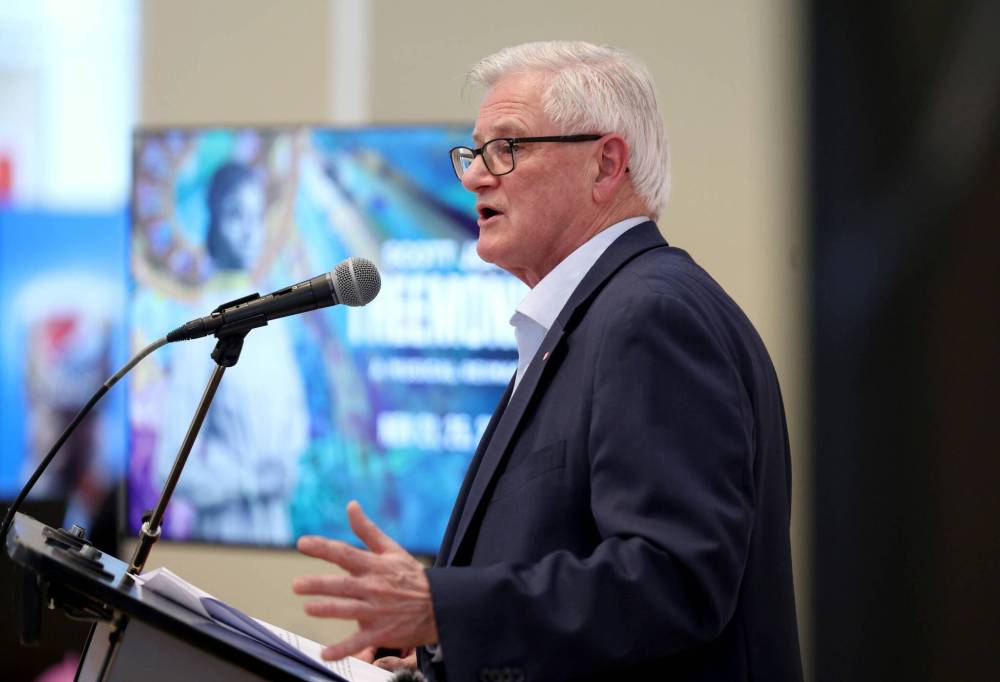
This is Desrochers’ final season of programming. It feels like a fitting finale, he says.
Madama Butterfly was the first opera ever presented by the Manitoba Opera during its debut season in 1972 and was last mounted in 2017. Puccini’s tragic love story follows a young Japanese geisha who marries, and is eventually betrayed by, an American naval officer.
Korean-born soprano Karah Son will sing the lead role of Cio-Cio-San, a.k.a. Madam Butterfly, next spring, with tenor Dominick Chenes making his local debut as Pinkerton.
“It’s about honouring those values of the company and not forgetting our traditions and where we come from, but finding ways to move the artform forward, include more diverse artists and tell more diverse stories,” says Desrochers, who last summer announced his departure after 25 years as the organization’s CEO and general director.
Michael Blais moved into the role of executive director last year and Manitoba Opera is set to announce a new artistic director in the coming months.
The company’s 2025-26 season wraps up next month with The Marriage of Figaro on April, 18, 22 and 24.
winnipegfreepress.com/evawasney

Eva Wasney covers environmental issues in Manitoba for The Narwhal in partnership with the Winnipeg Free Press. Read more about Eva.
Every piece of reporting Eva produces is reviewed by an editing team before it is posted online or published in print — part of the Free Press‘s tradition, since 1872, of producing reliable independent journalism. Read more about Free Press’s history and mandate, and learn how our newsroom operates.
Our newsroom depends on a growing audience of readers to power our journalism. If you are not a paid reader, please consider becoming a subscriber.
Our newsroom depends on its audience of readers to power our journalism. Thank you for your support.
Related Articles
Larry Desrochers wins Manitoba Arts Award of Distinction
Advertisement Advertise With Us
Advertisement Advertise With Us