New census data offers snapshot of Canada’s transgender population for first time
Advertisement
Read this article for free:
or
Already have an account? Log in here »
To continue reading, please subscribe:

Digital Subscription
One year of digital access for only $205*
- Enjoy unlimited reading on winnipegfreepress.com
- Read the E-Edition, our digital replica newspaper
- Access News Break, our award-winning app
- Play interactive puzzles
*First annual payment billed as $205.00 + GST for one year. This annual subscription will automatically renew at $233.00 + GST every 52 weeks (10% off the regular annual price of $259.35). Offer available to new and qualified returning subscribers only. Cancel any time.
To continue reading, please subscribe:
Add Free Press access to your Brandon Sun subscription for only an additional
$1 for the first 4 weeks*
- Enjoy unlimited reading on winnipegfreepress.com
- Read the E-Edition, our digital replica newspaper
- Access News Break, our award-winning app
- Play interactive puzzles
*Your next Brandon Sun subscription payment will increase by $1.00 and you will be charged $17.95 plus GST for four weeks. After four weeks, your payment will increase to $24.95 plus GST every four weeks.
Read unlimited articles for free today:
or
Already have an account? Log in here »
Hey there, time traveller!
This article was published 27/04/2022 (1605 days ago), so information in it may no longer be current.
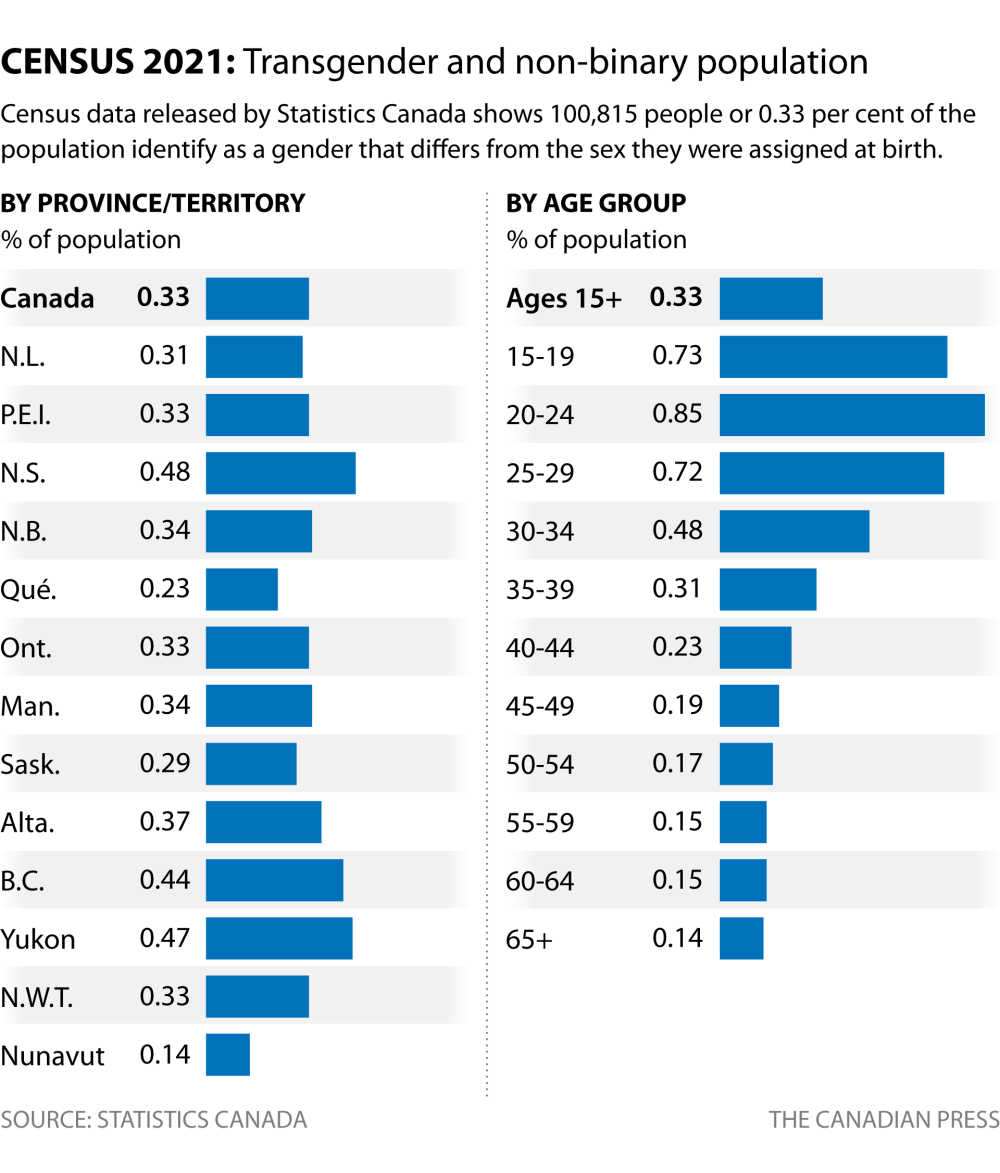
TORONTO – Census data released Wednesday offers an unprecedented snapshot of Canada’s transgender population, showing 0.33 per cent of residents identify as a gender that differs from the sex they were assigned at birth.
The data collected during last year’s national household survey shows about 100,815 people are transgender or non-binary, including 31,555 who are transgender women, 27,905 who are transgender men and 41,355 who are non-binary.
It’s the first time Statistics Canada has differentiated between “sex at birth” and “gender” in the census. While the agency and advocates agree the new numbers likely underestimate the true size of the population, they say the data will offer crucial insight into a marginalized community.
Fae Johnstone, a transgender advocate, said population-level data backing up trans people’s lived experience has thus far been slim, so this new information is important both symbolically and practically.
“It says something when our government is recognizing the existence of trans folks who have historically been kept out of these conversations and uncounted,” Johnstone said. “But it also is useful to us to better understand how we can focus interventions and address health inequities experienced by trans folks across this country.”
While previous censuses asked only about sex, the 2021 edition asked about both “sex at birth,” which it said is “determined by a person’s biological characteristics,” and “gender,” which it said could differ from what’s indicated on legal documents.
Under “gender,” respondents were able to choose either male or female, or write in a third option.
Florence Ashley, a transfeminine jurist and bioethicist who uses they/them pronouns, said that methodology presents some issues.
Even using the phrase “sex at birth” rather than the preferred “sex assigned at birth” is misleading, Ashley said.
“When you describe it as ‘sex at birth,’ you’re suggesting that sex or gender is fundamentally something you read on the body, rather than something that is assigned based on the social meaning that’s attributed to those bodies,” they said, noting it also leaves out intersex people.
Government demographers said they will use “sex at birth” to compare to historical data on sex.
In some cases, Statistics Canada said, it will be necessary to narrow gender down into two categories “to protect the confidentiality of responses provided.” Those categories will be “men+” and “women+”, and each will encompass some people who are non-binary.
Ashley said maintaining the binary in that way is also problematic, because it continues to misgender non-binary people. To maintain confidentiality, they suggested creating a third “not disclosed” or “not applicable” category and collapsing individual ages into wider age groups.
They said this issue could have been avoided, had the government listened to some of the feedback it received from transgender experts and community members in consultations.
“The general idea is the government needs to do better in actually collaborating with communities rather than then engaging them in a very superficial and tokenistic manner,” they said.
Ashley said those reading the data should take into account that they likely don’t capture the whole transgender and non-binary population.
“The way the census is collected favours a certain type of class position,” they said. “But then, also, you have a bunch of people who are not necessarily in an environment where they can safely disclose their gender to other people.”
Statistics Canada backed this up. It noted that the proportions of transgender and non-binary people was “three to seven times higher” for those born between 1981 and 2006 than for those born in 1980 and before.

“Over time, the acceptance and understanding of gender and sexual diversity has evolved. Further, there has been social and legislative recognition of transgender, non-binary and LGBTQ people in general,” Statistics Canada said. “Younger generations may be more comfortable reporting their gender identity than older generations.”
The inclusion of transgender people in the census is part of a broader move by the Liberal government to be more inclusive of the LGBTQ community.
In 2017, the government added gender identity and expression to the list of prohibited grounds of discrimination under the Canadian Human Rights Act, and amended the Criminal Code to include those same groups in the list of “identifiable groups” that could be targets of genocides and hate crimes.
The following year, the federal budget noted Statistics Canada’s efforts to reflect gender diversity in the census and allocated funds to the agency to create a new Centre for Gender, Diversity and Inclusion Statistics.
Its mandate, Statistics Canada said, is to develop “a Gender-Based Analysis Plus (GBA+) data hub to support evidence-based policy development and decision making, both within the federal government and beyond.”
“This development does speak to good faith, and a lot of important work that’s being done by individual people within the government,” Ashley said. “The problem is that oftentimes those that are doing the really good work end up having their ideas taken and distorted.”
Gemma Hickey, a transmasculine non-binary author and activist, said it’s “about time” the census provided this recognition.

“As an advocate for LGBTQ+ rights for over 20 years, I’ve been a part of and witnessed many changes. But these types of changes, especially when it comes to the census, are long overdue.”
Nearly five years ago, Hickey became one of the first Canadians to receive a gender-neutral birth certificate.
Hickey said they hope the census will spark a broader conversation by acknowledging that the sex a person was assigned at birth is not necessarily the same as gender.
“That visibility — that recognition — is very important for people, because we are here. We have been here as long as you’ve been here,” they said.
This report by The Canadian Press was first published April 27, 2022.