Face to face in our often contentious historical space

Advertisement
Read this article for free:
or
Already have an account? Log in here »
To continue reading, please subscribe:
Digital Subscription
One year of digital access for only $1.44 a week*
- Enjoy unlimited reading on winnipegfreepress.com
- Read the E-Edition, our digital replica newspaper
- Access News Break, our award-winning app
- Play interactive puzzles
*Billed as $5.77 plus GST every four weeks. After 52 weeks, price increases to the regular rate of $19.95 plus GST every four weeks. Offer available to new and qualified returning subscribers only. Cancel any time.
To continue reading, please subscribe:
Add Free Press access to your Brandon Sun subscription for only an additional
$1 for the first 4 weeks*
- Enjoy unlimited reading on winnipegfreepress.com
- Read the E-Edition, our digital replica newspaper
- Access News Break, our award-winning app
- Play interactive puzzles
*Your next Brandon Sun subscription payment will increase by $1.00 and you will be charged $17.95 plus GST for four weeks. After four weeks, your payment will increase to $24.95 plus GST every four weeks.
Read unlimited articles for free today:
or
Already have an account? Log in here »
Hey there, time traveller!
This article was published 02/05/2025 (535 days ago), so information in it may no longer be current.
The two men trapped in the elevator were sure to come to blows. That much seemed clear from the first adversarial undertones of their conversation before the stall.
One, a young Indigenous man, gregarious and educated. The other, a white lawyer, in a hurry for a meeting. Both on their way to the top floor, both stalled on their journey and brought face to face with their own discomforting assumptions and histories.
This is the setting for David McLeod’s Elevate: Manaaji’idiwin, on the mainstage for another week at the Royal Manitoba Theatre Centre.
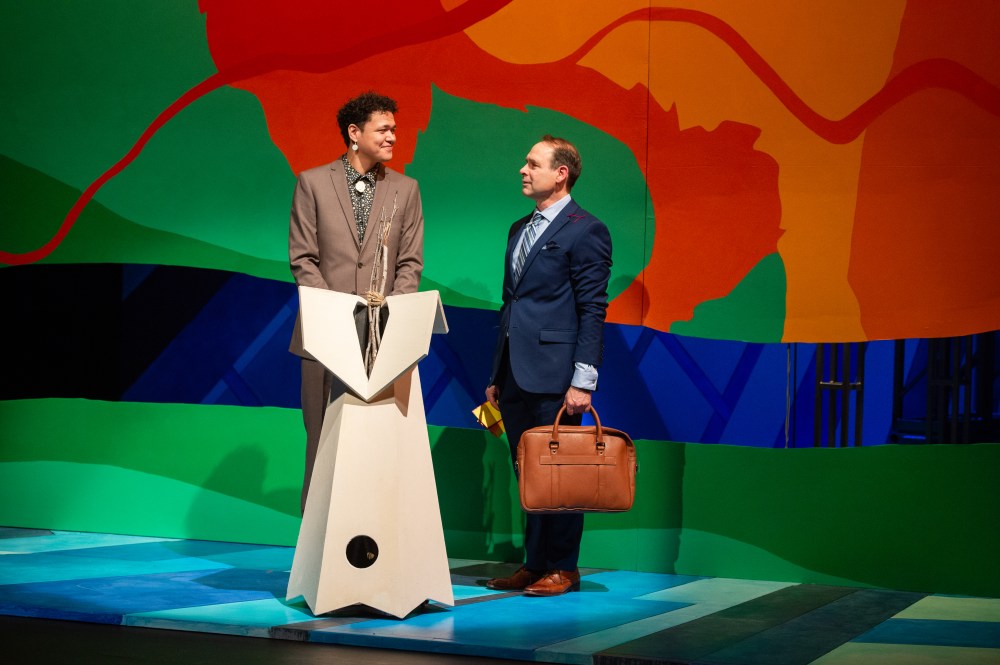
Peppered with local references from Children of the Earth High School to Ray “Coco” Stevenson’s Pow Wow Club, the conversations and place names are unabashedly niche: the Winnipeg we inhabit is also frequented by the characters in the elevator. This familiar landscape cultivates intimacy with the audience, trapped, as we are, in the same suspended time and space as the characters.
Like Jonesie, the white lawyer who cannot, despite his efforts, silence his young and verbose travelling partner Tallahassee, the audience is brought into this difficult space of Indigenous/non-Indigenous relations, and is along for the ride, for as long as it takes, until the doors open again.
This very local play is a product of RMTC’s own Indigenous playwriting circle, Pimootayowin, which works to create and develop new plays written by Manitoba-based Indigenous playwrights. It’s an endeavour that comes under fire in the themes of Elevate: Manaaji’idiwin itself: why devote resources to Indigenous stories in particular? What makes them so “special?”
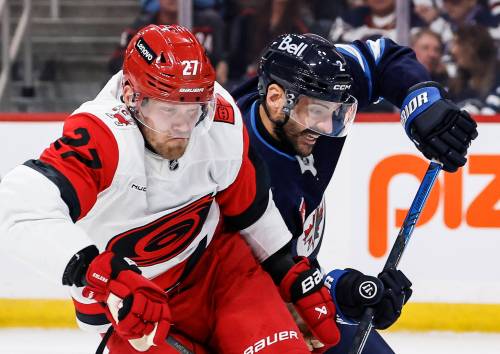
I suppose the answer to this is part of the same reason the Jets’ NHL playoff towels were sourced from Dreamcatcher Promotions, an Indigenous-owned business. And it’s partly the reason for the Indigenous stoles worn by graduates at our universities and colleges.
It’s why True North Real Estate Development partnered with the Southern Chiefs’ Organization to breathe new life into the former Bay building downtown. It’s placing Indigenous success at centre stage of what we do in Winnipeg, what we celebrate and how.
In other words, it’s a way to get us into the elevator together, to confront and challenge some of the assumptions we may make about one another, and to make sure Indigenous folks not only have a voice, but an audience.
It’s tricky, but fitting, in the homeland of the Métis, the middle of the country, a place of mixing and remixing ideas and ideologies, that there would be some friction in the necessary shoulder-rubbing we must do to find harmony with one another.
I walk the line between these Indigenous and non-Indigenous identities. This friction, the drawing of a bow on a string, resonates in me too.
I’m a Red River Métis citizen, but of a rather pale variety, and once had an enlightening and impassioned phone chat with a Free Press reader, who asked me just who do I mean when I write the word “we.” Do I mean “we” Métis people? “We” Indigenous people? “We” Winnipeggers?
The reader, Indigenous herself, wanted me to commit, to write from a Métis viewpoint, to write on Indigenous issues from an Indigenous perspective. I told her I’d have to think about that, and about how freely I toss around this word “we.”
Because like in McLeod’s work, “we” does shift, does change depending on what we’re doing, where we’re going, what we’re hoping could happen.

The truth is I am Métis, and I am also a Winnipegger. I feel at home claiming membership in both communities, and maybe it doesn’t matter, in the moment, who “we” is when I write it on the page. “We” is just whoever’s in the elevator at that moment.
And how fortunate is it, that we might be crammed into a theatre, a hockey rink or an elevator with someone we don’t recognize as ourselves until we’ve been there for a while. How we can shift our “we” because we belong to more than a single identity.
How fortunate to live in a place and among people who understand what it is to celebrate one another, to preserve space for creativity, art and enterprise.
And not just in self-started playwright circles, but on the mainstage, in the NHL playoffs, and in those passing places like street corners and elevators that bring us to common futures we didn’t know were waiting for us.
rebecca.chambers@freepress.mb.ca
Rebecca explores what it means to be a Winnipegger by layering experiences and reactions to current events upon our unique and sometimes contentious history and culture. Her column appears alternating Saturdays.
Our newsroom depends on a growing audience of readers to power our journalism. If you are not a paid reader, please consider becoming a subscriber.
Our newsroom depends on its audience of readers to power our journalism. Thank you for your support.
Rebecca explores what it means to be a Winnipegger by layering experiences and reactions to current events upon our unique and sometimes contentious history and culture. Her column appears alternating Saturdays.
Our newsroom depends on a growing audience of readers to power our journalism. If you are not a paid reader, please consider becoming a subscriber.
Our newsroom depends on its audience of readers to power our journalism. Thank you for your support.
Related Articles
Elevator a smart setting for funny, pointed commentary on reconciliation

Advertisement Advertise With Us
Advertisement Advertise With Us