Ali Smith fans will find comfort in her new novel
Advertisement
Read this article for free:
or
Already have an account? Log in here »
To continue reading, please subscribe:

Digital Subscription
One year of digital access for only $205*
- Enjoy unlimited reading on winnipegfreepress.com
- Read the E-Edition, our digital replica newspaper
- Access News Break, our award-winning app
- Play interactive puzzles
*First annual payment billed as $205.00 + GST for one year. This annual subscription will automatically renew at $233.00 + GST every 52 weeks (10% off the regular annual price of $259.35). Offer available to new and qualified returning subscribers only. Cancel any time.
To continue reading, please subscribe:
Add Free Press access to your Brandon Sun subscription for only an additional
$1 for the first 4 weeks*
- Enjoy unlimited reading on winnipegfreepress.com
- Read the E-Edition, our digital replica newspaper
- Access News Break, our award-winning app
- Play interactive puzzles
*Your next Brandon Sun subscription payment will increase by $1.00 and you will be charged $17.95 plus GST for four weeks. After four weeks, your payment will increase to $24.95 plus GST every four weeks.
Read unlimited articles for free today:
or
Already have an account? Log in here »
Hey there, time traveller!
This article was published 02/07/2011 (5569 days ago), so information in it may no longer be current.
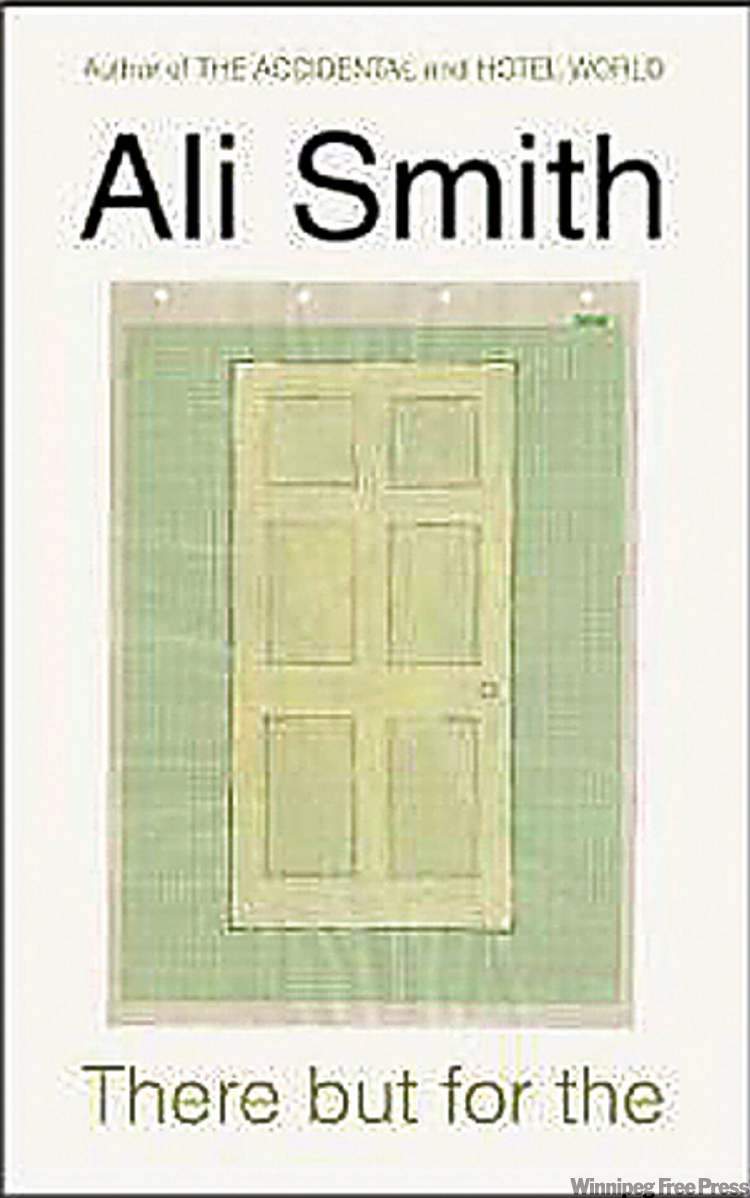
There but for the
By Ali Smith
Hamish Hamilton, 357 pages, $34

A spirited dinner party in Greenwich, England, begins normally enough — the hostess is pretentious and the guests lively, the conversation is just highbrow enough to be a little too self-aware, the meal (seared scallops and chorizo to start, followed by lamb tagine) is appropriately upmarket. Then, just before the crème brûlée, one guest, Miles, locks himself in an upstairs bedroom and refuses to leave.
This is the premise of Scottish bestseller Ali Smith’s clever new novel, the unusually titled There But for The.
Presumably based on the saying “There but for the grace of God go I,” the title is also a list of each of the book’s four sections, all narrated by a different character distantly related to Miles.
There’s an elderly lady, May, who seems to slip from senility to lucidity and back again, and, Anna, Miles’ friend from decades ago, who tries to persuade him to leave the room.
While in Greenwich, she strikes up a friendly relationship with the young girl, Brooke, who lives next door. They share a love for puns, and one can imagine Smith giggling to herself as certain turns of phrase occurred to her and she had the audacity to include them. Among the more noteworthy groaners is “Observe-a-Tory.”
Brooke is precocious — likely bordering on genius — inquisitive and joyful. However, we learn she is being victimized by bullies for her lack of a Facebook account, and refuses to tell her parents. In her chapter, The, she contemplates the redundancy of the word “the,” and the reliability of recorded history.
Throughout, Smith is up to her usual vocabularic acrobatics, but she is at her most entertaining during Mark’s chapter, But.
“But the thing I particularly like about the word ‘but,’ now that I think about it, is that it always takes you off to the side, and where it takes you is always interesting.”
Her telltale stream-of-consciousness method makes notable appearances, and she unleashes her joyfully obscene side in the form of Mark’s long-dead mother, whom he hears inside his head, and who speaks only in vindictive or lewd rhyming couplets (none of which can be reprinted here), if she can help it.
As entertaining as Mark’s chapter is, he may also be the most defeated character. At a low point, he desperately types “something beautiful” into Google only to find “Google is so strange. It promises everything, but everything isn’t there.”
The characters — particularly the four main narrators — are so engrossing, readers will be disappointed to see the end of each chapter. Miles is the one person about whom we learn the least: regrettable, but fitting, considering he spends the entire book locked in a guest room with ensuite.
For those looking for the answer to the question “What happens when a house guest overstays his welcome?” look elsewhere. There is no shortage of projects that have tackled this topic, including George S. Kaufman and Moss Hart’s well-loved 1939 theatrical comedy The Man Who Came to Dinner.
In fact, Smith herself explored the consequences of an uninvited house guest in her 2005 Whitbread Award-winning novel, The Accidental.
In that novel, the precocious daughter Astrid Smart idolizes her family’s lodger and confides in her that bullies stole her mobile phone but she is too afraid to admit it to her mother.
Sound familiar? Astrid and Brooke are strikingly similar to the point where they seem interchangeable.

Smith fans will find comfort in her new novel. Hidden amid her manipulation of the parts of speech is a carefully crafted statement on society’s dependence on divisive technology. The characters and settings are familiar; the wordplay is omnipresent and threatens to overpower the story. Logophiles will delight, but many will likely find it too contrived and hoity-toity.
In the end, we’re not sure if the title means us to feel thankful we’re not Miles in his self-imposed captivity or that we’re not those carrying on around him, their lives as meaningless as banal dinner-party chatter.
Jennifer Ryan is a Winnipeg writer.
Related Articles
Thornton wins $15,000 award
Advertisement Advertise With Us
Advertisement Advertise With Us