Not your typical Jewish boys
Notorious Montreal gangsters were heavily involved in drug trade, gambling
Advertisement
Read this article for free:
or
Already have an account? Log in here »
To continue reading, please subscribe:

Digital Subscription
One year of digital access for only $205*
- Enjoy unlimited reading on winnipegfreepress.com
- Read the E-Edition, our digital replica newspaper
- Access News Break, our award-winning app
- Play interactive puzzles
*First annual payment billed as $205.00 + GST for one year. This annual subscription will automatically renew at $233.00 + GST every 52 weeks (10% off the regular annual price of $259.35). Offer available to new and qualified returning subscribers only. Cancel any time.
To continue reading, please subscribe:
Add Free Press access to your Brandon Sun subscription for only an additional
$1 for the first 4 weeks*
- Enjoy unlimited reading on winnipegfreepress.com
- Read the E-Edition, our digital replica newspaper
- Access News Break, our award-winning app
- Play interactive puzzles
*Your next Brandon Sun subscription payment will increase by $1.00 and you will be charged $17.95 plus GST for four weeks. After four weeks, your payment will increase to $24.95 plus GST every four weeks.
Read unlimited articles for free today:
or
Already have an account? Log in here »
Hey there, time traveller!
This article was published 03/11/2018 (2878 days ago), so information in it may no longer be current.
Adapted from Seeking the Fabled City: The Canadian Jewish Experience. Allan Levine, © 2018. Published by McClelland & Stewart, a division of Penguin Random House of Canada. Reprinted with permission of the publisher.
Beyond the garment factories, some Canadian Jews sought more creative ways to make a dollar and survive the Great Depression. Good Jewish boys, these were not. Harry Ship and his friends raked in cash from illegal gambling operations during the late 1930s and 1940s. Such Montreal nightclubs as Tic Toc, the Gayety, the Hawaiian Lounge, and Ruby Foo’s had links to illegal gambling run by Eastern European Jews. Canada never quite had the Jewish gangster problem of the U.S., where infamous mobsters like Meyer Lansky and Benjamin “Bugsy” Siegel made millions of dollars from gambling and selling liquor during the Prohibition era, and racketeer Louis “Lepke” Buchalter organized a contract-killing hit squad, later known as Murder, Inc. (and by its members as “The Combination”). This notorious Jewish and Italian gang — including the ever-feared killer-for-hire Samuel “Red” Levine (absolutely no relation to the author), who was an observant Jew who wore a kippah and avoided murder jobs on the Sabbath, if he could help it — was likely responsible for more than five hundred murders. But though there may not have been any activity on that scale in Canada, several Montreal Jewish immigrants were heavily involved in trafficking opium, morphine, and heroin — and paid the ultimate price.
Harry Davis, born Chaskel Lazarovitch in Romania in 1898, arrived in Canada at the age of ten. He grew up dirt poor, and never forgot that. Before he was twenty-five years old, Davis, who loved fine and expensive suits, was making big money from gambling, prostitution, fencing stolen property, and dealing in drugs. For a time, he conducted his operations from a shop on St. Urbain Street. The Royal Canadian Mounted Police (RCMP) came after Davis and his chief partner, former featherweight boxer Eddie “Kid” Baker, a Russian Jewish immigrant and professional gambler who later had a financial interest in the Gayety Theatre. During the late twenties, both were convicted of conspiracy to traffic in drugs, though only served short prison sentences.
By the time the Depression crippled the Canadian economy, Davis had teamed up with two other Jewish toughs: Pincus “Pinky” Brecher from New Jersey, and “Fat” Charlie Feigenbaum. Like an early version of The French Connection, they planned to smuggle in cocaine and heroin worth more than $200,000 (over $4 million today) from Paris into the Port of Montreal.
One of Feigenbaum’s responsibilities was looking after three hundred slot machines in resort hotels in the Laurentians. He also made money illegally bringing in silk, which at the time was subject to high government tariffs. Bribing custom officials was a piece of cake for Fat Charlie. Nonetheless, late in 1930 the law caught up with him. Convicted of silk smuggling, he was sentenced to five and half years in prison — and was miserable about it.
Meanwhile, in April 1933, having become aware of the Davis gang’s drug operations, the RCMP swooped in and arrested Davis, Brecher, and six others. All of them were charged with drug smuggling. Feigenbaum was tired of rotting in prison. He had intimate knowledge of how Davis and Brecher worked, and offered to testify against his former partners — he became a “stool pigeon,” as the press later put it — in exchange for a reduced sentence. In a brief trial held in October 1933, and owing to Feigenbaum’s detailed descriptions of the gang’s drug business, Davis was sentenced to ten strokes of the lash, a $10,000 fine, and fourteen years in Laval’s Saint-Vincent-de-Paul Penitentiary. Brecher’s trial was not scheduled for another year.

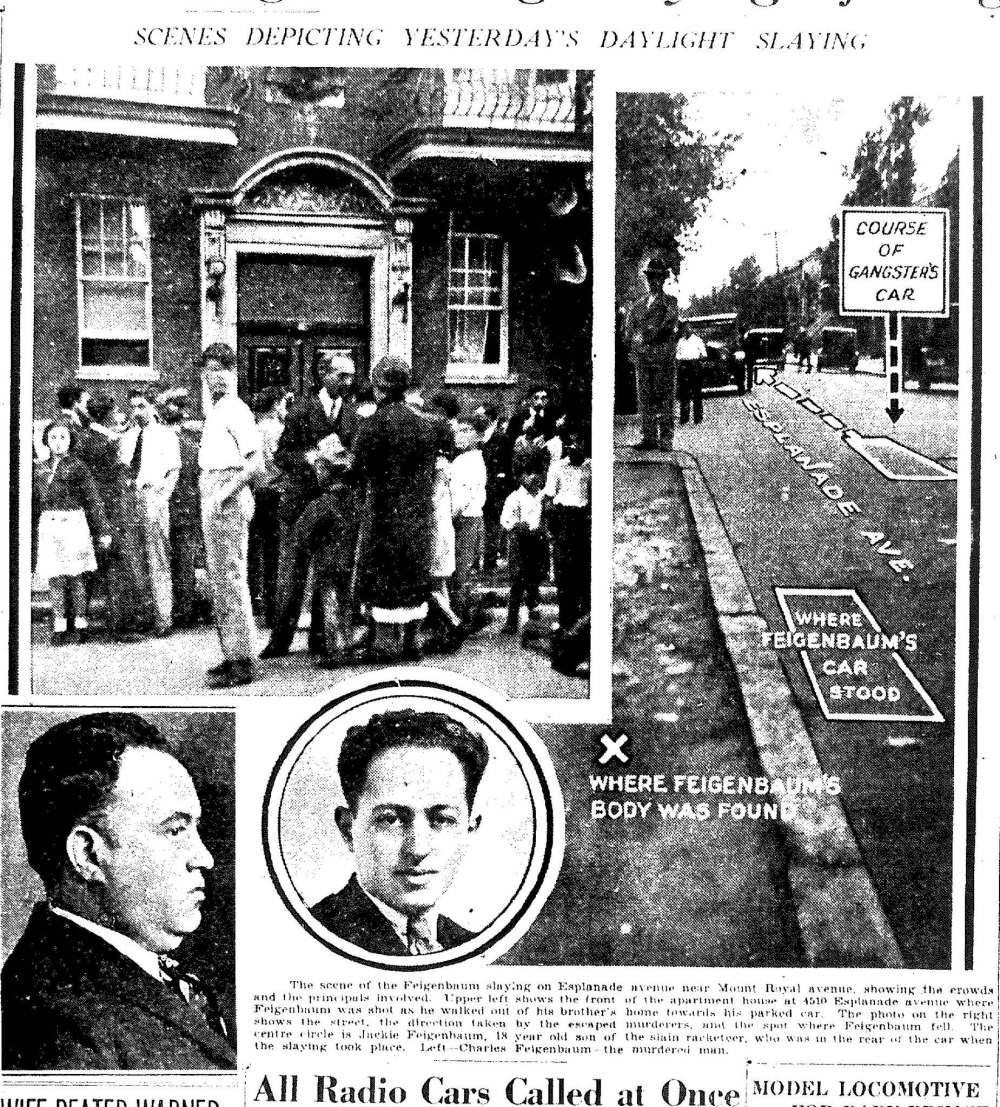
Feigenbaum, forty-eight years old, was back on the streets of Montreal by the summer of 1934. Despite being an informer, he was foolish enough to believe that he could resume life with his wife and children and get back into smuggling and illegal gambling. He was wrong. Late in the afternoon on August 21, 1934, he walked out of his brother’s house on Esplanade Avenue, a few blocks from St. Lawrence Blvd or the “Main,” the centre of Jewish Montreal, accompanied by his eighteen-year-old son Jackie. There was a black Hudson sedan parked across the street. The man in the passenger seat got out, moved closer to Feigenbaum, and shot him six times in the chest and head. He then calmly returned to the car, which sped off. Other residents on the street witnessed the murder, but the killer and the driver — who might have been a local Jewish hood named Louis Bercovitch — were never apprehended. (The murder was famous in Montreal police history because it was the first time radio-equipped cars were summoned to the scene of a crime.)
Many members of the Montreal Jewish community were shocked at the killing and embarrassed by the Jewish connection to gambling and crime commented on in the French and English newspapers. True, the murder occurred “in the heart of the Jewish quarter,” the Yiddish newspaper the Keneder Adler (“Canadian Eagle”) noted in an editorial a few days after Feigenbaum’s death, and the victim was Jewish. But the paper stressed “it is clear that this has nothing to do with the Jewish community as a whole… For the well-being of the Jewish community it would be much better if the Jews were to be clean of such men and of such damaging spectacles.” Clearly not everyone around St. Lawrence Boulevard felt that way — an estimated three thousand people, presumably many of them Jews, attended Feigenbaum’s funeral. A month later, and despite the absence of Feigenbaum as a star witness, Brecher was also convicted of drug trafficking. Before he could be sentenced, however, he managed to break free from the guards watching him and leap over an open passageway. He fell thirty-five feet onto the hard asphalt below and died.
Having endured five lashes when he arrived at the penitentiary and five before he was released, Harry Davis was a free man again in 1945, and immediately got back into illegal gambling. With the death of Eddie Baker, Davis became the “edge man”: he collected money from his fellow bookies and gamblers and regularly paid off the police to look the other way. In the spring of 1946, Louis Bercovitch, the alleged driver of the car at the Feigenbaum murder who used the alias “Joe Miller,” wanted to open his own gambling operation. Davis, who had the final word about such activities, told him no. Bercovitch was angry about this and soon heard a rumour that Davis had put out a contract on his life. On the afternoon of July 25, 1946, Bercovitch met with Davis at his office on Stanley Street, half a block from Ste. Catherine, supposedly to smooth things out. The discussion immediately became heated. According to Bercovitch, Davis threatened him. “What we did to Feigenbaum, the same could happen to you,” he was alleged to have said. A few minutes later, and again according to Bercovitch, Davis reached for a gun and so did Bercovitch, who fired first. Davis was killed instantly and Bercovitch fled the scene. Realizing that too many people had seen him enter Davis’s office, a few hours after the shooting Bercovitch contacted a reporter at the Montreal Herald, told him his version of the altercation, and then turned himself in to the police. At his trial three months later, the jury more or less believed him that he had shot Davis in self-defence — though it was common knowledge that Davis did not normally carry a revolver — and found him guilty of manslaughter. He still received a life sentence, and appealed. He was not released until January 1958, having served eleven years.
The funeral of Harry Davis on July 28, 1946 was another big occasion in the city’s Jewish quarter. It was like a “midway side show,” the Globe and Mail reported, with a crowd of about five thousand people gathering outside the funeral home on St. Urbain Street. Newspaper photographers tried to take pictures of the two hundred or so mobsters attending the service, and were threatened with physical harm. A long motorcade followed the hearse carrying his casket to the Saint Laurent Jewish cemetery.
The Adler was once more on the defensive, and scrambled to explain the violent death of another Jewish gangster, supposedly a “victim of circumstances.” This time, they blamed police corruption, which was likely not far from the truth. “If the police were not corrupt and had not taken bribes,” an editorial of July 30, 1946 pointed out, “gambling houses would not be able to operate and the Harry Davis’s of the world would perhaps be forced to earn their living in the usual manner.”