Walsh’s essays on art bring energy, emotion

Advertisement
Read this article for free:
or
Already have an account? Log in here »
To continue reading, please subscribe:

Digital Subscription
One year of digital access for only $205*
- Enjoy unlimited reading on winnipegfreepress.com
- Read the E-Edition, our digital replica newspaper
- Access News Break, our award-winning app
- Play interactive puzzles
*First annual payment billed as $205.00 + GST for one year. This annual subscription will automatically renew at $233.00 + GST every 52 weeks (10% off the regular annual price of $259.35). Offer available to new and qualified returning subscribers only. Cancel any time.
To continue reading, please subscribe:
Add Free Press access to your Brandon Sun subscription for only an additional
$1 for the first 4 weeks*
- Enjoy unlimited reading on winnipegfreepress.com
- Read the E-Edition, our digital replica newspaper
- Access News Break, our award-winning app
- Play interactive puzzles
*Your next Brandon Sun subscription payment will increase by $1.00 and you will be charged $17.95 plus GST for four weeks. After four weeks, your payment will increase to $24.95 plus GST every four weeks.
Read unlimited articles for free today:
or
Already have an account? Log in here »
Hey there, time traveller!
This article was published 28/05/2022 (1575 days ago), so information in it may no longer be current.
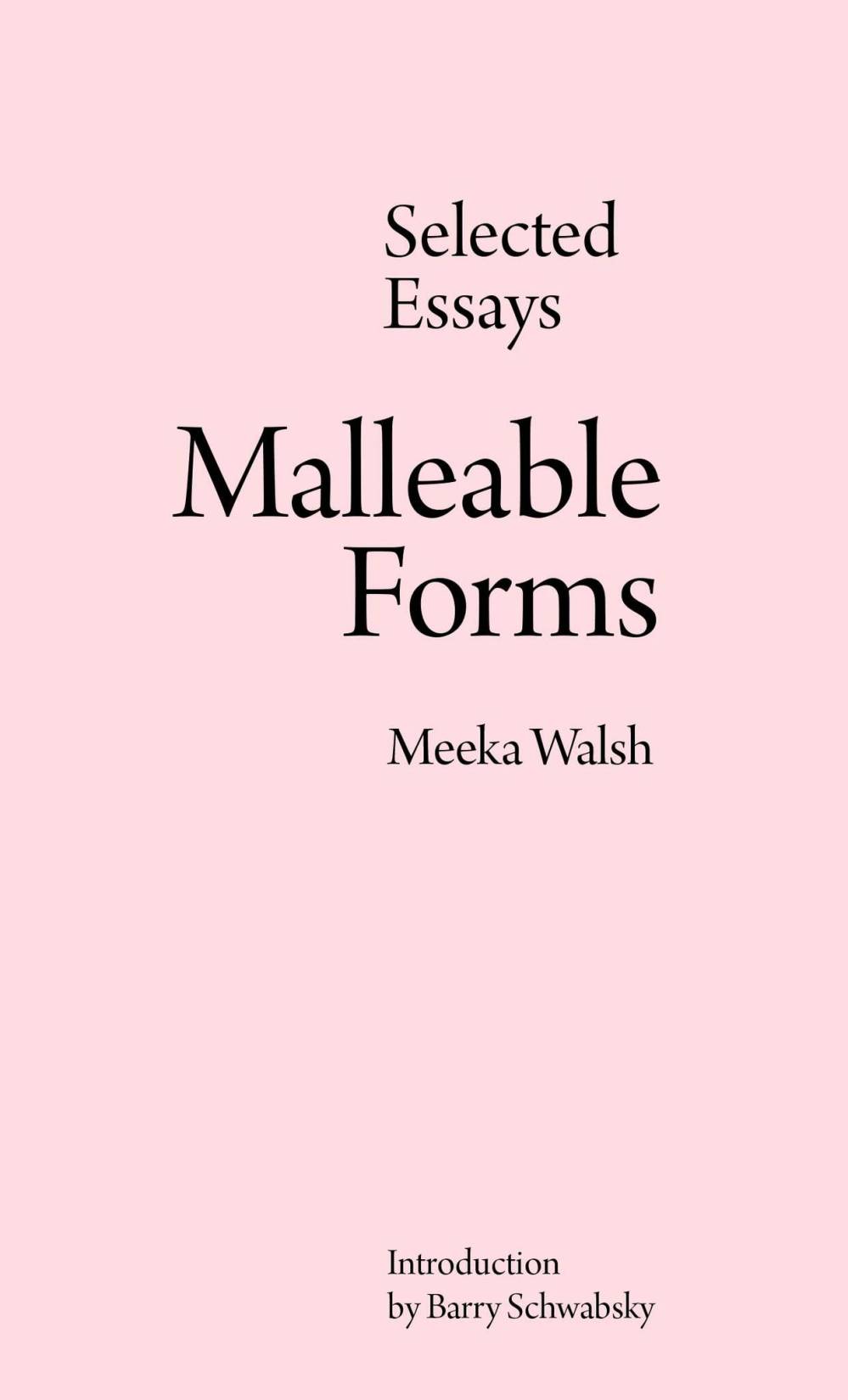
This new collection of essays by the long-time editor of Border Crossings is dense.
It’s dense in the literal sense. In gathering Meeka Walsh’s magazine essays into a more concentrated form, the publisher has emphasized the physicality of books, and Malleable Forms, though as small as a mass-market paperback, is unexpectedly hefty.
Comprised of 47 essays originally published in Border Crossings, Malleable Forms is also dense with ideas, fizzing with intellectual energy and vivid insight as Walsh name-checks creators from Susan Sontag to Kim Gordon, Caravaggio to Robert Frank. Her focused gaze spans the local and the global, the historical and the contemporary, the realms of high art and mass culture.
Walsh has been editor of the award-winning Winnipeg-based Border Crossings since 1993 (full disclosure: this reviewer’s first published piece was written for the magazine in 1984), a position that has brought her into close connection with some of the central creative figures of our time in visual art, architecture, literature, music, film and criticism. Driven by intense interest, by passionate curiosity, most of these essays circle around the central question of why art matters.
Walsh’s reading is deep and wide, with a particular affinity for writers working in those complex hybrids that combine memoir and fiction, philosophy and criticism, such as Max Blecher, Primo Levi, Helen DeWitt, Peter Handke and especially Walter Benjamin.
She likes to make connections, tracing Benjamin’s tragic confrontations with 20th-century history to Picasso’s Guernica or seeing in the photography of Hiroshi Sugimoto a shadowed premonition of 9/11. Often Walsh brings together seemingly disparate elements just to see what happens, as in a wonderfully idiosyncratic piece on hares, in which she moves from Albrecht Dürer to Joseph Beuys to Bugs Bunny to a bucktoothed boy she had a crush on when she was eight.
As a stylist, Walsh is highly individual but also supple, responsive to her subjects and their imperatives. She sometimes moves subtly toward the artists she’s covering. When Walsh writes of Gertrude Stein, for example, you can see her purposely picking up the rhythmic repetitions of Stein’s experimental riffs.
Like the magazine, which has an ambitious national and international reach but remains stubbornly rooted in its prairie home, Walsh might break away from musing on some Mitteleuropean essayist or Italian feminist architectural theorist to talk of our weather, our skies, the rooflines of the Warehouse District or the shorelines of Lake Winnipeg. Some essays are dedicated specifically to the ideas of place, memory and home, including childhood recollections that are sharp and intensely specific, like watching her mother knit, her childhood self “rapt with rabbity desire as [she] completed a white angora bandeau.”

Whatever the topic, Walsh’s responses tend to be both deeply emotional and highly cerebral, demonstrating that these qualities are not oppositional but in fact intimately intertwined.
Near the end of the book, Walsh examines a foundational question for the editor of an arts magazine: How should one write about art?
In an essay that looks at American critic Dave Hickey and American art historian Linda Nochlin, Walsh sets out some ideas. “A certain lyricism interests me,” she writes, “And a sense that the writer, recognizing an obligation to the reader, develops a style to which you can respond.” She likes “an indication that the writer is present in the work” but not to the point that they’re overbearing or crowding out the art. She values generosity, she suggests, but also rigour. And making a point that has become increasingly important in our fraught and difficult times, Walsh looks for writers she can engage with even when she disagrees.
All of these qualities are present — abundantly — in Malleable Forms.
Alison Gillmor wrote on pop culture for the Free Press.
Studying at the University of Winnipeg and later Toronto’s York University, Alison Gillmor planned to become an art historian. She ended up catching the journalism bug when she started as visual arts reviewer at the Winnipeg Free Press in 1992.
Our newsroom depends on a growing audience of readers to power our journalism. If you are not a paid reader, please consider becoming a subscriber.
Our newsroom depends on its audience of readers to power our journalism. Thank you for your support.
Malleable Forms: Selected Essays
By Meeka Walsh
ARP Books, 480 pages, $30
Studying at the University of Winnipeg and later Toronto’s York University, Alison Gillmor planned to become an art historian. She ended up catching the journalism bug when she started as visual arts reviewer at the Winnipeg Free Press in 1992.
Our newsroom depends on a growing audience of readers to power our journalism. If you are not a paid reader, please consider becoming a subscriber.
Our newsroom depends on its audience of readers to power our journalism. Thank you for your support.
Advertisement Advertise With Us
Advertisement Advertise With Us