Tracker hunts for missing engineer

Advertisement

Advertise with us

When someone goes missing, their loved ones will sometimes post a reward for their safe return. Colter Shaw, a professional tracker, makes a decent income finding those missing people and claiming the rewards. Introduced in The Never Game (2019), Shaw has become one of Jeffery Deaver’s more interesting characters — not as compelling, perhaps, as the author’s most celebrated character, the quadriplegic criminalist Lincoln Rhyme, but certainly a strong series lead.

Read this article for free:


or

Already have an account? Log in here »

To continue reading, please subscribe:

Subscribe and receive a limited-edition Free Press branded hat or tote.

Digital Subscription

One year of digital access for only $205*

  • Enjoy unlimited reading on winnipegfreepress.com
  • Read the E-Edition, our digital replica newspaper
  • Access News Break, our award-winning app
  • Play interactive puzzles

*First annual payment billed as $205.00 + GST for one year. This annual subscription will automatically renew at $233.00 + GST every 52 weeks (10% off the regular annual price of $259.35). Offer available to new and qualified returning subscribers only. Cancel any time.

To continue reading, please subscribe:

Add Free Press access to your Brandon Sun subscription for only an additional

$1 for the first 4 weeks*

  • Enjoy unlimited reading on winnipegfreepress.com
  • Read the E-Edition, our digital replica newspaper
  • Access News Break, our award-winning app
  • Play interactive puzzles
Start now

*Your next Brandon Sun subscription payment will increase by $1.00 and you will be charged $17.95 plus GST for four weeks. After four weeks, your payment will increase to $24.95 plus GST every four weeks.

Hey there, time traveller!
This article was published 06/01/2024 (987 days ago), so information in it may no longer be current.

When someone goes missing, their loved ones will sometimes post a reward for their safe return. Colter Shaw, a professional tracker, makes a decent income finding those missing people and claiming the rewards. Introduced in The Never Game (2019), Shaw has become one of Jeffery Deaver’s more interesting characters — not as compelling, perhaps, as the author’s most celebrated character, the quadriplegic criminalist Lincoln Rhyme, but certainly a strong series lead.

In the fourth book in the series, Hunting Time (Putnam, 544 pages, $13.50), Shaw is hired to find a missing engineer and her teenage daughter. As it turns out, the engineer is missing for a good reason and she really doesn’t want to be found. She also happens to be very good at staying hidden, which poses some interesting challenges for Shaw.

Featuring some quite nasty villains and some neck-wrenching plot twists — two of Deaver’s specialties — this is a tightly plotted thriller that delivers the goods.

Buy on mcnallyrobinson.com

● ● ●

Nita Prose follows up her startlingly good debut The Maid (2022) with The Mystery Guest (Penguin Canada, 304 pages, $25), in which Molly Gray, the newly-appointed Head Maid at the glitzy Regency Grand Hotel, investigates the sudden death of a well-known, if not necessarily well-liked, novelist.

Understand, please, that Molly is not a professional investigator. In fact, her amateur status seriously bothers the actual investigators, headed by the rather unlikable Detective Stark, but this doesn’t deter Molly in her search for the truth.

Molly, in case you haven’t read The Maid (and you really must), is a unique and entirely wonderful narrator, an amateur sleuth unlike any you’ve seen before. Quite simply a wonderful novel.

Buy on mcnallyrobinson.com

● ● ●

John Marrs has been having a pretty good run. Although most readers know his name from his breakout novel The One (2016), which has been made into a television series, he’s published a string of excellent books, including some that were self-published.

One of those, 2015’s Welcome to Wherever You Are, has been lightly rewritten and retitled as The Vacation (Hanover Square Press, 480 pages, $24), and it’s very good.

It seems, at first, like a simple story about a group of strangers who come together at a hostel in California. As we come to know these people, though, we begin to understand that none of them are quite who they seem to be and that all of them have something to hide.

Marrs’ great strength is in his character building and these are some of his most interesting.

Buy on mcnallyrobinson.com

● ● ●

If the word “reimagining” causes you to clench up a little, that’s okay. There have been a lot of weird and questionable reimaginings of classic works of fiction.

On the other hand, there’s T. Kingfisher’s What Moves the Dead (Tor, 176 pages, $20), a retelling of Edgar Allan Poe’s The Fall of the House of Usher from the point of view of Alex Easton, a childhood friend of Madeline Usher.

News of Madeline’s illness sends Alex off to Ruritania and the Usher estate, where Alex finds some very weird things, including an odd fungus and a strangely-behaving Roderick, Madeline’s twin brother.

Kingfisher’s approach to the story is breathtakingly original: she mixes Poe’s setting and characters with new (and in some cases decidedly modern) elements.

“Brilliant” is not too large a word for this novel, and if you’ve read Poe’s classic, you absolutely need to read this one.

Buy on mcnallyrobinson.com

Halifax freelancer David Pitt’s column appears the first weekend of every month. You can follow him on X (formerly Twitter) at @bookfella.
Report Error Submit a Tip

More Stories

A life’s story: activist, educator, organizer knew the true meaning of community

Janine LeGal 7 minute read Preview

A life’s story: activist, educator, organizer knew the true meaning of community

Janine LeGal 7 minute read 3:00 AM CDT

Somewhere between a love for sharing stories and a love of community connections, Michael (Mike) Maunder lived his life. Giving voice to people and neighbourhoods was a passion for the natural-born community organizer.

An author, teacher and principal, Maunder lived in a one-bedroom apartment in West Broadway and devoted himself to community development, education and neighbourhood renewal.

He maintained a connection with Augustine United Church, whose commitment to social justice he appreciated, volunteered at the Sandy-Saulteaux Spiritual Centre, and found comfort in a Buddhist prayer community.

Maunder died on July 15 at the age of 80.

Read
3:00 AM CDT

Manitoba abandoning spring, fall clock changes

Carol Sanders 8 minute read Preview

Manitoba abandoning spring, fall clock changes

Carol Sanders 8 minute read Updated: Yesterday at 8:48 AM CDT

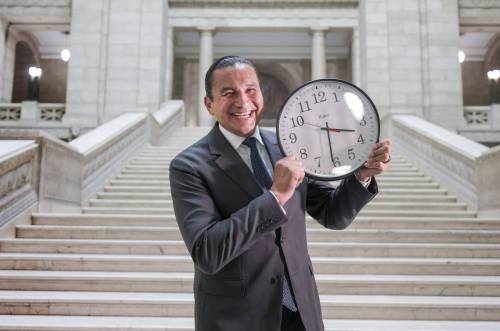
Time’s up for the time change in Manitoba.

Manitobans won’t be setting their clocks back an hour in November. The province has decided to permanently stay on daylight time after surveying residents on the twice annual clock adjustment.

“We heard from Manitobans loud and clear — no more changing the clocks in Manitoba,” Premier Wab Kinew said in a news release Thursday.

Most of the 72,000 votes submitted in an online EngageMB survey — 92 per cent — said they would like to see the practice end. The survey asked if they preferred earlier sunrises in winter with standard time or the later sunsets in summer with daylight time. More than half of survey participants (58 per cent) indicated a preference to stay on permanent daylight time; 34 per cent voted to eliminate the time change but stay on standard time.

Read
Updated: Yesterday at 8:48 AM CDT

Klein has burned bridges with PM, Gillingham says

Joyanne Pursaga 3 minute read Preview

Klein has burned bridges with PM, Gillingham says

Joyanne Pursaga 3 minute read Yesterday at 5:51 PM CDT

One mayoral candidate accused another of writing a column so critical it could compromise his ability to work with the federal government.

Read
Yesterday at 5:51 PM CDT

Canada must not accept another Iranian autocracy

David Matas 5 minute read 2:01 AM CDT

Iran is a state run by a radical government victimizing its citizens and its neighbours. How do we change that? Any regime change that repeats the mistakes of the past is not a solution.

What went wrong in the past which led to the current regime? One answer is the U.K. and American aided coup which led to the ouster in 1953 of a democratically elected government headed at the time by Mohammad Mossadegh and its replacement with an American friendly autocrat, the Shah of Iran, Mohammad Reza Pahlavi.

The Shah imposed his rule through the Iranian National Intelligence and Security Organization — SAVAK, the acronym of its Persian name. SAVAK systematically inflicted torture, arbitrary killings and extra-judicial killings on perceived opponents of the regime. It was only a matter of time before repression of a regime directed to serving foreign interests would be overthrown.

What replaced the regime of the Shah, in 1979, the current regime of the mullahs, is a regime as intolerant and violent as the regime of the Shah and then some. That was not inevitable. But neither was it surprising. The vicious nature of the current regime, following the example set by the Shah, and its hatred for the United States, reacting to the U.S. aided imposition of the Shah, both echoes and reacts to the past. In 1979, the U.S. reaped what it sowed in 1953.

Canada-U.S. trade relationship is broken, but the damage can — and will — be repaired

Tom Brodbeck 5 minute read Preview

Canada-U.S. trade relationship is broken, but the damage can — and will — be repaired

Tom Brodbeck 5 minute read Thursday, Sep. 17, 2026

Canada needs to get serious about diversifying its trade beyond the United States. But at the same time, Canadians should expect relations with the U.S. to normalize after Donald Trump is no longer in the White House.

For generations, Canada-U.S. trade was considered almost a fact of geography. The two countries share the world’s longest undefended border, deeply integrated supply chains and a century of commercial relationships.

Canadian manufacturers depend on American customers. American manufacturers depend on Canadian suppliers. Energy, agriculture, automotive production and countless other industries operate across the border as though it barely exists.

That isn’t going to change dramatically, even in the midst of a bitter trade war unleashed by the U.S. president.

Read
Thursday, Sep. 17, 2026

Cabernet Sauvignon star of wine festival

Ben Sigurdson 5 minute read Preview

Cabernet Sauvignon star of wine festival

Ben Sigurdson 5 minute read 3:00 AM CDT

The Winnipeg Wine Festival will celebrate the king of red wine grapes next weekend — the theme of this year’s festival, which takes place Sept. 25 and 26 at the RBC Convention Centre, is Cabernet Sauvignon.

Cab Sauv, as it’s also known, is the world’s most widely planted wine grape of any colour, first coming to prominence in the 1800s in France’s Bordeaux region, where the grape is still popular. Rather than single-variety wines, Bordeaux reds tend to be blends, with those coming from the left bank of the Gironde estuary being Cabernet-dominant, while right-bank wines are Merlot-dominant, with Cabernet Sauvignon playing a supporting role. Cabernet and Merlot work well together and many other countries have followed suit in blending the two.

A team at University of California Davis put Cabernet Sauvignon through a DNA test in 1996 and discovered its parent grapes are Cabernet Franc and Sauvignon Blanc — it’s likely that at some point the two varieties, planted next to each other in some vineyard, crossed and mutated and became the grape we know today. (Someone growing grapes in the 19th century must have had an inkling of what was up, as the grape has been called Cabernet Sauvignon since long before the DNA test.)

Flavour-wise, most Cabernet Sauvignon wines are big and bold, with a core of deep dark berry flavours, some graphite and spice notes and relatively bright acidity. It’s a grape that is well-suited to barrel aging, with most examples seeing at least some time in wood.

Read
3:00 AM CDT