The inconvenient truth: Thomas King’s admission he isn’t Cherokee hits hard

Advertisement
Read this article for free:
or
Already have an account? Log in here »
To continue reading, please subscribe:
Digital Subscription
One year of digital access for only $1.44 a week*
- Enjoy unlimited reading on winnipegfreepress.com
- Read the E-Edition, our digital replica newspaper
- Access News Break, our award-winning app
- Play interactive puzzles
*Billed as $5.77 plus GST every four weeks. After 52 weeks, price increases to the regular rate of $19.95 plus GST every four weeks. Offer available to new and qualified returning subscribers only. Cancel any time.
To continue reading, please subscribe:
Add Free Press access to your Brandon Sun subscription for only an additional
$1 for the first 4 weeks*
- Enjoy unlimited reading on winnipegfreepress.com
- Read the E-Edition, our digital replica newspaper
- Access News Break, our award-winning app
- Play interactive puzzles
*Your next Brandon Sun subscription payment will increase by $1.00 and you will be charged $17.95 plus GST for four weeks. After four weeks, your payment will increase to $24.95 plus GST every four weeks.
Read unlimited articles for free today:
or
Already have an account? Log in here »
Hey there, time traveller!
This article was published 24/11/2025 (333 days ago), so information in it may no longer be current.
As it turns out, the author of The Inconvenient Indian is inconveniently not an Indian.
On Monday, the Globe and Mail published an exclusive interview with bestselling author Thomas King — and an op-ed by the 82-year old author himself — in which he announces he is not, in fact, a Native American.
King, the author of 25 novels and short story collections, numerous radio, TV and film projects, and the winner of several grants, awards and accolades, including a National Aboriginal Achievement Award, has represented himself as a Cherokee Indian from Oklahoma during his entire career.
“I’m still in shock,” King said in the interview about the discovery.
Patrick Doyle / THE CANADIAN PRESS FILES Author Thomas King is presented the Governor General’s Literary Award for fiction by Governor General David Johnston in 2014. On Monday the Globe and Mail published an interview with King in which he announces he is not a Native American.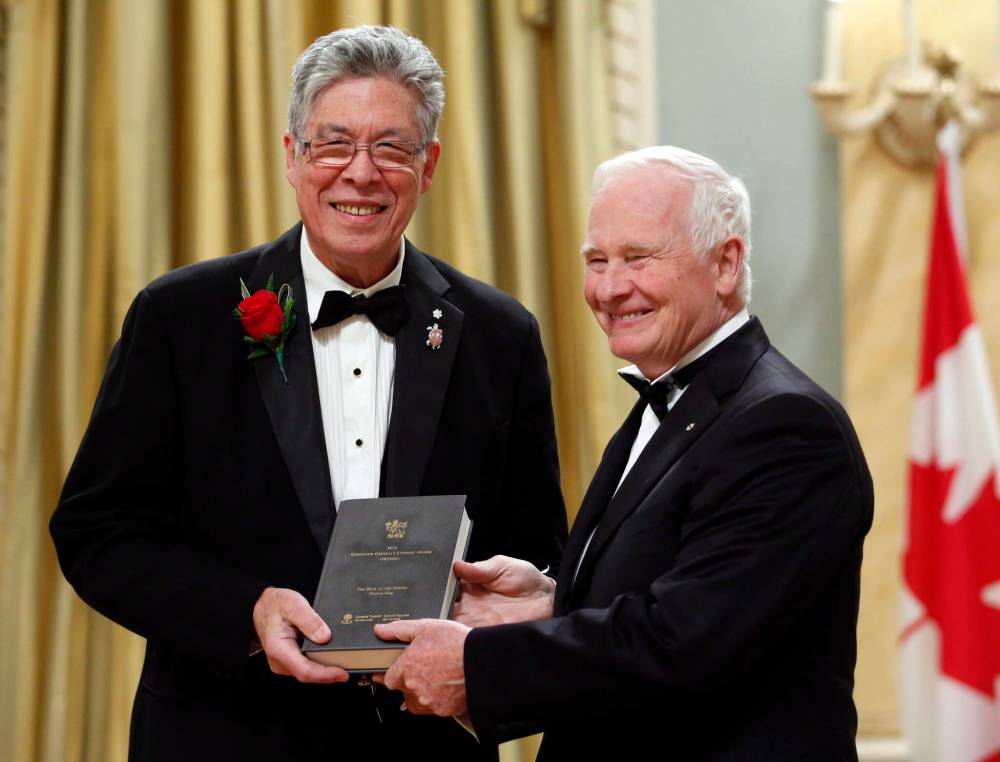
To call this fact a shock is an understatement. I would call it a gut punch, pipe bomb, and pulling out the rug from underneath the feet of the publishing world — even if King didn’t do anything out of malice.
The author discovered he isn’t Indigenous a few weeks ago, after attending a meeting with the non-profit organization called Tribal Alliance Against Frauds, which investigates individuals who claim and profit from their claims about Indigenous identity.
After showing him the genealogy of his estranged father (from whom he claimed his Native American background), King realized his background contains no ancestral connections to an Indigenous community.
“At 82, I feel as though I’ve been ripped in half,” King writes in his Globe op-ed, “a one-legged man in a two-legged story. Not the Indian I had in mind. Not an Indian at all.”
This wouldn’t have been a big deal if King, who has lived in Canada since 1980, had made Indigenous identity, culture and history a side interest in his writing, but claiming to have a complicated ancestry — what he called an “inconvenient Indian” — is at the centre of virtually every story he has written.
“I’m not the Indian you had in mind,” King would write in his poem of the same name.
Those words could not be more true now.
King took up a lot of space in most conversations about Indigenous peoples and politics in Canada. He was an authority, a professor, and a frequently quoted thinker and writer in universities, conferences, and essays across the world.
He came to national prominence in Canada in the 1990s with novels such as Medicine River, and Green Grass, Running Water, until travelling the country to give the 2003 Massey lectures — speeches that were turned into the bestselling book The Truth About Stories: a Native Narrative.
He broke into the United States market — a rarity for a Canadian author — with other novels such as Truth and Bright Water and Indians on Vacation, which won the 2021 Stephen Leacock Memorial Medal for Humour.
He was one of the most well-known faces in the country, recognized as member of the Order of Canada in 2004 and, in 2020, a Companion of the Order owing to his “enduring contributions to the preservation and recognition of Indigenous culture, as one of North America’s most acclaimed literary figures.”
Every colleague, award jury and publisher took King at his word that he was an Indigenous person.
They, like he, believed his story — a story that was false in the end — just like the stories of Joseph Boyden and Buffy Sainte-Marie, other non-Indigenous celebrities who claimed Indigenous identity falsely.
Now, the rest of us real Indigenous people have a big, bloody mess to clean up.
I met King through my father, Murray Sinclair. They were friends.
I remember about a decade ago first hearing the rumours about King’s identity and approaching my dad. He told me he trusted “Tom” and that we should be welcoming to Indigenous people with complicated backgrounds who want to “come home.”
That made sense. I know many Indigenous people who, through various reasons and often no fault of their own, do not know a lot about their background.
I simply thought King was one of those people and — despite questions about his identity persisting throughout the years — didn’t pursue the matter.
Now, I’ll think twice.
And this, truthfully, is the issue.
For decades, individuals have profited mightily by claiming to be Indigenous with little more than a vague family story while displacing legitimate Indigenous people.
Intentionally or not, the real-life consequences of King’s story is that his inability to find out the truth of his own identity, which apparently wasn’t hard for others, meant Canadians were duped, Indigenous peoples were marginalized, and all of us are left to ask a lot of questions.
Do we throw out King’s books and put an asterisk beside his name every time we cite him?
Do we make proving Indigenous ancestry a requirement for every job, award and speech?
Do we investigate anyone who claims to be Indigenous and assume they don’t really know?
Do we ever trust there’s truth in stories again?
niigaan.sinclair@freepress.mb.ca
Niigaan Sinclair is Anishinaabe from Peguis First Nation and a professor in the Department of Indigenous Studies at the University of Manitoba. He’s been a columnist for the Free Press since 2018. Read more about Niigaan.
Every piece of writing Niigaan produces is reviewed by an editing team before it is posted online or published in print — part of the Free Press‘s tradition, since 1872, of producing reliable independent journalism. Read more about Free Press’s history and mandate, and learn how our newsroom operates.
Our newsroom depends on a growing audience of readers to power our journalism. If you are not a paid reader, please consider becoming a subscriber.
Our newsroom depends on its audience of readers to power our journalism. Thank you for your support.
Niigaan Sinclair is Anishinaabe from Peguis First Nation and a professor in the Department of Indigenous Studies at the University of Manitoba. He’s been a columnist for the Free Press since 2018. Read more about Niigaan.
Every piece of writing Niigaan produces is reviewed by an editing team before it is posted online or published in print — part of the Free Press‘s tradition, since 1872, of producing reliable independent journalism. Read more about Free Press’s history and mandate, and learn how our newsroom operates.
Our newsroom depends on a growing audience of readers to power our journalism. If you are not a paid reader, please consider becoming a subscriber.
Our newsroom depends on its audience of readers to power our journalism. Thank you for your support.
Related Articles
Celebrated 'Inconvenient Indian' author Thomas King says he's not Indigenous

Advertisement Advertise With Us
Advertisement Advertise With Us