Tunes with teeth: Edison might have left his mark on piano

Advertisement

Advertise with us

WOODSTOCK, N.Y. (AP) — Hard of hearing, Thomas Edison found a unique way to appreciate piano music. As someone played, the great inventor would lean in close to the instrument, right above the keys, and he'd bite the piano.

Read this article for free:


or

Already have an account? Log in here »

To continue reading, please subscribe:

Subscribe and receive a limited-edition Free Press branded hat or tote.

Digital Subscription

One year of digital access for only $205*

  • Enjoy unlimited reading on winnipegfreepress.com
  • Read the E-Edition, our digital replica newspaper
  • Access News Break, our award-winning app
  • Play interactive puzzles

*First annual payment billed as $205.00 + GST for one year. This annual subscription will automatically renew at $233.00 + GST every 52 weeks (10% off the regular annual price of $259.35). Offer available to new and qualified returning subscribers only. Cancel any time.

To continue reading, please subscribe:

Add Free Press access to your Brandon Sun subscription for only an additional

$1 for the first 4 weeks*

  • Enjoy unlimited reading on winnipegfreepress.com
  • Read the E-Edition, our digital replica newspaper
  • Access News Break, our award-winning app
  • Play interactive puzzles
Start now

*Your next Brandon Sun subscription payment will increase by $1.00 and you will be charged $17.95 plus GST for four weeks. After four weeks, your payment will increase to $24.95 plus GST every four weeks.

Hey there, time traveller!
This article was published 01/11/2022 (1419 days ago), so information in it may no longer be current.

WOODSTOCK, N.Y. (AP) — Hard of hearing, Thomas Edison found a unique way to appreciate piano music. As someone played, the great inventor would lean in close to the instrument, right above the keys, and he’d bite the piano.

Pressing his teeth into the wood of phonographs and pianos helped Edison experience the vibrations in his skull. Or in his own words, it allowed him to “hear through my teeth.”

Robert Friedman recently showed off marks on a Steinway grand piano once owned by Edison — a cluster of shallow indentations roughing up the black lacquer above the keyboard. Friedman, who buys and sells Steinways, purchased the piano last year and says he was surprised by the toothy signatures left by the inventor of the phonograph. He’s now looking for the right home for the novel historical artifact.
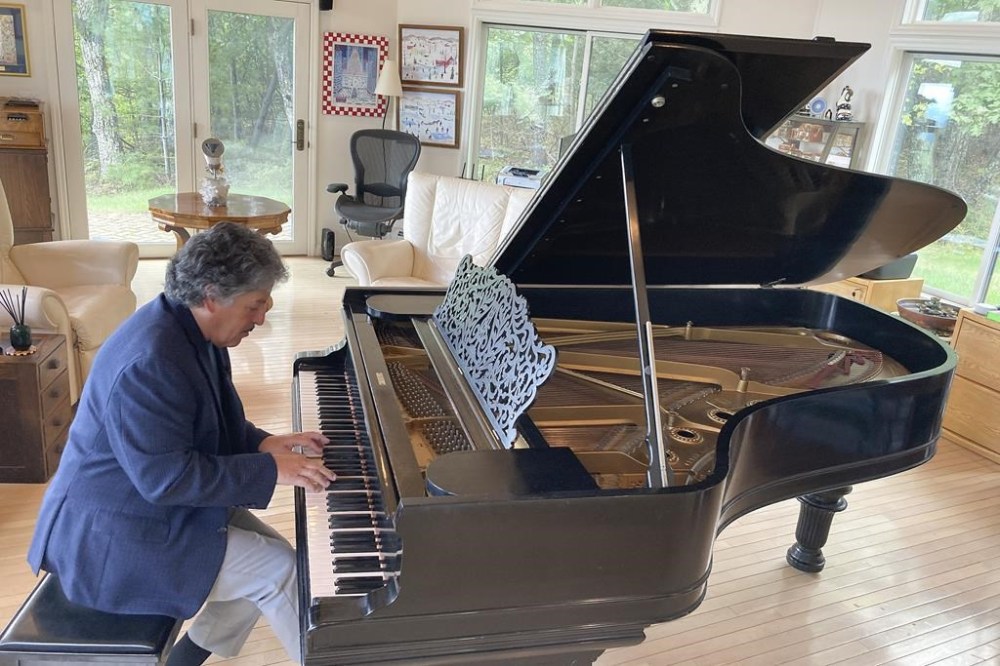
Robert Friedman plays a Steinway grand piano once owned by Thomas Edison, with possible bite marks from the inventor visible, on Sept. 28, 2022, in Woodstock, N.Y. Edison, who was hard of hearing, bit into phonographs and pianos to help him better experience music. Friedman purchased the piano last year and hopes to find a home for it where it can be seen by the public. (AP Photo/Michael Hill)

“I believe that it belongs somewhere where many, many, many people can see it,” Friedman said.

Edison bought the Model “B” Ebony from Steinway & Sons in 1890 for $725. Paperwork with the sale includes the handwritten notation “office furniture,” indicating it was sent to his lab in New Jersey. The piano “for some reason unknown to me it gives better results than any so far tried,” Edison wrote the company. “Please send bill with lowest price.”

Edison invented the phonograph in 1877. When he bought the piano 13 years later, he was experimenting with sound recording. Edison owned the instrument for decades, so it’s possible it was used in early recordings.

So did Edison’s teeth make those marks?

There’s no known old black-and-white photo of Edison chomping this piano to prove it. But he was known to bite into phonographs and pianos to help him experience music as his hearing faded. His daughter once recalled a guest weeping at the sight of Edison clamped on to a piano as someone played it.

“I hear through my teeth, and through my skull,” said Edison, as quoted in Edmund Morris’ 2019 biography. ”I bite my teeth into the wood and then I get it good and strong.”

The formulation is simple for Friedman: Those are tooth marks, and who else would have bit the piano?

“I’ve probably had my hands on a few thousand Steinways in the last 50 years,” Friedman said. “I’ve never seen that anywhere.”

Friedman bought the piano for about $45,000, sight unseen, in early January 2021 as part of an estate sale on Long Island. Friedman didn’t notice the marks at first.

His friend Charles Frommer, a musician and recording history enthusiast, came to Friedman’s house in New York’s Hudson Valley to tune the piano, noticed the indentations and told him “those are Edison’s bite marks.”
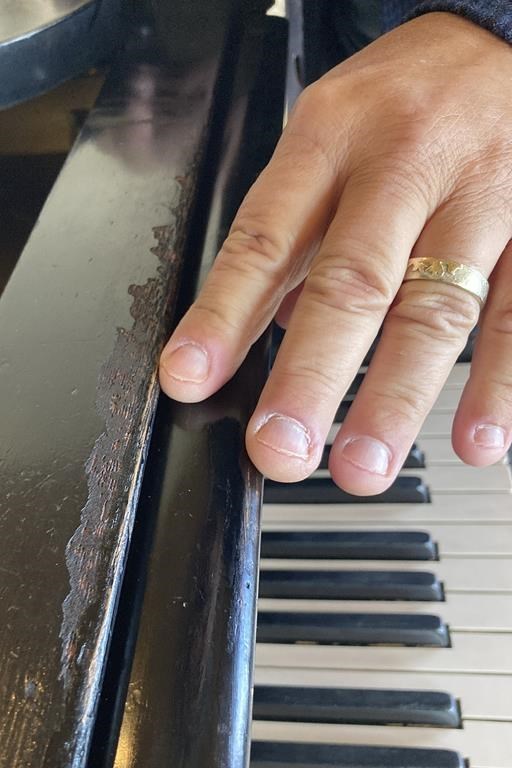
Robert Friedman points out possible bite marks from Thomas Edison on a Steinway grand piano once owned by the inventor, on Sept. 28, 2022, in Woodstock, N.Y. Edison, who was hard of hearing, bit into phonographs and pianos to help him better experience music. Friedman purchased the piano last year and hopes to find a home for it where it can be seen by the public. (AP Photo/Michael Hill)

Friedman, who calls himself the Steinway hunter, finds and buys the high-end pianos from people and then sells them, usually to dealers or rebuilders. But this one is more complicated.

Given this piano’s historic association, he doesn’t want it to go back into private hands. He has yet to find an appropriate historic site that would buy the piano, which he is offering for what it cost him to purchase, ship and recondition it.

The Thomas Edison National Historical Park in West Orange, New Jersey, passed up a chance to buy the piano from its previous owner in 2020 for several reasons, including limited space, cost and the fact that some original interior parts were replaced since Edison owned it, museum curator Jerry Fabris said in an email.

Friedman is undeterred and still looking for a home. A documentary also is possible, or having the piano recorded for a virtual instrument sample library. In the meantime, the piano has been featured at fundraisers for the Ulster County Jewish Federation at the home of friends in Woodstock who housed the instrument until recently.

And, yes Edison’s listening technique has been tested on the piano. Not wanting to mark up the instrument any further, Frommer said they tried it with wooden shims placed on the piano.

“We were able to replicate the effect,” Frommer said. “And yeah, you do hear it in your skull.”
Report Error Submit a Tip

More Stories

Tunes with teeth: Edison might have left his mark on piano

Michael Hill, The Associated Press 5 minute read Preview

Tunes with teeth: Edison might have left his mark on piano

Michael Hill, The Associated Press 5 minute read Tuesday, Nov. 1, 2022

WOODSTOCK, N.Y. (AP) — Hard of hearing, Thomas Edison found a unique way to appreciate piano music. As someone played, the great inventor would lean in close to the instrument, right above the keys, and he'd bite the piano.

Pressing his teeth into the wood of phonographs and pianos helped Edison experience the vibrations in his skull. Or in his own words, it allowed him to "hear through my teeth.”

Robert Friedman recently showed off marks on a Steinway grand piano once owned by Edison — a cluster of shallow indentations roughing up the black lacquer above the keyboard. Friedman, who buys and sells Steinways, purchased the piano last year and says he was surprised by the toothy signatures left by the inventor of the phonograph. He's now looking for the right home for the novel historical artifact.

“I believe that it belongs somewhere where many, many, many people can see it,” Friedman said.

Read
Tuesday, Nov. 1, 2022

United Way, other charities fight for dollars as donor base shrinks

Scott Billeck 8 minute read Preview

United Way, other charities fight for dollars as donor base shrinks

Scott Billeck 8 minute read Yesterday at 2:00 AM CDT

Winnipeg’s charitable sector is being squeezed from both sides: demand for help is growing while the pool of donors to meet that need is shrinking.

The imbalance is increasingly being carried by a relatively small group of deep-pocketed donors. Last year, 600 people — about three per cent of United Way Winnipeg’s individual donors — accounted for roughly $8 million, or 55 per cent of individual donations.

The fundraising pitch isn’t getting any easier.

Homelessness and public drug use have become increasingly visible, household budgets remain strained and the problems charities are trying to address can seem so entrenched that donors may reasonably wonder what difference another contribution can make.

Read
Yesterday at 2:00 AM CDT

A Winnipeg lawyer has been disbarred after admitting to six counts of professional misconduct and two counts of providing incompetent service involving eight clients.

The career-ending decision marks the sixth time Gisele Champagne has been disciplined by the Law Society of Manitoba since she was called to the bar in 1992.

“Disbarment is the appropriate remedy when a lawyer has demonstrated a repeated pattern of conduct that violates professional standards,” a law society panel said in a written decision released Wednesday.

“A lawyer who has been unable to learn from past discipline proceedings to fulfill his or her obligation to provide ethical and high-quality legal services must at some point lose the privilege of practising law.”

Desperate Poilievre wants Canadians to believe the sky is falling when it’s just cloudy outside

Tom Brodbeck 5 minute read Preview

Desperate Poilievre wants Canadians to believe the sky is falling when it’s just cloudy outside

Tom Brodbeck 5 minute read Yesterday at 12:47 PM CDT

Pierre Poilievre has a problem.

Canadians just don’t seem to be paying much attention to him anymore.

So, naturally, the Conservative Opposition leader has decided to turn up the volume.

At a recent party caucus retreat in Penticton, B.C., Poilievre delivered the familiar message: Canada is in trouble, Canadians are hurting and the Liberal government is making everything worse.

Read
Yesterday at 12:47 PM CDT

Give-and-take relationship of Roman leaders takes centre stage in Harris’s historical fiction

Reviewed by Kathryne Cardwell 4 minute read Preview

Give-and-take relationship of Roman leaders takes centre stage in Harris’s historical fiction

Reviewed by Kathryne Cardwell 4 minute read 2:01 AM CDT

British novelist Robert Harris’s latest work is a reflection on tyranny, corruption and betrayal among all-powerful political leaders.

You might be forgiven for thinking it’s a contemporary thriller — it’s actually historical fiction set in ancient Rome.

A former BBC journalist, Harris debuted as a novelist in 1992 with Fatherland, an alternative history where Nazi Germany won the Second World War.

Since then, the prolific author has become best-known for his works of historical fiction, especially his ancient Rome trilogy released from 2006-2015 and the novel Conclave, which was published in 2016 and was made into the film of the same name in 2024.

Read
2:01 AM CDT

Siloam Mission, WFPS discussing on-site paramedic to reduce staggering number of emergency calls

Scott Billeck 4 minute read Preview

Siloam Mission, WFPS discussing on-site paramedic to reduce staggering number of emergency calls

Scott Billeck 4 minute read Yesterday at 2:00 AM CDT

Winnipeg’s fire-paramedic service and its largest homeless-serving organization are discussing what it would look like to station at least one paramedic at Siloam Mission, as emergency calls to the downtown facility surge.

The ongoing discussions come as Winnipeg Fire Paramedic Service crews were dispatched 1,771 times during the first eight months of the year to the two adjacent Siloam properties at 303 Stanley St. and 300 Princess St.

WFPS said most of the calls were related to overdoses or other consequences of substance use, with the total nearly double the 854 calls recorded over the same period last year. By comparison, there were 831 calls during the same span in 2024, and 591 in 2023.

“The number of emergency calls isn’t sustainable for us as a service, but it’s certainly not sustainable for them as an agency trying to provide services,” WFPS chief Ryan Sneath told the Free Press. “And they recognize that they’re impacting emergency services, not them specifically, but the site in a significant way.”

Read
Yesterday at 2:00 AM CDT