New on DVD VOD

Advertisement
Read this article for free:
or
Already have an account? Log in here »
To continue reading, please subscribe:

Digital Subscription
One year of digital access for only $205*
- Enjoy unlimited reading on winnipegfreepress.com
- Read the E-Edition, our digital replica newspaper
- Access News Break, our award-winning app
- Play interactive puzzles
*First annual payment billed as $205.00 + GST for one year. This annual subscription will automatically renew at $233.00 + GST every 52 weeks (10% off the regular annual price of $259.35). Offer available to new and qualified returning subscribers only. Cancel any time.
To continue reading, please subscribe:
Add Free Press access to your Brandon Sun subscription for only an additional
$1 for the first 4 weeks*
- Enjoy unlimited reading on winnipegfreepress.com
- Read the E-Edition, our digital replica newspaper
- Access News Break, our award-winning app
- Play interactive puzzles
*Your next Brandon Sun subscription payment will increase by $1.00 and you will be charged $17.95 plus GST for four weeks. After four weeks, your payment will increase to $24.95 plus GST every four weeks.
Read unlimited articles for free today:
or
Already have an account? Log in here »
Hey there, time traveller!
This article was published 19/02/2015 (4230 days ago), so information in it may no longer be current.
Life Itself
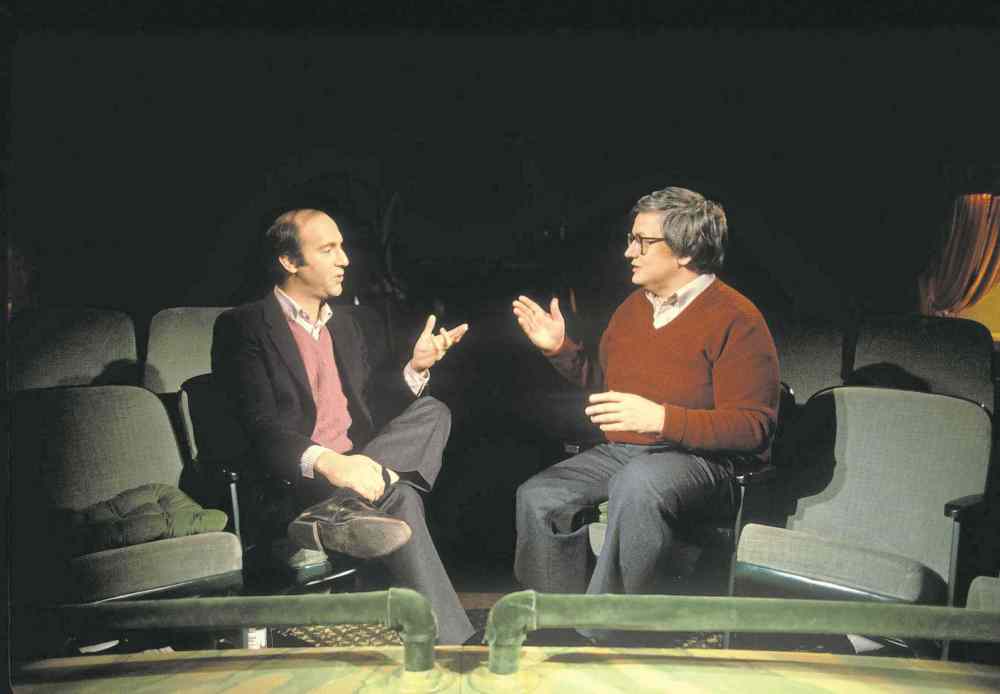
You have to go to the DVD extras of this documentary to understand why director Steve James came to be the guy to tell the life story of the late great film critic Roger Ebert.
James directed Hoop Dreams, the story of a couple of black athletes staking their futures on the unlikely chance of a career in the NBA. The film might have fallen into obscurity if it had not been championed by Ebert and his fellow Chicago critic (and frequent sparring partner) Gene Siskel.
Hence, James doesn’t feel obliged to keep a subjective arm’s length from his subject, which amounts pretty much to a tribute doc.
Loosely adapted from Ebert’s own autobiography, the film still fascinates on the strength of Ebert’s presence, with James given access to the critic in the final months of his losing battle with cancer, when his jawbone had been removed and he could no longer speak, eat or drink. (The man could still smile, and this he does, frequently and heroically.)
Ebert’s history proves rich too, encompassing his early embrace of the hard-living, hard-drinking newspaperman ethos at the start of his career, his creative collaboration with skin-flick auteur Russ Meyer (which, contrary to what is shown in this film, extended beyond Beyond the Valley of the Dolls), and his pinnacle of fame, at his most verbally abrasive alongside Siskel for the weekly series Sneak Previews.
Along the way, Ebert helped boost the work of directors such as Errol Morris, Martin Scorsese (who executive-produced this film) and Werner Herzog, who actually dedicated one of his films to Ebert and herein lauds him as a “soldier of cinema.”
He was that. But he was also a man, and the film ultimately pays its most meaningful homage to Ebert as a guy who made the most of his life and career, an aspiration for anyone, not just critics.
****
The Homesman
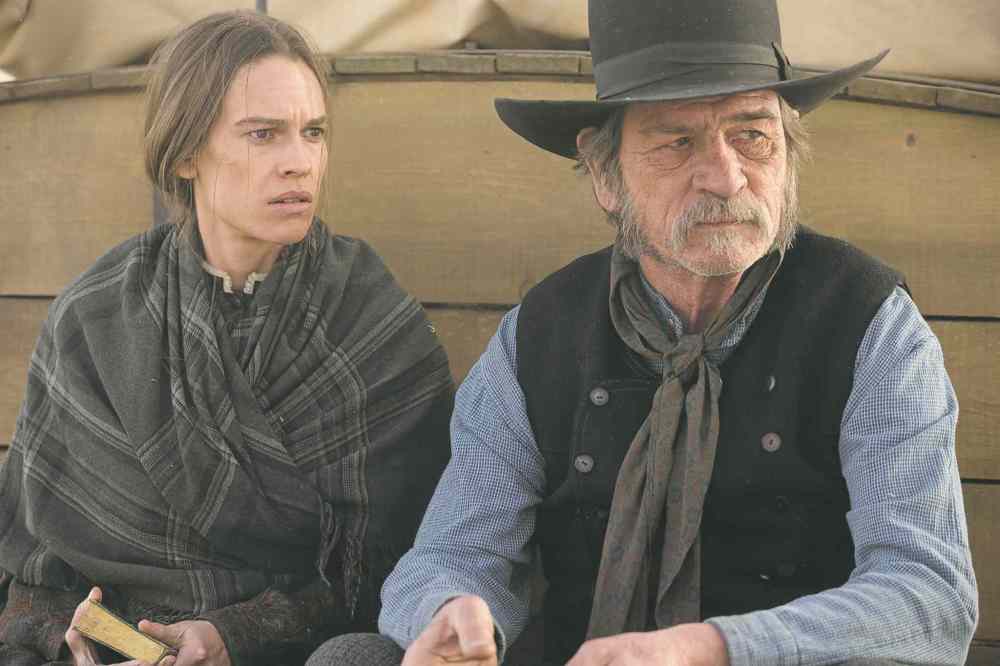
Mary Bee Cuddy (Hilary Swank) is an upright frontierswoman who takes it upon herself to escort a trio of “crazy” women from the Nebraska barrens to the comparative civilization of Iowa when their husbands prove unwilling or unable. Realizing the task may be beyond her abilities, Cuddy takes it upon herself to get some help, drafting the gruff itinerant George Briggs (Tommy Lee Jones) to accompany her when she saves him from a lynching.
The journey proves to especially arduous for the three women: the traumatized, mute young mother Arabella (Grace Gummer); the infanticidal Theoline (Miranda Otto); and the deranged immigrant Gro (Sonja Richter), as all three have already cracked under the heavy strain of frontier life. But the mission grows especially difficult for Cuddy, whose state of chronic loneliness is edging toward high desperation.
An adaptation of the novel by Glendon Swarthout directed by Jones himself, the film is in some ways a distant cousin to Jones’s Lonesome Dove, offering a similar twist on western convention, de-romanticizing the iconic frontier loner into a creature at once more practical, frightened, vengeful and self-centred.
Here, violence is not necessarily the product of opposing ideologies of good and evil, but of prickly personalities rubbing up against one another. This is especially evident in a scene in which Briggs is obliged to rescue Arabella from the clutches of a drifter (Tim Blake Nelson) who could be a mirror image of himself.
When Briggs does resort to violence, as when he is moved to avenge himself on a hotelier (James Spader) who refuses him shelter, the revenge is entirely disproportionate to the original offense.
In The Homesman, “crazy” covers a wide spectrum.
A visually beautiful film (thanks in large part to Rodrigo Prieto’s painterly cinematography), the movie does have one of the more stunning late-second-act plot twists in recent memory, one that may be expected to unbalance audiences who may assume a heroine’s strength in a contemporary movie to be an inviolable thing.
Jones, a prickly individual himself, demonstrates otherwise in the context of a seemingly traditional but damnably subversive film that shows sanctified American values — family, motherhood, dignity — completely undone by relentless tragedy and privation.
*** 1/2
Dumb and Dumber To
At the beginning of this sequel, we find Harry Dunne (Jeff Daniels) more or less on his own after his chip-toothed buddy Lloyd Christmas (Jim Carrey) has been reduced to a vegetative state following the events of the first movie. But it emerges that Lloyd’s two-decade-long catatonia has just been a sustained practical joke on Harry, leading to a Gotcha moment that, for both these idiots, is totally worth it.
Reteamed, Harry enlists Lloyd in a plan to save his own life. Harry needs a kidney transplant. And after picking up 20 years worth of mail from his adoptive parents, Harry realizes he apparently fathered a child two decades earlier. The mom, Fraida Felcher (Kathleen Turner), steers the boys on a journey to find Harry’s biological daughter Penny (Rachel Melvin). For Harry, reuniting mother and daughter is a noble mission that could also save his life. For Lloyd, sexually aroused by a photograph of the winsome Penny, the motivations are somewhat more self-serving.
Directors Peter and Bobby Farrelly keep to the template of the first film and don’t make any bones about the replay aspects of this new movie. The closing credits sequence even shows parallel old-and-new scenes.
The comedy bits don’t pay off in the laboriously constructed set pieces as well as they do in the small throwaway zingers. (Harry, going through his ancient mail, notes: “Oh, I got into Arizona State.”)
Still, the overall film demonstrates how “new” is not necessarily “better.” There’s a marked tonal shift in the comedy towards callousness and cruelty that belies the comparatively benign comedy of the first movie, so it’s not so much Dumb and Dumber, as Mean and Meaner.
**
randall.king@freepress.mb.ca
Our newsroom depends on a growing audience of readers to power our journalism. If you are not a paid reader, please consider becoming a subscriber.
Our newsroom depends on its audience of readers to power our journalism. Thank you for your support.
Our newsroom depends on a growing audience of readers to power our journalism. If you are not a paid reader, please consider becoming a subscriber.
Our newsroom depends on its audience of readers to power our journalism. Thank you for your support.
Advertisement Advertise With Us
Advertisement Advertise With Us