The intelligence is artificial; the questions are real
Sci-fi film puts stock in characters, not robot wars

Advertisement
Read this article for free:
or
Already have an account? Log in here »
To continue reading, please subscribe:

Digital Subscription
One year of digital access for only $205*
- Enjoy unlimited reading on winnipegfreepress.com
- Read the E-Edition, our digital replica newspaper
- Access News Break, our award-winning app
- Play interactive puzzles
*First annual payment billed as $205.00 + GST for one year. This annual subscription will automatically renew at $233.00 + GST every 52 weeks (10% off the regular annual price of $259.35). Offer available to new and qualified returning subscribers only. Cancel any time.
To continue reading, please subscribe:
Add Free Press access to your Brandon Sun subscription for only an additional
$1 for the first 4 weeks*
- Enjoy unlimited reading on winnipegfreepress.com
- Read the E-Edition, our digital replica newspaper
- Access News Break, our award-winning app
- Play interactive puzzles
*Your next Brandon Sun subscription payment will increase by $1.00 and you will be charged $17.95 plus GST for four weeks. After four weeks, your payment will increase to $24.95 plus GST every four weeks.
Read unlimited articles for free today:
or
Already have an account? Log in here »
Hey there, time traveller!
This article was published 08/05/2015 (4124 days ago), so information in it may no longer be current.
Anyone who has ever seen a science-fiction movie knows that an entity with artificial intelligence will turn on its creator.
That’s the precedent as seen again and again in movies such as The Terminator, Blade Runner, The Matrix, and yes, now playing, The Avengers: Age of Ultron.
Screenwriter Alex Garland’s directorial debut, Ex Machina, may or may not depart from that formula. But it certainly offers a compelling twist on the theme in its depiction of the singularity faceoff.
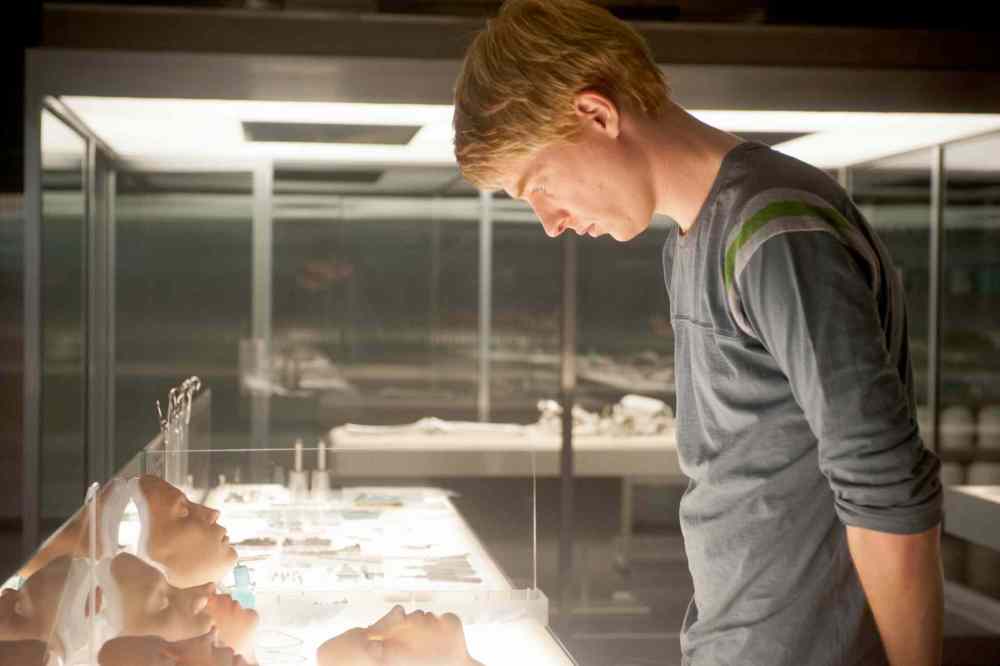
Caleb (Domnhall Gleeson) is a lowly computer programmer, a drone in the massive technological hive of tech magnate Nathan (Oscar Isaac). Caleb wins a lottery in which he has been chosen to meet Nathan on his estate, which, we gather, is the size of a small country.
It is here that the eccentric alpha genius enlists Caleb to assist with his latest project. Caleb will administer a Turing test on a cyborg named Ava (Alicia Vikander) to determine, as per the “imitation game” creator Alan Turing, to see if her lab-created brain can pass for a human intelligence.
Though Ava’s face and voice are that of a beautiful woman, Caleb can plainly see that beneath that veneer are the motors and rotors of an automaton. (The film’s visual effects are just realistic enough to unnerve.) But Caleb dutifully carries out the test and becomes increasingly drawn to Ava. Simultaneously, he becomes more repelled by Nathan, whom he comes to suspect is testing him, especially by exploiting the illusion of Ava’s gender.
Next to those aforementioned AI movie predecessors, Ex Machina is a small and low-budget affair, devoid of big action and grand set pieces. It is rare that a piece of science fiction can be described as intimate, but Garland’s movie is that. If it weren’t for Ava’s elaborately cybernetic body, this could almost be a stage play.
But if its scale is small, its ideas are big, and even a little radical. Most stories of AI assume an enhanced, manufactured intelligence will seek world domination. Isn’t it more likely that it would, like any other sentient being, seek freedom? (In this, Ex Machina does share some DNA with Blade Runner.)
In telling this fanciful story, Garland gets maximum dramatic stability from a tripod of gifted actors. Gleeson effortlessly registers smarts and heart, necessary qualities for deeply empathetic geek. Vikander’s performance is a little marvel of precision, wherein each glimmer of emotion may be suspect.
Most impressive of all is Isaac, whose Nathan is a freak of intelligence, ego and arrogance. How radically different Isaac is from role to role in Inside Llewyn Davis, A Most Violent Year and now this.
His work here brings to mind how, when I was a kid, we used to refer to Frankenstein’s monster as “Frankenstein” in a wilful refusal to separate the monster from his creator. In this movie, Isaac’s character wholly justifies the contraction.
randall.king@freepress.mb.ca
Our newsroom depends on a growing audience of readers to power our journalism. If you are not a paid reader, please consider becoming a subscriber.
Our newsroom depends on its audience of readers to power our journalism. Thank you for your support.
Movie review
Ex Machina
- Starring Oscar Isaac, Domnhall Gleeson and Alicia Vikander
- Grant Park, McGillivray VIP, Polo Park
- 14A
- 109 minutes
- 31/2 stars out of five
Other voices
Ex Machina is a smart, exceptionally stylish head trip.
— Ann Hornaday, Washington Post
Garland’s primary concern is his flesh-and-blood characters, even though they are not nearly as showy (or beautiful) as his main attraction, the vulnerable, delicate girl with a heart of steel and wires.
— Rene Rodriguez, Miami Herald
Alex Garland brilliantly brings the past into the present with the near-future tale Ex Machina, a stark but dazzling meditation on intelligence, consciousness and morality that discreetly uses special effects in service of story, dialogue and character.
— Cary Darling, Fort Worth Star-Telegram
This is (Garland’s) first turn as director, and it suits him; he’s created a cautionary tale that entertains even as it forces us to think.
— Chris Knight, National Post
A TED Talk in the form of a movie, with a few creepy twists and suspenseful deceptions that keep the plot moving forward.
— William Bibbiani, CraveOnline
Shrewdly imagined and persuasively made, Ex Machina is a spooky piece of speculative fiction that’s completely plausible, capable of both thinking big thoughts and providing pulp thrills.
— Kenneth Turan, Los Angeles Times
Our newsroom depends on a growing audience of readers to power our journalism. If you are not a paid reader, please consider becoming a subscriber.
Our newsroom depends on its audience of readers to power our journalism. Thank you for your support.
Advertisement Advertise With Us
History
Updated on Friday, May 8, 2015 10:09 AM CDT: Adds photo