Park drinking over indoor gatherings? Experts say finding risk mitigation is key
Advertisement
Read this article for free:
or
Already have an account? Log in here »
To continue reading, please subscribe:

Digital Subscription
One year of digital access for only $205*
- Enjoy unlimited reading on winnipegfreepress.com
- Read the E-Edition, our digital replica newspaper
- Access News Break, our award-winning app
- Play interactive puzzles
*First annual payment billed as $205.00 + GST for one year. This annual subscription will automatically renew at $233.00 + GST every 52 weeks (10% off the regular annual price of $259.35). Offer available to new and qualified returning subscribers only. Cancel any time.
To continue reading, please subscribe:
Add Free Press access to your Brandon Sun subscription for only an additional
$1 for the first 4 weeks*
- Enjoy unlimited reading on winnipegfreepress.com
- Read the E-Edition, our digital replica newspaper
- Access News Break, our award-winning app
- Play interactive puzzles
*Your next Brandon Sun subscription payment will increase by $1.00 and you will be charged $17.95 plus GST for four weeks. After four weeks, your payment will increase to $24.95 plus GST every four weeks.
Read unlimited articles for free today:
or
Already have an account? Log in here »
Hey there, time traveller!
This article was published 31/07/2020 (2242 days ago), so information in it may no longer be current.
As bars, restaurants and house parties continue to play significant roles in spreading COVID-19, some infectious disease experts in Canada think it’s time to offer a safer alternative to drinking in public.
Cracking a cold one in a park may be a good substitution, they say, if only it wasn’t illegal throughout most of the country.
Drinking among friends in sprawling green spaces — where there’s much more room to physically distance — can keep people away from dangerously crowded indoor gatherings, says Dr. Zain Chagla, an associate professor at McMaster University in Hamilton.
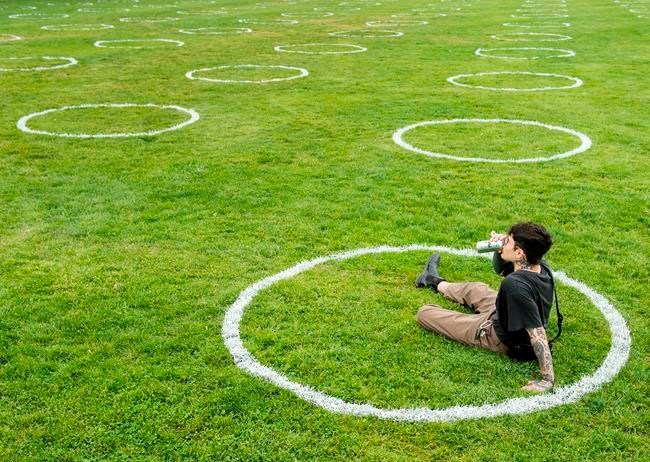
“There’s all these reports of transmission in bars and house parties. So why don’t we mitigate that risk?” he said. “Let’s use the outdoors rather than forcing people indoors for their gatherings.”
Chagla likens the debate to sexual health scenarios.
While abstinence is the best way to avoid sexually-transmitted infections, asking people to refrain from sex doesn’t work. Making sex safer by wearing a condom is more realistic.
“Drinking in public isn’t by any means a perfect solution, but people want to drink with their friends,” he said. “Why can’t we do it in a way that’s less risky?”
While drinking in public parks is commonplace in many European cities, Canada has been slower to adopt those laws.
Some areas seem to be moving in that direction — or at least crawling towards it.
Park board commissioners in Vancouver this week voted in favour of allowing alcohol consumption in 22 parks around the city, though actual implementation of legal park drinking likely won’t happen until next summer.
Steven Taylor, a professor and clinical psychologist at UBC, doesn’t see the public drinking option as an either-or scenario where people will choose between enjoying beer in a bar or pilsner in a park.
They’ll likely imbibe in both, he says, adding that alcohol’s disinhibiting properties will lead people to pay less attention to safety precautions.
People are getting increasingly tired of the rules, Taylor said.
“And the longer social distancing drags out, the worse compliance becomes.”
Toronto and Peel Region moved into Stage 3 of Ontario’s reopening plan Friday, allowing bars and restaurants to operate. Patios within the province had reopened during Stage 2.
But indoor eateries and watering holes, as well as private parties, have proven risky environments for COVID-19 spread.
A sudden surge in B.C. cases led the province to announce stricter measures for restaurants, bars and nightclubs. And large clusters of cases were also traced back to parties in the Kelowna area.
Edmonton had 41 cases traced to restaurants last month, and a downtown Calgary establishment shut its doors two weeks ago after six cases originated there.
While Chagla agrees alcohol can cause people to relax or ignore physical distancing, indoor environments makes those settings especially dangerous.
“That transmission is happening not just because of the drinking, it’s all the things people do in bars — they get up close and personal, they interact with a bunch of different people,” Chagla said.
“We go to bars for a social experience.”
Being allowed to drink outdoors will take care of some of the risk, but not all.
The dangers associated with public drinking such as reckless behaviour, public drunkenness and the potential for drunk driving, make the topic controversial.
Taylor doesn’t think it’s worth it.
“Inevitably, there’ll be some bad actors who egregiously violate social distancing under the influence of alcohol,” he said. “My concern is that this could well precipitate a second round of lockdown.
“We’ve seen bored, stressed out people congregating in large groups and partying, and that’s leading to spikes in outbreaks. And alcohol is just going to fuel that, unfortunately.”
Dr. Ilan Schwartz, an infectious disease expert with the University of Alberta, says being able to drink in public doesn’t mean people will drink in excess.
The Winnipeg native has lived in areas with loosened public drinking laws in Texas and South Africa and said issues were minimal there.
“We don’t want to outlaw all behaviour just because taken to the extreme there can be problematic examples,” he said.
Schwartz says easing up on public drinking laws would be useful right now, during the short summer months of a lengthy global pandemic.
“We need to realize that we’re in this for the long haul and we need to make concessions so people buy into the program that this isn’t just a big conspiracy to suppress any joy in life,” he said.
“Anything that is outdoors — as long as people aren’t shoulder to shoulder — we should be encouraging.”
Public drinking rules differ from province to province, and municipalities often have their own bylaws. Drinking or holding an open container of alcohol in a Toronto park, for example, carries a $300 fine.
Chagla says people would need to be mindful of distance if public drinking laws were passed in their municipalities. Higher-risk individuals should still avoid those scenarios, he added.
“It would be low risk, but not zero-risk,” he said.
This report by The Canadian Press was first published July 31, 2020.