Ontario wineries hit hard as COVID-19 pandemic stretches into second summer

Advertisement

Advertise with us

Caroline Granger couldn't imagine a worse year for her small winery.

Read this article for free:


or

Already have an account? Log in here »

To continue reading, please subscribe:

Subscribe and receive a limited-edition Free Press branded hat or tote.

Digital Subscription

One year of digital access for only $205*

  • Enjoy unlimited reading on winnipegfreepress.com
  • Read the E-Edition, our digital replica newspaper
  • Access News Break, our award-winning app
  • Play interactive puzzles

*First annual payment billed as $205.00 + GST for one year. This annual subscription will automatically renew at $233.00 + GST every 52 weeks (10% off the regular annual price of $259.35). Offer available to new and qualified returning subscribers only. Cancel any time.

To continue reading, please subscribe:

Add Free Press access to your Brandon Sun subscription for only an additional

$1 for the first 4 weeks*

  • Enjoy unlimited reading on winnipegfreepress.com
  • Read the E-Edition, our digital replica newspaper
  • Access News Break, our award-winning app
  • Play interactive puzzles
Start now

*Your next Brandon Sun subscription payment will increase by $1.00 and you will be charged $17.95 plus GST for four weeks. After four weeks, your payment will increase to $24.95 plus GST every four weeks.

Hey there, time traveller!
This article was published 23/05/2021 (1946 days ago), so information in it may no longer be current.

Caroline Granger couldn’t imagine a worse year for her small winery.

Granger said that the COVID-19 pandemic has damaged almost every aspect of The Grange of Prince Edward Vineyards and Estate Winery in Hillier, Ont., which she runs with her daughter.

“I’m a farmer and a worrier and I love to make up all the bad things that could possibly happen and I could never imagine such a perfect storm,” she said.
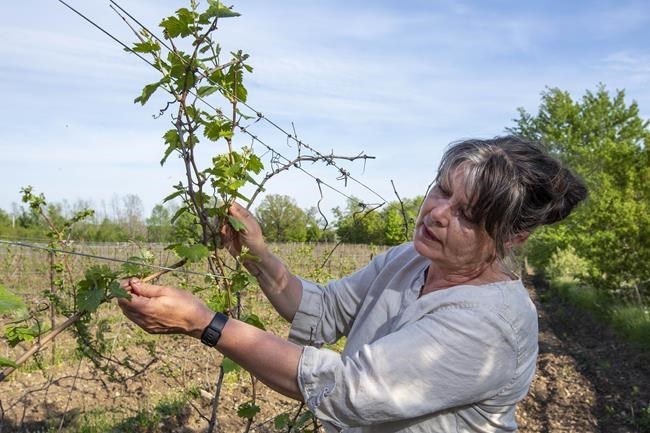
Caroline Granger, founder/winemaker of The Grange of Prince Edward Vineyards and Estate Winery poses for a portrait in her field of Victoria block chardonnay at her vineyard in Hillier, Ont., on Friday, May. 21, 2021. THE CANADIAN PRESS/Lars Hagberg

Granger estimates that in a typical year 50 per cent of her revenue comes from retail sales, either at local liquor stores, restaurants, or from wine enthusiasts visiting her farm and purchasing bottles after a tasting.

But Ontario’s ongoing COVID-19 restrictions have prevented her from hosting oenophiles and the restaurants she partners with are closed for in-person dining. That leaves the LCBO and online sales as income sources.

At the same time, the grapes still have to come off the vine.

Most of the 180 wineries in Ontario are family-run operations with fewer than 20 employees. The Grange, like many of Ontario’s wineries, relies on migrant workers to help bring in her crops but travel restrictions have made that challenging.

On top of that, Granger’s usual crew of labourers lives on the Caribbean island of St. Vincent, which was rocked by a volcanic eruption last month, endangering the lives of employees she now considers family.

“Maybe what I should be doing is prepping for a plague of locusts because it’s been a pretty wild ride,” said Granger.

According to Vintners Quality Alliance Ontario, wineries in the province’s wine-producing regions contribute to 18,000 jobs with a total economic benefit of more than $4 billion per year. Every bottle of VQA wine sold generates $98.20 in economic benefit for the province.

Ontario’s larger wineries haven’t escaped the financial crush either.

J. Murray Souter, the CEO and president of Lakeview Wine Co. in Niagara-on-the-Lake, said that about 40 per cent of his business traditionally comes from exports and restaurant sales, two revenue streams that have been evaporated by the pandemic.

He said he hopes that there is some level of reopening to Ontario’s economy this summer, but that he recognizes that some safety protocols will stay in place for the foreseeable future.

Souter said he looks forward to people visiting Ontario’s three wine regions — Lake Erie North Shore, Niagara Peninsula, and Prince Edward County — this summer as wine tourism generates $850 million per year for the province.

“It’s been a desert down there over the past 12 months,” said Souter. “We’d traditionally have five or six thousand people visit our winery over the course of a week in the summer and we haven’t had that many over the past year.”

Ed Madronich, president of Flat Rock Cellars in Jordan, Ont., said that the pandemic has made him evolve his business model.

“It’s forced us to get online, get online quickly, and make sure we’re communicating and facilitating people being able to buy our wine,” said Madronich. “We saw a real growth in that particularly at the beginning of COVID, but it’s not the same a year later, (sales are) definitely down from last year.”

Although Granger and Souter operate at different scales, they both said they would like to see the provincial government adjust how wine is taxed in Ontario.

“The reason the Spanish can land a bottle of wine in this country at $7.95, which means they’re shipping it out at $2.50, is because they subsidize the industry,” said Souter, who is also the vice-chair of the Winery Growers of Ontario. “Either create a barrier for them dumping their product here or support us at the same level their governments support their industry.”

This report by The Canadian Press was first published May 23, 2021.

Report Error Submit a Tip

More Stories

Grieving child builds backyard rocket ship

Harriet Zaidman 4 minute read 2:01 AM CDT

I Built a Rocket Ship (Kids Can Press, 32 pages, hardcover, $22) by Winnipegger Anna Lazowski is a tender story for children ages 4-8 about a little girl trying to make sense of her mother’s death. The child engages in conversation with her late mom, agreeing and disagreeing about things said as she carries objects (and of course, the cat) to the backyard. There, she is building a rocket ship she will pilot into the skies to find her mom again.

Jennica Lounsbury’s varied perspectives show the range of emotions the little girl experiences.

● ● ●

Northwoods Lullaby by Mary Casanova (University of Minnesota Press, 32 pages, hardover, $25) is a bedtime book for readers up to age eight, perfect to bring a busy, happy day to a close. Just like children who are listening to adults reading the book, all the animal babies are being tucked into their nests and burrows by loving parents: “Thump and scamper,/nimble clover./ Soon it’s time to rest. Baby loon/ nestles in/as Papa floats along.”

Siloam Mission, WFPS discussing on-site paramedic to reduce staggering number of emergency calls

Scott Billeck 4 minute read Preview

Siloam Mission, WFPS discussing on-site paramedic to reduce staggering number of emergency calls

Scott Billeck 4 minute read Yesterday at 2:00 AM CDT

Winnipeg’s fire-paramedic service and its largest homeless-serving organization are discussing what it would look like to station at least one paramedic at Siloam Mission, as emergency calls to the downtown facility surge.

The ongoing discussions come as Winnipeg Fire Paramedic Service crews were dispatched 1,771 times during the first eight months of the year to the two adjacent Siloam properties at 303 Stanley St. and 300 Princess St.

WFPS said most of the calls were related to overdoses or other consequences of substance use, with the total nearly double the 854 calls recorded over the same period last year. By comparison, there were 831 calls during the same span in 2024, and 591 in 2023.

“The number of emergency calls isn’t sustainable for us as a service, but it’s certainly not sustainable for them as an agency trying to provide services,” WFPS chief Ryan Sneath told the Free Press. “And they recognize that they’re impacting emergency services, not them specifically, but the site in a significant way.”

Read
Yesterday at 2:00 AM CDT

Near-future U.S. the setting for surreal dual-world storyline

Reviewed by Morley Walker 4 minute read Preview

Near-future U.S. the setting for surreal dual-world storyline

Reviewed by Morley Walker 4 minute read 2:01 AM CDT

It’s not every day you encounter a seriously intended literary novel that attempts to dramatize a mind-bending physics theory like quantum entanglement.

But then the B.C.-born-and-raised Emily St. John Mandel is not your everyday Canadian literary writer.

In her late 40s, she has lived in the U.S. for her entire writing career. She is best known for her 2014 dystopian novel Station Eleven, about a Shakespearean acting troupe navigating a pandemic-ravaged America.

Her new outing, her seventh, Exit Party, shares DNA with detective and sci-fi genres more than with conventional literary fiction.

Read
2:01 AM CDT

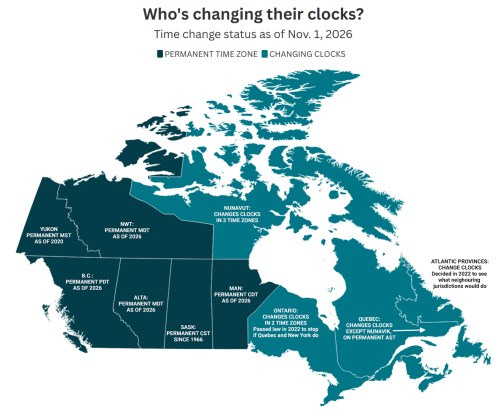
A quick look at where provinces and territories stand on time changes

The Canadian Press 2 minute read Preview

A quick look at where provinces and territories stand on time changes

The Canadian Press 2 minute read Updated: Yesterday at 6:28 AM CDT

WINNIPEG - Manitoba's government said Thursday the province will be sticking with daylight time year-round, making it the latest jurisdiction to move away from twice-annual time changes. Here's a look at where things stand across Canada:

British Columbia said in March that it was moving to permanent Pacific daylight time. The change also means that parts of northeastern B.C., which have been on mountain standard time year round, are now in alignment with the rest of the province.

Alberta also switched to permanent daylight time this year in what it calls Alberta time. The change means it now has the same time as Saskatchewan year round.

Saskatchewan has been on permanent central standard time since 1966.

Read
Updated: Yesterday at 6:28 AM CDT

Cabernet Sauvignon star of wine festival

Ben Sigurdson 5 minute read Preview

Cabernet Sauvignon star of wine festival

Ben Sigurdson 5 minute read 3:00 AM CDT

The Winnipeg Wine Festival will celebrate the king of red wine grapes next weekend — the theme of this year’s festival, which takes place Sept. 25 and 26 at the RBC Convention Centre, is Cabernet Sauvignon.

Cab Sauv, as it’s also known, is the world’s most widely planted wine grape of any colour, first coming to prominence in the 1800s in France’s Bordeaux region, where the grape is still popular. Rather than single-variety wines, Bordeaux reds tend to be blends, with those coming from the left bank of the Gironde estuary being Cabernet-dominant, while right-bank wines are Merlot-dominant, with Cabernet Sauvignon playing a supporting role. Cabernet and Merlot work well together and many other countries have followed suit in blending the two.

A team at University of California Davis put Cabernet Sauvignon through a DNA test in 1996 and discovered its parent grapes are Cabernet Franc and Sauvignon Blanc — it’s likely that at some point the two varieties, planted next to each other in some vineyard, crossed and mutated and became the grape we know today. (Someone growing grapes in the 19th century must have had an inkling of what was up, as the grape has been called Cabernet Sauvignon since long before the DNA test.)

Flavour-wise, most Cabernet Sauvignon wines are big and bold, with a core of deep dark berry flavours, some graphite and spice notes and relatively bright acidity. It’s a grape that is well-suited to barrel aging, with most examples seeing at least some time in wood.

Read
3:00 AM CDT

United Way, other charities fight for dollars as donor base shrinks

Scott Billeck 7 minute read Preview

United Way, other charities fight for dollars as donor base shrinks

Scott Billeck 7 minute read Yesterday at 2:00 AM CDT

Winnipeg’s charitable sector is being squeezed from both sides: demand for help is growing while the pool of donors to meet that need is shrinking.

The imbalance is increasingly being carried by a relatively small group of deep-pocketed donors. Last year, 600 people — about three per cent of United Way Winnipeg’s individual donors — accounted for roughly $8 million, or 55 per cent of individual donations.

The fundraising pitch isn’t getting any easier.

Homelessness and public drug use have become increasingly visible, household budgets remain strained and the problems charities are trying to address can seem so entrenched that donors may reasonably wonder what difference another contribution can make.

Read
Yesterday at 2:00 AM CDT