Higher chocolate prices part of wider trend as climate, other factors disrupt supply
Advertisement
Read this article for free:
or
Already have an account? Log in here »
To continue reading, please subscribe:

Digital Subscription
One year of digital access for only $205*
- Enjoy unlimited reading on winnipegfreepress.com
- Read the E-Edition, our digital replica newspaper
- Access News Break, our award-winning app
- Play interactive puzzles
*First annual payment billed as $205.00 + GST for one year. This annual subscription will automatically renew at $233.00 + GST every 52 weeks (10% off the regular annual price of $259.35). Offer available to new and qualified returning subscribers only. Cancel any time.
To continue reading, please subscribe:
Add Free Press access to your Brandon Sun subscription for only an additional
$1 for the first 4 weeks*
- Enjoy unlimited reading on winnipegfreepress.com
- Read the E-Edition, our digital replica newspaper
- Access News Break, our award-winning app
- Play interactive puzzles
*Your next Brandon Sun subscription payment will increase by $1.00 and you will be charged $17.95 plus GST for four weeks. After four weeks, your payment will increase to $24.95 plus GST every four weeks.
Read unlimited articles for free today:
or
Already have an account? Log in here »
Hey there, time traveller!
This article was published 25/03/2024 (925 days ago), so information in it may no longer be current.
Higher chocolate prices this Easter after bad crops on the other side of the world are just the latest example of disruptions in the food supply chain, a trend experts say consumers are noticing in growing numbers.
“I think people are becoming more interested in where their food comes from,” said Sophia Carodenuto, a professor of geography at the University of Victoria whose research specializes in global food systems.
The past few years have seen a number of high-profile disruptions including a spike in lettuce prices due to flooding in California, rising orange juice prices because of bad crops and higher wheat prices linked to the Russia-Ukraine war.
These kinds of disruptive events feel like they’re becoming more common, said Graeme Crosbie, senior economist at agriculture lending firm Farm Credit Canada.
Cocoa futures have “gone vertical” this year, especially in the last four or so months, said Crosbie.
Futures are a way of measuring commodity prices based on contracts for future delivery, a common way to track prices for commodities like wheat, gold and oil.
A February report by agriculture-focused co-operative bank CoBank said cocoa prices were nearly 65 per cent higher than a year ago, and New York futures prices were at a 46-year high.
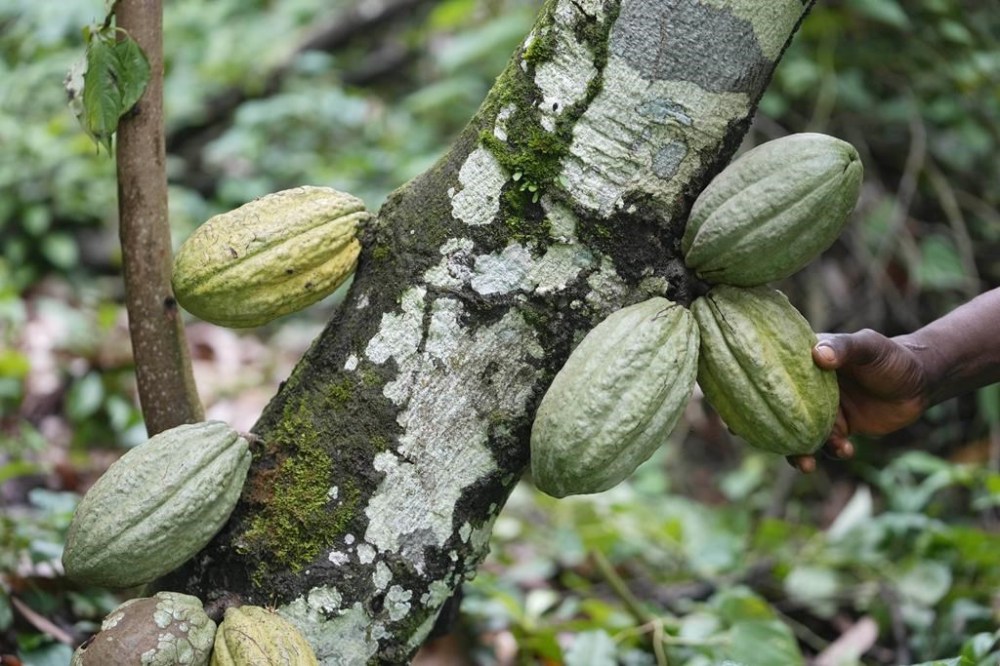
Bad weather and disease in West Africa have damaged crop yields, said Crosbie, hurting supply for the product that goes into Halloween, Valentine’s Day and Easter candy.
“The confection business is going to bear the brunt of the margin impact due to cocoa,” Hershey chief financial officer Steven Voskuil told analysts on a conference call in February.
Most cocoa, especially the cocoa found in many popular chocolate products, comes from West Africa, Carodenuto said. Côte D’Ivoire, which she said produces about 40 per cent of the world’s cocoa, saw a 30 per cent decline in production over the past year due to climate change and disease, she said.
“That’s one of the main drivers of … this huge rise in prices on the commodity markets,” she said.
“I think we’re seeing this all over the world, that the rainy season and the dry season are no longer predictable the way that they had been.”
Unlike some crops, cocoa production is highly concentrated, meaning huge portions of the world’s supply are grown in a handful of areas, said Crosbie. This makes the crop and its supply chain more vulnerable to disruptions.
Cocoa prices don’t directly translate to retail prices, since there are many things other than cocoa that make up a chocolate bar, Crosbie said. But they do have an effect, and he expects retail prices to increase.
According to Statistics Canadainflation data, the price of confectionary items rose more than nine per cent between January 2023 and 2024, compared with overall inflation for food purchased from stores of 3.4 per cent.
Michael Medline, the chief executive of Sobeys parent company Empire Co. Ltd., told investors earlier in March the grocer is seeing “sizable” price increases from some of its suppliers that will “inevitably affect the customer.”
“This is largely driven by some commodities like sugar and cocoa continuing to be very volatile due to ongoing climate and geopolitical factors impacting global supply,” he said.
Higher cocoa prices are an obstacle for manufacturers who have already been struggling with higher sugar prices over the past three years, said senior food and beverage economist Billy Roberts in the CoBank press release.
“That could lead to a further erosion of chocolate volume sales and begin to impact dollar sales as well,” he said.
Consumers are becoming more aware of these kinds of disruptions as food prices have risen across the board, Crosbie said.
“I think people are certainly paying more attention to the prices themselves, and even how their food is produced.”
In a 2021 survey by Deloitte, almost three-quarters of respondents said it’s important for them to understand where their food comes from.
And cocoa is one of many food products that consumers are eyeing more critically.
Cocoa is indigenous to Central America, said Carodenuto, and naturally grows under a canopy of rainforest trees in a diverse ecosystem. But large swaths of rainforest in West Africa have actually been wiped out to make room for cocoa farming, meaning less ecological diversity and more vulnerable crops.
Higher commodity futures also don’t necessarily dictate the prices farmers are being paid in real time, noted Carodenuto.
In Ghana and Côte D’Ivoire, the largest-producing countries for cocoa, the government creates a minimum price for farmers for the season, she said. But the large multinational companies buying and trading cocoa enter into forward contracts, meaning prices are agreed upon in advance.
It takes a lot of manual labour and investment to build a cocoa farm, so farmers need support, especially financially, Carodenuto said.
There’s hope that the higher futures prices will lead to more income next year, but it’s not a guarantee, she added — cocoa prices are cyclical, meaning there will likely be a price crash at some point.
Consumers looking to make ethical spending decisions face a difficult choice, said Carodenuto, especially given the price gap between premium and ethically sourced chocolate and popular, mass-market confections.
Carodenuto said shoppers don’t need to stop buying chocolate, but they should educate themselves and seek supply chain transparency by looking for the origin of the cocoa in a product.

Shoppers who can afford to spend more can also seek out businesses that specialize in sourcing ethical cocoa products, she said.
In the long term, there is lots of potential for cocoa to be grown in a more sustainable manner, she said, but it could mean lower production in the short term.
“It’s just that, who’s going to pay for that? … It shouldn’t be the most marginalized actor in the system. It shouldn’t be the smallholder farmer who has to pay for that.”
This report by The Canadian Press was first published March 25, 2024.
— With files from The Associated Press
Related Articles
Rich cocoa prices hitting shoppers with bitter chocolate costs as Easter approaches

Advertisement Advertise With Us
Advertisement Advertise With Us