Independent grocers adjusting to fuel surcharges from suppliers

Advertisement

Advertise with us

A few weeks into the war in Iran, an Ontario-based grocer started receiving surcharge letters from its suppliers stating that delivery costs would be going up.

Read this article for free:


or

Already have an account? Log in here »

To continue reading, please subscribe:

Subscribe and receive a limited-edition Free Press branded hat or tote.

Digital Subscription

One year of digital access for only $205*

  • Enjoy unlimited reading on winnipegfreepress.com
  • Read the E-Edition, our digital replica newspaper
  • Access News Break, our award-winning app
  • Play interactive puzzles

*First annual payment billed as $205.00 + GST for one year. This annual subscription will automatically renew at $233.00 + GST every 52 weeks (10% off the regular annual price of $259.35). Offer available to new and qualified returning subscribers only. Cancel any time.

To continue reading, please subscribe:

Add Free Press access to your Brandon Sun subscription for only an additional

$1 for the first 4 weeks*

  • Enjoy unlimited reading on winnipegfreepress.com
  • Read the E-Edition, our digital replica newspaper
  • Access News Break, our award-winning app
  • Play interactive puzzles
Start now

*Your next Brandon Sun subscription payment will increase by $1.00 and you will be charged $17.95 plus GST for four weeks. After four weeks, your payment will increase to $24.95 plus GST every four weeks.

A few weeks into the war in Iran, an Ontario-based grocer started receiving surcharge letters from its suppliers stating that delivery costs would be going up.

It was not an exorbitant amount; somewhere between $15 to $50 for a truckload, said Giancarlo Trimarchi, president of Vince’s Market, a family-owned grocery chain with four locations north of Toronto.

But that quickly adds up, he said.
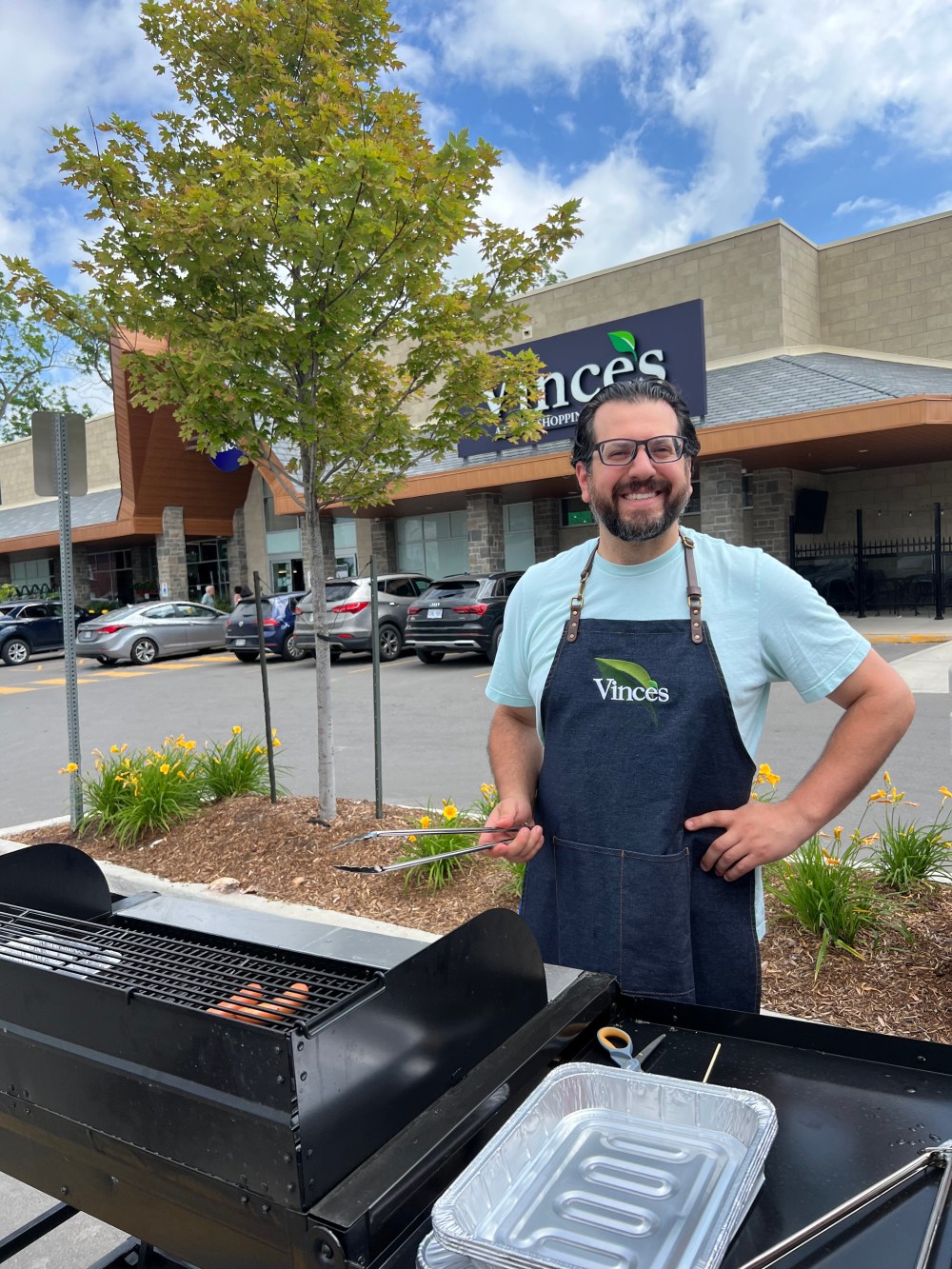
Giancarlo Trimarchi, president of the family-owned grocery chain Vince's Market in southern Ontario, says they have started to receive letters from suppliers, adding about $15 to $50 a truckload, as fuel prices remain elevated amid the ongoing conflict in the Middle East. Trimarchi is seen in an undated handout photo. THE CANADIAN PRESS/Handout - Vince's Market (Mandatory Credit)

“Smaller grocers like us often have smaller orders because we have smaller stores and smaller back rooms where we can’t hold a lot of stuff,” Trimarchi said. 

“We usually try to order less, more often, to keep our shelves full … (which) becomes a larger proportional cost on the goods.”

Higher fuel prices have started to reflect in shipping costs after a large chunk of the global oil supply has largely remained choked off at the Strait of Hormuz as a result of the conflict in the Middle East. As the pressure continues, many economists are forecasting an uptick in grocery prices across the board.

While most grocers are bracing for another bout of food inflation, independent grocers expect an even higher bill on their wholesale deliveries as suppliers start charging more to offset fuel costs.

Many independent grocers have already started to receive notices from their suppliers about price increases or temporary surcharges, said Gary Sands, a senior vice-president at the Canadian Federation of Independent Grocers, which represents 6,900 independent grocers across the country.

Some suppliers are adding surcharges of 10 to 15 per cent on deliveries, while others are baking price increases into items, he said.

The impact on food prices depends on how far that food item has to travel, said Mike von Massow, a food economist at the University of Guelph. 

Usually, he said, transportation represents about 3.5 to four per cent of the retail price of food, but it varies widely for individual items. For instance, the retail share of transporting fresh fruits and vegetables could range between 10 and 15 per cent, reflecting the cost of a long journey from parts of the United States or Mexico to stores in Canada, and shorter shelf lives.

While that’s a cost all grocers would bear, von Massow said shipping to independent stores can be more expensive because, like Vince’s Market, they tend to have more frequent deliveries of smaller loads.

Other factors, such as a truck idling in heavy traffic and burning fuel, or waiting to unload the shipment, also add to the cost of deliveries, von Massow added. 

Sands said some independent grocers try to keep their costs low by doing things like picking up their own fresh produce from a wholesale market.

They are trying to stay agile, he said.

Vince’s Market picks up its fresh produce from a wholesale food market several times a week. Each round trip is roughly 100 kilometres, plus delivery stops at all its locations. 

“We’re definitely seeing our cost of transportation internally rise, which of course puts pressure on our operating costs,” Trimarchi said. So far, the cost of gas has risen about 25 per cent month-to-month, he added.

The federal government’s 20-week pause on some fuel taxes, which kicks in on Monday, is expected to save consumers 10 cents per litre on regular gasoline and four cents per litre on diesel.

At a rural grocery store in Tignish, P.E.I., however, the troubles aren’t just limited to fuel surcharges and expensive groceries. They’re also facing delays in shipments as some truck operators weigh their profit margins for certain routes amid elevated gas prices.

“The last point of contact is the difficulty in finding carriers, and if it’s not a beneficial route that they can’t make a profit off delivering, then they would likely not take on that as a delivery option,” said Darren MacKinnon, general manager of the Tignish Co-operative Association Ltd.

The delays are anywhere from a couple of days to a week, he said.

While shipments eventually arrive, MacKinnon said the delays add costs to the business for missed sales opportunities and labour that’s mismatched with delivery timings. 

Von Massow said independent grocers might see their already-narrow margins squeezed further as the current ceasefire in the war remains on shaky ground. Independent grocers usually operate on a margin of about two per cent. That’s lower than average large-scale grocery margins of 3.5 per cent, according to the Retail Council of Canada. 

If independent grocers pass those costs on to consumers, it will make their prices less competitive, von Massow said.

But independent grocers have more flexibility to switch up their offerings, unlike large-scale chains that are expected to carry everything regardless of price, he said.

“They’ll buy what they can get the best deal on, and they’ll buy stuff that maybe needs less transportation costs,” von Massow said. “There might be ways to adapt.”

Even as cost pressures mount, both Vince’s Market and Tignish Co-op are taking a wait-and-see approach.

“For now, we’re absorbing the costs. We haven’t passed them through yet in any way,” Trimarchi said. But that could change by the end of this month, as shipping costs become clearer, he said.

There’s also a growing fear that if those higher costs are passed on, consumers might choose to shop elsewhere, he said.

“We have to be really calculated and we can’t just make rash decisions,” he said.

For the rural grocer in Tignish, losing consumers to other retailers is less of a concern.

“When you look at the scope of logistics, food to any banner of a retail store is going to be affected,” MacKinnon said. “I don’t have a direct fear that there will be any other retailer in any better position than we will be.”

This report by The Canadian Press was first published April 19, 2026.
Report Error Submit a Tip

More Stories

Protein crests current appetite wave

Laura Rance-Unger 4 minute read Preview

Protein crests current appetite wave

Laura Rance-Unger 4 minute read 2:01 AM CDT

Holiday feasts often reflect the latest fads and trends influencing how we eat.

This Thanksgiving’s table is likely to feature more Canadian content than it might otherwise as a point of national pride.

In the recent past, the carb-free craze has made cauliflower a substitute for the mashed potatoes on some family spreads. Some have gone meatless, while others have added more. Still others offer gluten-free, dairy-free or fat-free alternatives.

Nowadays, it seems consumers can’t get enough protein. Desmond Sobool, deputy chief economist Farm Credit Canada, told a recent economic update for the agri-food sector there are two converging influences in play.

Read
2:01 AM CDT

‘Please excuse us from writing these notes …’

Editorial 4 minute read Preview

‘Please excuse us from writing these notes …’

Editorial 4 minute read Yesterday at 2:01 AM CDT

It’s a common-sense prescription for the health-care system. The only wonder is that it took so long to happen.

Read
Yesterday at 2:01 AM CDT

Musk’s meddlesome trolling

Editorial 4 minute read Preview

Musk’s meddlesome trolling

Editorial 4 minute read 2:01 AM CDT

It seems obvious the world’s first trillionaire thought he was helping separatists within the Canadian federation when he encouraged three provinces — Alberta, Saskatchewan and Quebec — to leave Canada.

Unfortunately for Elon Musk, a man suffering from a profound deficit of self-awareness, his comments may only help those who want to keep the country together.

Musk entered the national unity debate on Wednesday, two days after the pro-independence Parti Quebecois was returned to power in Quebec with a minority mandate. The PQ has promised to hold a third referendum on separation at some point in its current term.

Musk — who has a Canadian mother and attended university in Ontario — took to X, the social media platform formerly known as Twitter (which he owns) and encouraged Quebec to forge ahead with plans to separate. He said Alberta — which will hold a vote this fall on whether to hold a binding referendum on separation — and Saskatchewan should follow suit.

Read
2:01 AM CDT

Landlords will face fines for breaching confidentiality

Carol Sanders 4 minute read Preview

Landlords will face fines for breaching confidentiality

Carol Sanders 4 minute read Yesterday at 5:04 PM CDT

The province is amending legislation to allow landlords to be penalized if they breach the confidentiality of tenants who break their lease by obtaining a domestic violence certificate.

“Hopefully, now there’s going to be measures in place so that if this happens again, and God forbid it happens again to anyone else, that there would be penalties imposed on landlords who do that,” said one victim whose concerns were published on the front page of the Free Press last month.

Under current legislation, landlords must ensure that any information received from those tenants regarding the termination of the tenancy is kept confidential, but there are no penalties for landlords who violate that section of the act. After hearing from victims put at risk when landlords broke the law by violating their confidentiality, the government announced Monday that it is amending the Residential Tenancies Act to allow for penalties.

The young woman who spoke to the Free Press showed that her landlord copied her alleged abuser in email correspondence that included her personal email address and the domestic violence certificate she obtained in 2025 to end a tenancy agreement early and leave an abusive relationship.

Read
Yesterday at 5:04 PM CDT

Longtime voice of the Blue and Gold marks major milestone

David Sanderson 8 minute read Preview

Longtime voice of the Blue and Gold marks major milestone

David Sanderson 8 minute read Yesterday at 12:52 PM CDT

Bob McGregor made his debut as the Winnipeg Blue Bombers’ public-address announcer on June 7, 1997, during a pre-season game at Winnipeg Stadium between the hometown Blue Bombers and their western rivals, the Calgary Stampeders.

McGregor will be behind the microphone again this Saturday, detailing the action on the field in addition to leading a boisterous Princess Auto Stadium crowd through what has become his signature call, “And that is another Winnipeg Blue Bombers first down!”

The Bombers’ final home date of the 2026 regular season will mark a major milestone for McGregor, and the former newscaster feels it’s only fitting the same two teams as 10,717 days ago — the Bombers and Stampeders — will be the ones butting helmets.

“I knew at the start of the season I was closing in on 300 games as the PA guy, only it wasn’t until I went through the schedule that I realized my 300th would be Winnipeg-Calgary, which struck me as kind of cool,” McGregor says, seated in a St. James breakfast nook, dressed in dark trousers and a blue-and-gold Blue Bombers golf shirt.

Read
Yesterday at 12:52 PM CDT

Nature doesn’t waste its time

Russell Wangersky 7 minute read Preview

Nature doesn’t waste its time

Russell Wangersky 7 minute read 2:01 AM CDT

Sixteen months in and the black burn from a forest fire somehow transitions from the foreground to the background. I’m not sure if it actually softens, if it really changes, or if is just that your eyes, now used to the background, start seeing less of it.

One thing’s for certain: nature doesn’t waste any time taking its opportunities. In the sheltered ground behind where the shed over our Newfoundland root cellar used to be, a forest of sorrel has arisen, its dark-green leaves with their distinctive double horns at their base crowding in tight amongst each other.

It’s no surprise: sorrel is new beginnings, often the first plant I see recultivating abandoned gardens or disturbed ground and I’m happy to have it around always. Its distinctive lemony bite is a fine addition to salads, though we’re not likely to choose it from that particular root cellar patch. Not with the way the asphalt roof shingles burned right around there. I shovelled up the heavy pats of congealed black tar last spring, right after the fire, bringing them up from inside the cellar in big plastic buckets to send to safe disposal. But there’s probably plenty of tar still in the ground and out of sight — hardly an appetizing thought.

From other areas, maybe we will eventually sample sorrel: it depends on how close they were to the house or shed or anything else that burned. And so very much burned. The province has said gardens are safe from contamination by fire-retardant chemicals as nothing has shown up in tests. But we know what way the wind was blowing — what burned, and where, is always part of the equation. It’s a strange calculation to make: I’m just glad our house wasn’t heated with fuel oil, was too old to contain asbestos, and didn’t have indoor plumbing for decades.

Read
2:01 AM CDT