Food bloggers bring Africa’s rich cuisines to the world

Advertisement

Advertise with us

NGAPAROU, Senegal - In the quiet hours before lunch, two women worked side by side in an airy kitchen. One, a chef, cleaned fresh red snapper filets with a sharp knife. The other, a filmmaker, pointed her camera into a large pot of simmering vegetables.

Read this article for free:


or

Already have an account? Log in here »

To continue reading, please subscribe:

Subscribe and receive a limited-edition Free Press branded hat or tote.

Digital Subscription

One year of digital access for only $205*

  • Enjoy unlimited reading on winnipegfreepress.com
  • Read the E-Edition, our digital replica newspaper
  • Access News Break, our award-winning app
  • Play interactive puzzles

*First annual payment billed as $205.00 + GST for one year. This annual subscription will automatically renew at $233.00 + GST every 52 weeks (10% off the regular annual price of $259.35). Offer available to new and qualified returning subscribers only. Cancel any time.

To continue reading, please subscribe:

Add Free Press access to your Brandon Sun subscription for only an additional

$1 for the first 4 weeks*

  • Enjoy unlimited reading on winnipegfreepress.com
  • Read the E-Edition, our digital replica newspaper
  • Access News Break, our award-winning app
  • Play interactive puzzles
Start now

*Your next Brandon Sun subscription payment will increase by $1.00 and you will be charged $17.95 plus GST for four weeks. After four weeks, your payment will increase to $24.95 plus GST every four weeks.

Hey there, time traveller!
This article was published 06/01/2019 (2830 days ago), so information in it may no longer be current.

NGAPAROU, Senegal – In the quiet hours before lunch, two women worked side by side in an airy kitchen. One, a chef, cleaned fresh red snapper filets with a sharp knife. The other, a filmmaker, pointed her camera into a large pot of simmering vegetables.

“What would you say this is, low heat or medium?” Tuleka Prah asked, setting the camera aside.

Her pen poised over a lime green notebook, the 37-year-old Prah waited for the next step in the recipe for thiebou dieune, a traditional Senegalese dish of spiced rice, tender vegetables and fish. She came to this West African nation to document its four most popular dishes as part of My African Food Map, a blog and film archive.
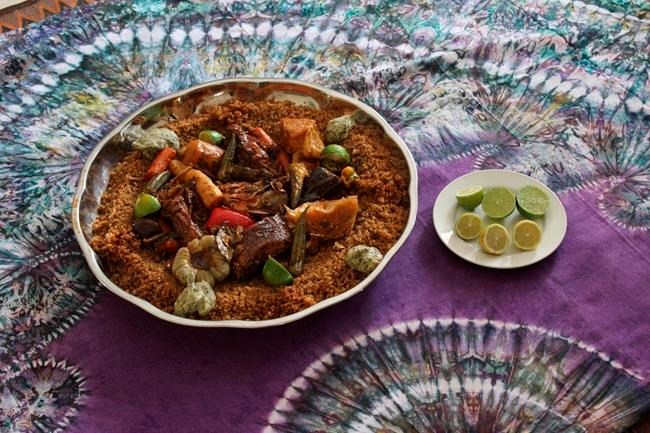
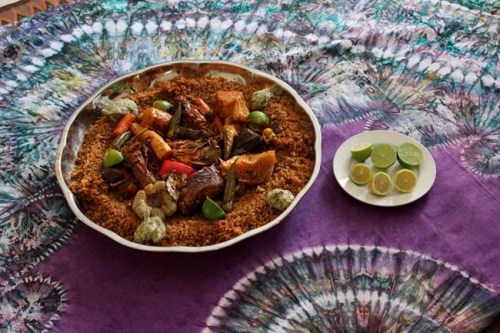
In this Nov. 24, 2018, photo, a platter of thiebou dieune, a traditional Senegalese dish of spiced rice, is serve by Chef Touty Sarr, in Ngaparou, Senegal. In the quiet hours before lunch, two women worked side by side in an airy kitchen. One, a chef, cleaned fresh red snapper filets with a sharp knife. The other, a filmmaker, pointed her camera into a large pot of simmering vegetables. (AP Photo/Amelia Nierenberg)

“Low heat,” said 38-year-old Touty Sarr, who runs the kitchen of a popular cafe in Dakar. She turned to her daughter, who was watching her cook. “This one, if you put it on high, it would all get dry. That’s one of the secrets.”

Senegal was Prah’s fifth destination since her project began in 2012. She hopes to show the care and skill that goes into African dishes, such as South Africa’s fried dough amagwinya and Kenya’s kachumbari, an onion and tomato salad.

“The idea, at its most basic, is to present the food how people who love it would prepare it,” Prah said. “It’s like a database or a digital vault where people can open the drawer, see recipes, see some ingredients.”

Born in England to a Ghanaian father and a South African mother, she lived in six African countries during her childhood including Namibia, Kenya and what is now South Sudan. After finding no reliable recipes online for Ghanaian dishes — and no photos that made the beloved food look appetizing — she started My African Food Map.

She celebrates the cuisines of a continent often marred by negative stereotypes.

“Africa is often associated with poverty, with hunger, with failures of food in a political and nutritional sense,” said James C. McCann, chair of the history department at Boston University and a specialist in African environmental history and cuisine. “It’s an area of the world that has not been covered by the food craze.”

Other culinary historians, chefs, and foodies are fighting such stereotypes. Some, like author and professor Jessica Harris, have studied African and diaspora cuisine, exploring the roots of foods taken far from home by slavery. Others, like Fran Osseo-Asare and her Ghanaian-focused project Betumi, investigate the foods of a single country.

“The internet was the democratization of African food writing,” said Osseo-Asare, who said she has blogged about African food since the 1980s. “When the internet came, you didn’t have publishers as gatekeepers that could stop you from getting your work out.”

Unique among prominent bloggers, Prah takes an almost pan-African approach.

“I always feel like I am from the whole continent,” she said. “I can find myself in different aspects of different countries I visit.”

Her videos often have tens of thousands of views, and she dreams of doing her project full-time like Anthony Bourdain did. She said she has had no luck finding sponsors but intends to keep trying.

“The best outcome is when people say, ‘That is our food, that is our dish,'” she said, remembering her work in Kenya. “I was extremely happy when the first comments I got on YouTube were, ‘Oh, this reminds me of home.'”

To find authentic recipes and skilled chefs, Prah asks everyone she meets in a country – hosts, cab drivers, shop keepers and strangers – about their favourite foods. She met Sarr this way, through friends of friends.
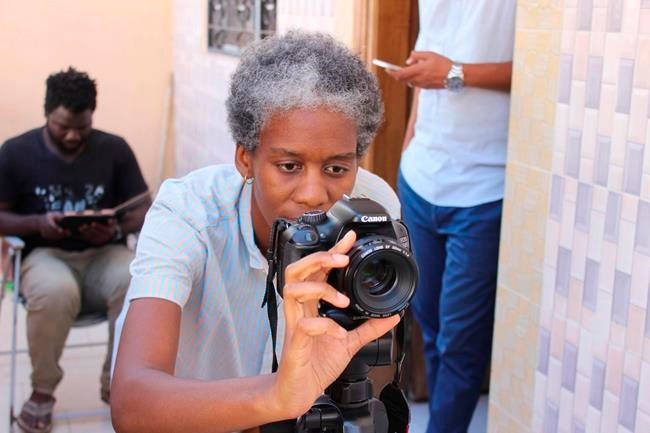
This Nov. 20, 2018, photo shows filmmaker Tuleka Prah, the founder of My African Food Map, at work in Ngaparou, Senegal. In the quiet hours before lunch, two women worked side by side in an airy kitchen. One, a chef, cleaned fresh red snapper filets with a sharp knife. The other, a filmmaker, pointed her camera into a large pot of simmering vegetables. (AP Photo/Amelia Nierenberg)

“I learned from my grandma. I used to follow her everywhere,” said Sarr, who wears her stiff white chef’s uniform every time she cooks, even at home, because it makes her feel more professional. “And our grandmas, they think that taking time with the food gives it more flavour. So I take time, too.”

She said she became a chef after money ran out to pursue her dream of being a doctor.

“There are a lot of similarities between cooking and medicine,” she said, skinning onions. “The feeling of being full after you have eaten is the same sensation as getting better after being sick. It’s something that gives me a lot of pride.”

She dropped garlic into sizzling oil, then stepped back as Prah moved close to the pot to film. The two women orbited each other, artists collaborating over the pot burbling on the stove.

Sarr said she cooks by smell, by sound and by taste, but Prah wrote her steps down in order, recording a recipe for others without the guidance of grandmothers and mothers at their side.

After two hours of chopping and pounding, scraping and whipping, boiling and simmering, Sarr spread red-tinted rice across a platter almost two feet wide. She flattened it and carefully arranged the vegetables and fish in a circle for a communal meal, with some family members eating with spoons and others with their hands.

Prah snapped a picture, and then another, before putting her camera aside to try the dish.

“It’s really good,” she said, her mouth full, smiling at Sarr. “Really, really good.”

___

Follow Africa news at https://twitter.com/AP_Africa
Report Error Submit a Tip

More Stories

Real journalists matter in an AI world

Paul Deegan 4 minute read Preview

Real journalists matter in an AI world

Paul Deegan 4 minute read 2:00 AM CDT

An algorithm can decide what you see, but it doesn’t report the news. Nunatsiaq News, an award-winning newspaper in Nunavut, recently reported that a so-called “news” website was posting AI-generated articles about the north by stealing real news stories produced by real journalists.

The articles were supposedly written by Nunavut correspondent Leah Qammaniq — a fake journalist, with a fake photo and a fake bio.

Governor General Louise Arbour warned us of fake news in her installation speech in June. She said, “We must continue to protect the public space in which our national debates take place: from schools and universities to the media, political parties, unions and civil society organizations …With instant access to vast amounts of information, it is very tempting to pay little attention to the reliability of sources. The lines between knowledge and belief, between truth and falsehood, between facts and assumptions, are increasingly blurred. AI could be threatening not only the way we live and work, but also the control we exercise over our own destiny.”

The Government of Canada has recognized the problem as well. Its recent discussion paper, Enhancing trust in artificial intelligence through increased transparency, stated, “Canadians encounter news reporting, product reviews, and audio-visual content across the internet, often without any indication of whether it was written by a person, generated by an AI system, or produced through some combination of both … A particular concern within this broader landscape is that generative AI greatly enables the creation and dissemination of deceptive or misleading content.”

Read
2:00 AM CDT

Letters, Oct. 6

6 minute read 2:00 AM CDT

High road not so easy

Re: Khan should’ve taken high road: Goertzen (Oct. 3)

Politics is a tough game. Just ask former provincial Liberal leader Dougald Lamont. He got thrown under the bus by a prominent Manitoba/Canadian Liberal who advised people to vote NDP in the last provincial election.

As Lamont said when he lost the election, he is “human” and what happened to him “hurt.” Khan is also human. It is easy to criticize him for not taking the “high road.”

Former host/VJ Rick Campanelli revisits his gambling addiction in new memoir

Jen Zoratti 7 minute read Preview

Former host/VJ Rick Campanelli revisits his gambling addiction in new memoir

Jen Zoratti 7 minute read Yesterday at 6:00 AM CDT

To many Canadians, veteran media personality Rick Campanelli is better known as Rick the Temp, the energetic, baby-faced intern-turned-VJ on MuchMusic in the 1990s and early 2000s.

But behind that winning smile was a much darker reality.

In his new memoir, Tempted: My Story, released last month via HarperCollins Canada and co-written with John Meyer, Campanelli, 56, opens up for the first time about his struggles with a serious — and secret — gambling addiction, which reached its nadir in 2008 when the then-host of Entertainment Tonight Canada was detained by U.S. Homeland Security for unpaid casino debts on a flight back from Las Vegas.

The Free Press caught up with Campanelli in advance of his Winnipeg launch Monday evening at McNally Robinson Grant Park. This interview has been lightly edited for length and clarity.

Read
Yesterday at 6:00 AM CDT

Essential workers ruling raises questions

Editorial 4 minute read Preview

Essential workers ruling raises questions

Editorial 4 minute read 2:00 AM CDT

Ever been to a Dynacare clinic? Most of us have been. It’s an amazing demographic and ethnic slice of the city we’ve become. Old patients. Young patients. New arrivals. Long-time Canadians. People who know the ropes — others who are startled by the crowds and the noise and the lockstep forward motion of professionals doing what they have been trained to do. It seems, all at the same time, both chaotic and diagnostic, as names of patients are steadily called out and thousands of tests are performed.

But Dynacare is at the centre of a new kind of test and this time, we’re all in the test tube together.

It’s the first real test for new labour law put in place by the government of Premier Wab Kinew in 2024 — a law that redefined what essential services are for provincially-regulated workplaces. Under this law, companies and their employee and unions must have an agreement of which employees are essential — which ones must stay on the job during a legal strike for the protection of the health and safety of the public.

Dynacare had that kind of essential employee agreement with its staff and union — the company and the union had agreed the employees were not essential.

Read
2:00 AM CDT

Stevenson set for first Jets start against Penguins

Ken Wiebe 5 minute read Preview

Stevenson set for first Jets start against Penguins

Ken Wiebe 5 minute read Sunday, Oct. 4, 2026

DETROIT — Clay Stevenson, the stage is yours.

As the Winnipeg Jets wrap up a two-game road trip on Monday against the Pittsburgh Penguins, the newest member of the team will be between the pipes after Stuart Skinner got the call in the first two outings of the campaign.

There will be an element of familiarity for Stevenson, as PPG Paints Arena is where he made his first NHL appearance with the Washington Capitals on April 17, 2025.

“There is some comfortability in that building,” said Stevenson, who made 33 saves in a 5-2 loss to the Penguins in that NHL debut. “It’s always a great challenge to play against (Sidney) Crosby and (Evgeni) Malkin and those guys. It’s an honour to get into the crease anytime.”

Read
Sunday, Oct. 4, 2026

Food bloggers bring Africa's rich cuisines to the world

Amelia Nierenberg, The Associated Press 6 minute read Preview

Food bloggers bring Africa's rich cuisines to the world

Amelia Nierenberg, The Associated Press 6 minute read Sunday, Jan. 6, 2019

NGAPAROU, Senegal - In the quiet hours before lunch, two women worked side by side in an airy kitchen. One, a chef, cleaned fresh red snapper filets with a sharp knife. The other, a filmmaker, pointed her camera into a large pot of simmering vegetables.

"What would you say this is, low heat or medium?" Tuleka Prah asked, setting the camera aside.

Her pen poised over a lime green notebook, the 37-year-old Prah waited for the next step in the recipe for thiebou dieune, a traditional Senegalese dish of spiced rice, tender vegetables and fish. She came to this West African nation to document its four most popular dishes as part of My African Food Map, a blog and film archive.

"Low heat," said 38-year-old Touty Sarr, who runs the kitchen of a popular cafe in Dakar. She turned to her daughter, who was watching her cook. "This one, if you put it on high, it would all get dry. That's one of the secrets."

Read
Sunday, Jan. 6, 2019